
Your child understands that death is permanent. Their emotional wiring is not ready for that understanding.
Between the ages of nine and twelve, a child's brain builds the cognitive architecture to grasp that death is final, universal, and inevitable. But the emotional regulation system — the part that processes what that knowledge actually means — is still under construction. The result is a grief experience that confuses every adult in the room.
The child who laughs at a funeral and then sobs at bedtime. The child who asks clinical questions about what happens to a body and then refuses to go to school. The child who says they are fine and then starts getting stomach aches every single morning. These are not contradictions. They are the signature pattern of pre-adolescent grief — and most free resources do not explain any of it.
The Dual-Crisis Navigation System
This toolkit was built for the specific collision that happens when a death drops two emergencies on the same caregiver at the same time: a child who needs developmentally precise emotional support, and an estate that needs immediate legal and financial action.
Most resources handle one or the other. Grief books give you reflective essays about the stages of mourning but skip the part where the bank froze the accounts and the school needs guardianship documentation by Monday. Legal checklists give you probate timelines but assume you are a calm professional with an empty calendar, not someone running on four hours of sleep who also needs to explain cremation to a ten-year-old tonight.
The Dual-Crisis Navigation System puts both tracks on the same timeline. Every legal and financial step is paired with its impact on your child's stability. Every parenting strategy is built around the logistical reality that you are also managing an estate.
What's Inside
- The Disclosure Framework — a word-for-word structure for the first conversation, calibrated for the concrete thinking patterns of nine-to-twelve-year-olds. Covers which terms to use, which euphemisms to avoid (and why "went to sleep" creates actual sleep phobias), and how to answer the questions your child will ask in the first hour.
- Magical Thinking Defusion Scripts — pre-adolescents routinely believe their own anger, bad grades, or secret thoughts caused the death. The guide gives you specific dialogue sequences to surface and dissolve this guilt without dismissing it.
- The Somatic Symptom Decoder — a diagnostic framework for distinguishing grief-driven stomach aches, headaches, and fatigue from medical conditions that need a pediatrician. Includes the clinical markers that signal the line between normal grieving and complicated grief requiring professional intervention.
- School Reintegration Toolkit — a step-by-step process for requesting Section 504 accommodations, understanding when an IEP referral is more appropriate, and giving the school enough context to support your child without making them feel singled out.
- First-48-Hour Estate Checklist — the exact sequence of legal and financial actions that cannot wait, from ordering 10 to 20 certified death certificates to freezing credit reports to filing for Social Security survivor benefits. Each item includes who to call, what to say, and how long it takes.
- Family Conflict Mediation Framework — structured protocols for the most common estate disputes: cremation versus burial, guardianship disagreements, division of sentimental belongings, and executor transparency conflicts. Each protocol is designed to de-escalate before the conflict reaches your child.
- Guardianship Gap Navigation — explains the critical legal gap between being named in a will and actually having authority to act, including how to use Standby Guardianship Designations to secure immediate custody without waiting weeks for probate court.
- Multi-Jurisdiction Coverage — legal and financial guidance covering United States (Section 504, SSA survivor benefits, state probate frameworks), Canada (Ontario's 90-day CLRA deadline), and United Kingdom (Parental Responsibility under the Children Act 1989).
- Memory-Making Activities — therapeutic activities grounded in developmental research for children aged 9 to 12: memory boxes, legacy journals, and guided storytelling exercises designed for the pre-adolescent attention span and emotional processing style.
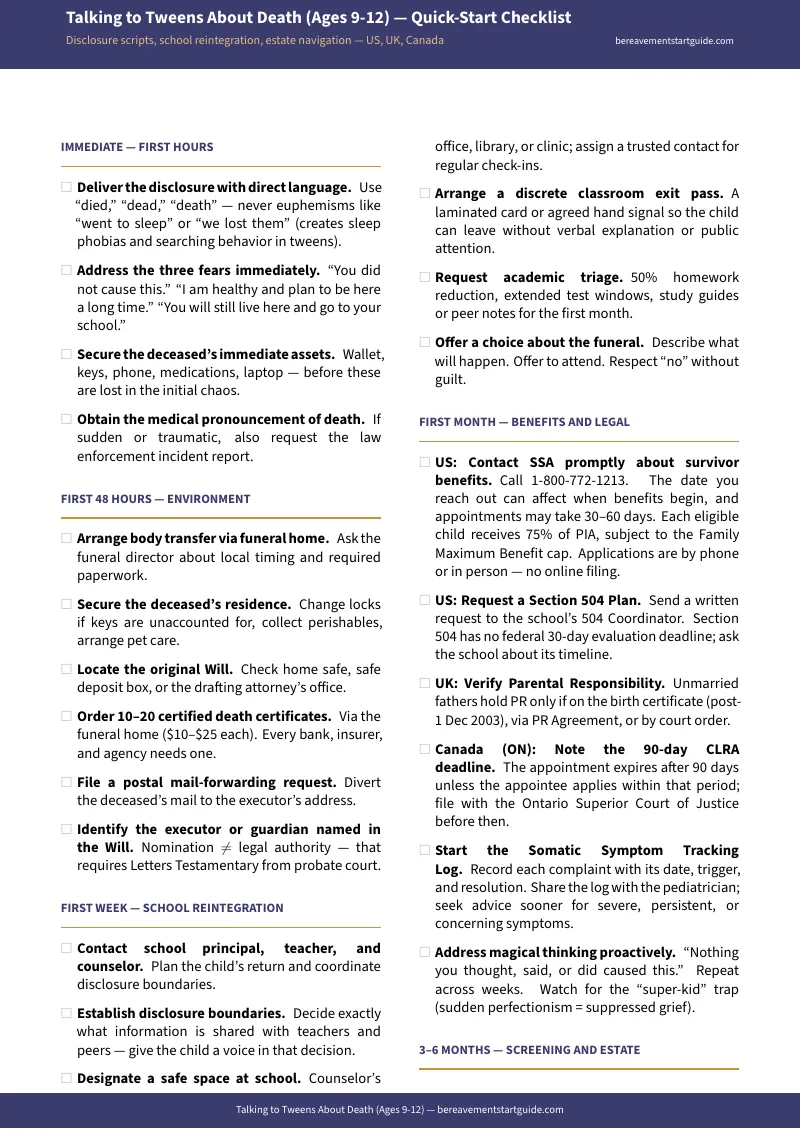
- Quick-Start Checklist — a standalone 2-page checklist with 26 prioritized action items, organized by urgency tier (first 48 hours, first week, first three months). Print it, work through it, and use the full guide as the reference manual behind each item.
Who This Is For
You are the surviving parent, grandparent, aunt, uncle, stepparent, or close family friend who just became the person responsible for both a grieving pre-adolescent and a legal process you never asked to manage. You are operating on minimal sleep, maximum cognitive load, and the quiet terror that you might say or do something that permanently damages this child.
You do not need another article about the five stages of grief. You need a manual that tells you exactly what to do, in what order, starting right now.
Why Free Resources Fall Short
Free articles on talking to children about death are written for a general audience across all ages. They tell you to "be honest" and "use age-appropriate language" without explaining that a nine-year-old's grief looks fundamentally different from a six-year-old's or a fifteen-year-old's. They skip the legal and financial logistics entirely. And they assume you have the bandwidth to stitch together advice from twelve different sources into a coherent action plan.
Etsy planning binders give you blank templates for estate organization but know nothing about childhood grief. Legal forms portals give you state-specific documents behind a subscription paywall but do not tell you how filing a probate petition affects your child's sense of stability. Grief books give you beautifully written reflections on loss but do not mention that the bank will freeze the checking account and the mortgage payment is due next week.
This toolkit sits at the intersection that none of those resources cover: a single document that integrates the developmental psychology of pre-adolescent grief with the operational logistics of settling an estate — written for a person whose capacity for absorbing information is at its absolute lowest.
Our Guarantee
If this toolkit does not deliver the clarity and structure you need, email hello@bereavementstartguide.com for a full refund, no time limit. We read every message.
Get the Free Checklist or the Full Toolkit
Start with the free Quick-Start Checklist — 26 prioritized action items you can begin working through tonight. If you need the full guide with scripts, frameworks, worksheets, and multi-jurisdiction legal coverage, upgrade to the complete toolkit for less than the cost of one hour with any professional you will eventually need to call.
The price of inaction is not abstract. Every week without a structured plan is another week of unaddressed magical thinking, missed legal deadlines, and family conflicts that compound. The toolkit costs a fraction of one missed probate filing fee. It costs far less than the therapy sessions that follow a botched disclosure conversation. And it is available right now, at 2 a.m., when you need it most.