You Have Seven Days. Every Ritual Decision Is Permanent.
When a Myanmar Buddhist family member dies, the clock starts immediately. The body must be washed in the correct direction — feet to head, never the reverse. The Gadoe-ga ferry toll must be placed before the coffin is sealed. The presiding Sayadaw must be notified within hours, not days. The community expects a properly prepared Yet Le merit feast on the seventh day. And if a single processional taboo is broken — if the coffin touches the ground before reaching the cemetery, if water is used during the procession — folk belief holds that the entire quarter will suffer misfortune.
Most families face this compressed, high-stakes sequence with nothing but fragmented internet threads mixing Thai Theravada customs with Mahayana Chinese practices, monastery handouts written entirely in Burmese or Pali script, and a funeral director whose "Buddhist package" was designed for a different tradition entirely.
The Myanmar Ritual Navigator — One Document That Replaces Forty Hours of Panicked Research
This guide consolidates the entire seven-day funeral sequence — from the first-hour death certificate through the hundredth-day memorial — into a single, chronological manual built specifically for Myanmar Theravada Buddhist practice. Every chapter is structured as a decision tree: here is what happens next, here is exactly how to do it, here is why it matters, and here is how to adapt it if you are organizing from overseas.
Where other resources treat Myanmar funeral customs as a footnote inside generic "Buddhist funeral" overviews, this guide distinguishes between orthodox Theravada doctrine and pre-Buddhist animistic folk practices — and treats both with equal depth and respect. You will know exactly which rituals are canonical, which are regional folk customs, and which are family-specific traditions you should verify with your own elders before the funeral begins.
What's Inside
- First-Hours Crisis Protocol — the exact notification sequence (physician, Sayadaw, parahita mutual-aid association, ward administration) with contact timing benchmarks, so you are not guessing who to call first while the family is in shock
- Complete Body Preparation Walkthrough — the ye-cho ritual washing, binding of thumbs and toes, Gadoe-ga ferry toll placement, Leikpya Kwe De string-cutting ceremony, and modern diaspora adaptations for each step when dealing with Western crematoriums or medical-examiner requirements
- Monk Invitation Scripts and Kappiya Donation Protocol — pre-written scripts for inviting monks, plus a step-by-step guide to presenting navakamma donations through a lay steward so you never accidentally hand cash directly to a monk and violate monastic Vinaya rules
- Seven-Day Timeline Cards — visual day-by-day cards covering every ritual milestone from the Thet Pyauk Swan first-day offering through the Yet Le seventh-day separation ceremony, including the catering logistics for the communal Mohinga feast
- Repatriation Document Checklist — the full regulatory sequence for transporting a body from Singapore, Australia, the US, or the UK back to Myanmar, including No Objection Certificate, embassy passport cancellation, embalming certification, and air cargo booking as special cargo
- Regional Variation Notes — how Rakhine (Arakanese) catafalque rituals, Shan and Lanna monastic cremation traditions (Phongyibyan), and Mon coconut-water face-washing customs differ from standard Bamar practice, with "Elders' Interview Templates" for verifying your own family's specific customs
- Sino-Burmese Dual-Tradition Reconciliation — a practical framework for families navigating both Myanmar Theravada and Chinese Mahayana or ancestor-worship obligations, covering conflicts in mourning colours, altar traditions, and offering protocols
- Dress Code and Etiquette Reference — what family members wear (plain white), what guests wear (subdued dark or neutral), seating posture around monks, photography boundaries, and the cultural context behind card-playing during night vigils
- Memorial Milestone Planner — extends beyond the funeral itself to cover the 49th-day and 100th-day merit ceremonies, annual memorial offerings, and how to set up a temporary home altar with the photograph, candles, and incense configuration that satisfies both orthodox and folk expectations
- Seven Printable Worksheets — timeline planner, notification contact sheet, mortician communication sheet, monastic invitation and donation worksheet, Yet Le feast planning sheet, repatriation document checklist, and elders' interview template — all designed for families managing the funeral under severe emotional stress
Who This Guide Is For
- Diaspora families organizing a Myanmar Buddhist funeral in Singapore, Australia, the US, the UK, or anywhere outside Myanmar — particularly second-generation children who understand the cultural significance but lack fluency in the ritual details
- Interfaith or non-Buddhist spouses and partners who have been thrust into the primary organizer role and need absolute clarity on etiquette, taboos, and the theological meaning behind each ritual step
- Repatriation coordinators managing the legal and logistical process of returning a deceased family member to Myanmar for burial or cremation
- Sino-Burmese families navigating the friction between Myanmar Theravada traditions and Chinese Mahayana or ancestor-worship customs within the same household
- Community support workers and NGO advocates assisting migrant populations who face barriers accessing traditional funeral rites due to documentation status
Why Free Online Resources Fall Short
The free information available on Myanmar Buddhist funerals falls into four categories, and each one has a critical gap:
Temple handouts and monastic portals provide Pali scriptures and basic precept guidelines — but they are written in Burmese or formal Pali, offer zero logistical guidance, and completely ignore the folk practices that most families still observe. You will not find instructions for the Gadoe-ga, the Leikpya Kwe De, or the processional taboos in any monastery pamphlet.
Community mutual-aid associations (parahita) provide extraordinary physical support — body retrieval, coffins, hearses — but they operate locally within Myanmar and have no written manuals. A diaspora family in Melbourne or San Francisco has no access to this network.
Commercial funeral directors sell packages, but their "Buddhist" packages are typically designed for Chinese Mahayana customs and carry significant markups. They handle caskets and permits; they do not teach you how to seat monks correctly, when to perform the water libation, or why the Mohinga broth must be cooked the night before to form its protective oil film.
Forum threads and blog posts are fragmented, unverified, and routinely confuse Myanmar Theravada practice with Thai, Cambodian, or Chinese Buddhist customs. Following the wrong tradition's etiquette at a Myanmar funeral creates exactly the kind of social violation that causes lasting family regret.
This guide replaces all four sources with a single, culturally verified reference written in English with phonetic Pali transliterations, so every family member — regardless of their religious literacy or language background — can participate with confidence.
Your Purchase Is Protected
If the guide does not give you the clarity and confidence you need, email us at any time for a full refund. No questions, no forms, no hoops. We would rather you have your money back than feel unsupported during one of the hardest weeks of your life.
Get the Guide — Or Start With the Free Checklist
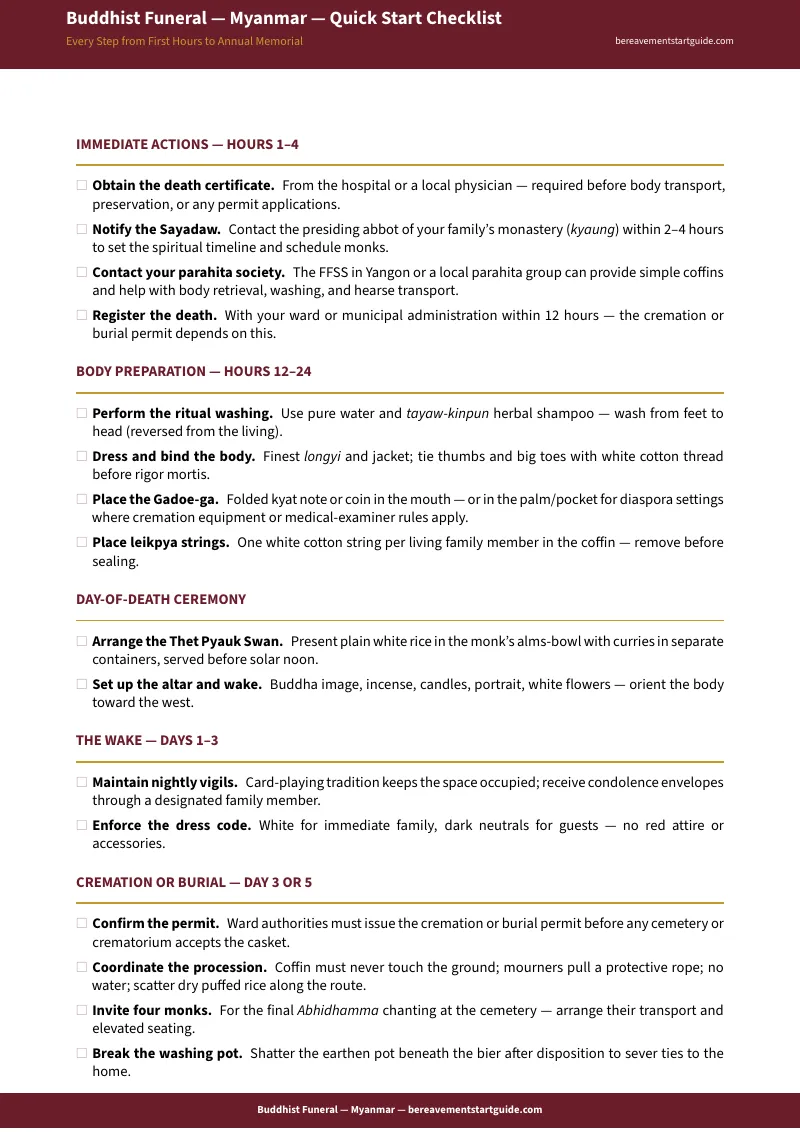
Download the free quick-reference checklist to see the seven-day timeline at a glance. When you are ready for the complete ritual navigator — the 51-page guide, seven printable worksheets, every regional variation, every repatriation document — the full kit is available for immediate download at .
Frequently Asked Questions
What if the rules change after I buy?
We update the guide when the rules change. Email us any time, even years later, and we'll send you the current edition free.