The hospital wants to move the body. Your family elders say absolutely not. You have no idea what to tell either of them.
In the Vajrayana tradition, the hours after the final breath are not an administrative detail — they are the most spiritually consequential window of the entire death process. The subtle consciousness is still dissolving through the central channel, still sensitive to every touch and sound. Moving the body prematurely can force the consciousness out through a lower exit, directing the rebirth toward suffering. And yet the hospital has regulations, the coroner has a schedule, and no one on staff has ever heard of a non-contact protocol.
That is exactly the gap this guide fills. Not meditation philosophy. Not academic theory. The Bardo Bridge System — a complete operational toolkit that translates Tibetan Buddhist funeral requirements into the specific language, documents, and step-by-step workflows that hospitals, funeral homes, and municipal agencies actually respond to.
What makes this different from free online resources
You could read every FPMT prayer sheet, every Dharma Wheel forum thread, every cultural tourism article about sky burial. You would end up with eighty-seven spiritual practices listed without priority, conflicting advice from practitioners of different lineages, and sensationalized descriptions that treat jhator as a curiosity rather than an act of sacred generosity. None of it tells you what to say to the hospital administrator at 3 a.m., how to fill in the data your astrologer needs for the death horoscope, or how to perform daily Sur offerings in a modern apartment without triggering the smoke alarm.
The difference between scattered free information and this toolkit is the difference between knowing you need a Phowa ceremony and having the exact notification script, the backup plan for remote Phowa via video connection, and the checklist that ensures the death room conditions are correct before the lama begins.
What's inside the Bardo Bridge System
- Emergency First-Hours Protocol — the five-contact notification sequence, bedside shrine setup, acoustic control guidelines, and exact language for requesting a religious accommodation hold before any institutional handling begins
- Spiritual Care Directive Worksheet — a fill-in document naming your root lama, preferred mantras, non-contact duration, and authorized family contacts in a format hospital compliance officers recognize as a formal accommodation request
- Body Preparation Walkthrough — consecrated saffron-water washing, orifice sealing with dudtsi, the two traditional postures (Sleeping Buddha and Crossed Vajra), seed syllable placement over the heart, and correct Takdrol mandala orientation
- Tukdam Recognition Guide — the physical signs that distinguish postmortem meditation from ordinary death, how to communicate tukdam to medical staff who have no framework for it, and the signs confirming the state has ended
- Tsi Bap Data Form — a structured intake form compiling the exact birth and death variables your astrologer needs to cast the death horoscope, so nothing is missed during the most stressful hours of your life
- 49-Day Bardo Calendar — a week-by-week ritual schedule covering all seven bardo intervals, prayer assignments, merit-making activities, monastery sponsorship coordination, and the critical 7th, 35th, and 49th day ceremonies
- Lineage Variation Reference — side-by-side comparison of Gelug, Nyingma, Kagyu, Sakya, Jonang, and Bön funeral customs so you follow your family's specific tradition rather than a generic Buddhist template
- Sur Offering Recipe and Safety Guide — the traditional tsampa-and-three-whites recipe, apartment-safe alternatives using slow-burning incense or aromatherapy warmers, fire code considerations, and the critical warning against gugal resin during the bardo period
- Funeral Director Intake Form — a printable handover document specifying every Vajrayana requirement in plain professional language: dry-ice refrigeration instead of embalming, witnessed cremation, body positioning, and shroud instructions
- Organ Donation Decision Framework — the bodhichitta argument for donation as an act of ultimate generosity alongside the traditional caution about premature organ retrieval, with specific questions to bring to your lama
- Cost Planning Workbook — line items for monastery sponsorship (dana), butter lamps, tsa-tsa creation, cremation, memorial services, and vegetarian catering across the full 49-day cycle
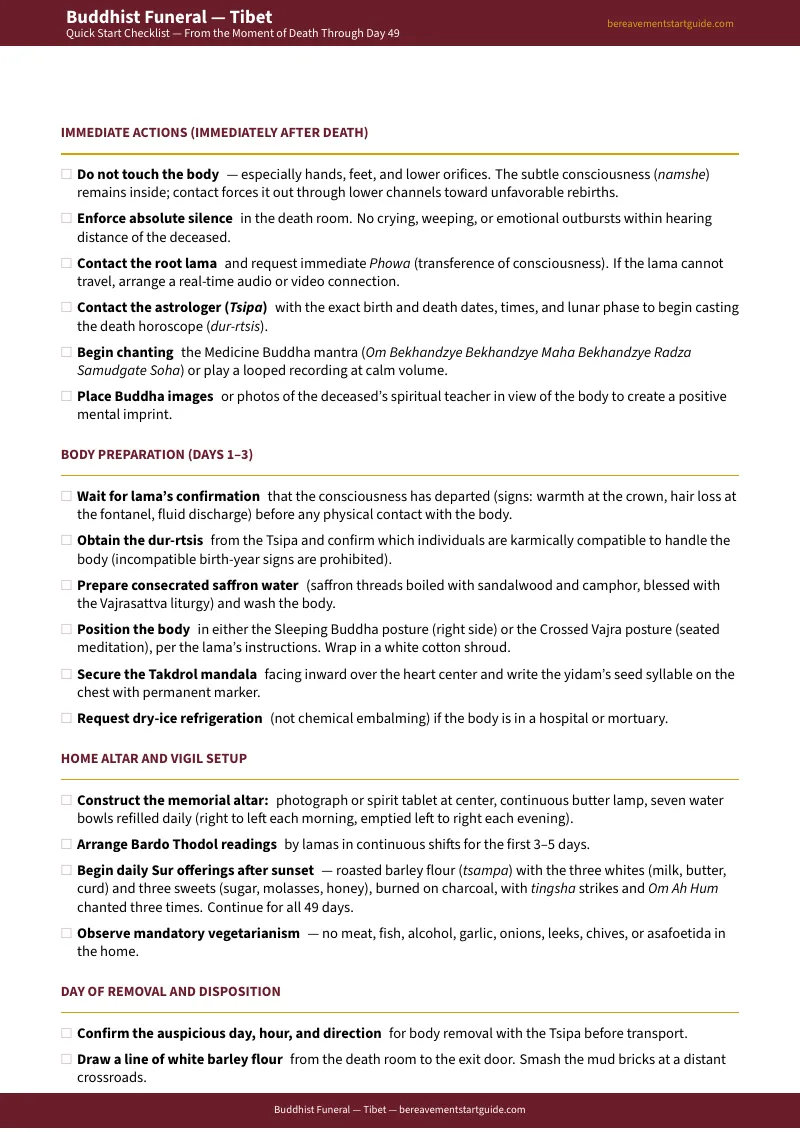
- Printable Quick-Start Checklist — immediate actions only, designed for the family member standing in a hospital corridor at 2 a.m.
Who this guide is for
- Diaspora adult children who feel the full weight of filial obligation to honor their parents' traditions but did not grow up memorizing complex liturgies or negotiating with monasteries — the guide bridges the gap between what your family elders expect and what you know how to execute
- Interfaith spouses and executors who are suddenly responsible for honoring a Vajrayana practitioner's wishes without any personal experience of the tradition — every requirement is translated into plain English with printable instruction sheets
- Convert practitioners preparing end-of-life documents so their non-Buddhist family members know exactly what to do and what to protect when the time comes
- Funeral directors and hospice workers serving a Tibetan Buddhist family for the first time — the Funeral Director Intake Form gives you every body handling, timing, and ceremony requirement in the professional format you already work with
Why scattered free information falls short
FPMT and other monastic organizations publish deeply authentic spiritual instructions — but they assume you have a lama on call, a dharma center nearby, and years of Vajrayana education. Academic books like Living is Dying offer beautiful philosophical frameworks — but a 200-page contemplative study is not a crisis manual when the coroner is asking whether to refrigerate. Generic funeral planning sites lump Theravada, Zen, and Vajrayana together, treating sky burial as clickbait and skipping the non-contact protocol, Phowa, Sur offerings, astrological divination, and everything else that makes a Tibetan funeral fundamentally different from other Buddhist traditions.
This guide does not replace your lama, your astrologer, or your funeral director. It makes you effective in working with all three — with the right questions prepared, the right documents ready, and the right timeline mapped before the crisis forces you to improvise.
Satisfaction guarantee
If the guide does not give you the clarity and confidence you need to navigate this process with cultural accuracy and spiritual integrity, email us and we will refund you in full. No time limit, no questions.
Start with the free checklist — or get the complete system
Download the free Quick-Start Checklist to see the immediate first-hours protocol. When you are ready for the full 49-day system — every script, every worksheet, every lineage variation — the complete Bardo Bridge toolkit is available for .