Three Systems Running at Once. No Manual. Hours to Get It Right.
When a Vietnamese Buddhist family loses someone, the funeral is not one ceremony — it is three operating simultaneously. Mahayana Buddhist liturgy governs the chanting, the merit-transfer prayers, and the 49-day transition framework. Confucian filial piety dictates the mourning garment hierarchy, the reciprocal bowing obligations, and the public display of devotion that every guest quietly evaluates. Vietnamese folk custom demands the green bananas on the abdomen, the rice and coins placed in the mouth, and the astrological calculations to avoid trùng tang — the feared phenomenon where inauspicious death timing triggers consecutive deaths in the family.
None of these systems is optional. A family that performs flawless Buddhist liturgy but skips the folk protections will alarm traditional elders. A family that follows every folk custom but fumbles the reciprocal bowing will offend the entire guest community. And a family that tries to manage all three from scattered online sources will spend the worst week of their lives cross-referencing contradictory advice from anonymous strangers while the funeral director's clock runs.
The Vietnamese Funeral Navigation System
This guide is a Vietnamese Funeral Navigation System — a single structured reference that consolidates every ritual requirement, every timing constraint, every garment rule, and every family coordination task into the chronological sequence you will actually face them. It replaces the frantic cycle of temple phone calls in Vietnamese you half-understand, funeral home upsells you cannot evaluate, and forum posts that confuse Buddhist doctrine with regional superstition.
The system works because it maps all three cultural layers — Buddhist, Confucian, and folk — onto one timeline with clear decision points. When the monk says the encoffining must happen at a specific hour, you know why. When a senior aunt insists on placing a knife on the abdomen, you know the folk rationale and can navigate the conversation calmly. When the funeral director suggests an upgraded casket, you know which elements are spiritually significant and which are commercial add-ons.
What's Inside
- First-hours protocol — the exact notification sequence from bedside vigil through family council assembly, with bilingual scripts for contacting your temple and funeral director and the critical 3–8-hour undisturbed-body window that Western hospitals routinely violate
- Body preparation and sacred protections — the complete khâm liệm purification ritual, the Ngậm Hàm rice-and-coin placement, the six-layer Buddhist shroud (Lục Phù), and the apotropaic folk protections with clear explanations of what each element means so you can discuss them confidently with elders
- Dual altar construction — the Buddha Altar and Spirit Altar (Bàn Thờ Vong) are distinct sacred spaces that must never share an incense burner, with symmetry requirements, offering schedules, and the precise meaning of the three rice bowls with their chopstick configurations
- Complete mourning garment code — the five-tier Ngũ Phục hierarchy from the Thọ Mai Gia Lễ: which headband color marks each family relationship (white for children, white-with-red for paternal grandchildren, white-with-blue for maternal grandchildren, yellow for great-grandchildren, red for great-great-grandchildren), and the specific cane and hood requirements for the Chief Mourner
- Eight liturgical ceremonies — from coffin purification through final spiritual release, with the Vietnamese terms, English translations, and a clear explanation of what happens at each stage so English-dominant family members can follow the service rather than sitting through hours of chanting they cannot decode
- Bowing mechanics and reciprocal obligations — the exact number of prostrations before the Buddha Altar (3), before an unburied coffin (2), and at a post-funeral grave or columbarium (4), with physically detailed descriptions of the gendered prostration forms and the mandatory Đáp Lễ that the Chief Mourner must perform for every guest
- 49-day memorial cycle — the weekly Cúng Thất schedule, the vegetarian diet requirements, the daily home altar maintenance routine, and the 100-day Tốt Khốc ceremony where the spirit formally transitions from the temporary altar to the ancestral altar
- Diaspora adaptations — how to compress a multi-day ceremony into Western funeral home time slots, navigate municipal noise and incense restrictions, handle cremated remains transport and international repatriation, and set up a proper home altar in an apartment
- Family dynamics chapter — practical strategies for boundary management when grief forces estranged relatives into close coordination, with scripts for declining excessive obligations, managing elder expectations, and fulfilling filial duties without compromising mental health
Who This Is For
- Adult children coordinating a parent's funeral — especially English-dominant Việt Kiều who know the culture intuitively but have never had to lead the logistics, negotiate with monks, or distribute mourning garments according to the Thọ Mai hierarchy
- Interfaith spouses and in-laws — navigating a tradition where a wrong headband color or a missed reciprocal bow creates social damage that lasts years, and where "just follow along" is not actionable advice when you don't know when to kneel, how many times to bow, or which direction to face
- Estranged or secular family members — obligated to coordinate as executor or next of kin despite distance from the tradition, needing a neutral reference that covers the logistics without requiring emotional negotiation with every elder in the room
- Professional funeral planners and celebrants — managing facilities and timelines for Vietnamese Buddhist services, needing verified cultural protocols for altar placement, incense safety, witnessed cremation requirements, and monk scheduling
Why Free Tools Don't Cover This
Temple monks provide spiritual leadership — they chant the sutras, calculate the auspicious dates, and guide the family through the liturgical sequence. But they operate primarily in Vietnamese. They do not produce English-language checklists, coordinate funeral director negotiations, or help you figure out which headband to give your non-Vietnamese brother-in-law.
Specialized funeral homes in Vietnamese communities handle the physical logistics expertly. But they are commercial operations with every incentive to upsell elaborate packages. The "standard" service includes items you may not need, and the funeral director is not an impartial advisor on which ritual elements are spiritually essential and which are profitable add-ons.
Online forums and community pamphlets contain genuine fragments of knowledge — but they are contradictory, untranslated, and organized by topic rather than by timeline. When you are in the first 12 hours after a death and need to know what to do next, a pamphlet written in archaic Vietnamese about historical rural burial customs is not a useful resource.
This guide sits in the gap between all three: a single structured reference, in English, covering the cultural, spiritual, and logistical dimensions together, organized in the sequence you actually face each decision.
What You Get
The complete package is a printable PDF toolkit — designed to be read on a phone at the hospital, printed and handed to family members so everyone has clear role assignments, and brought to the funeral director meeting as an independent reference. It includes:
- The full guide — 14 chapters, 57 pages, covering every stage from the bedside vigil to the multi-year memorial calendar
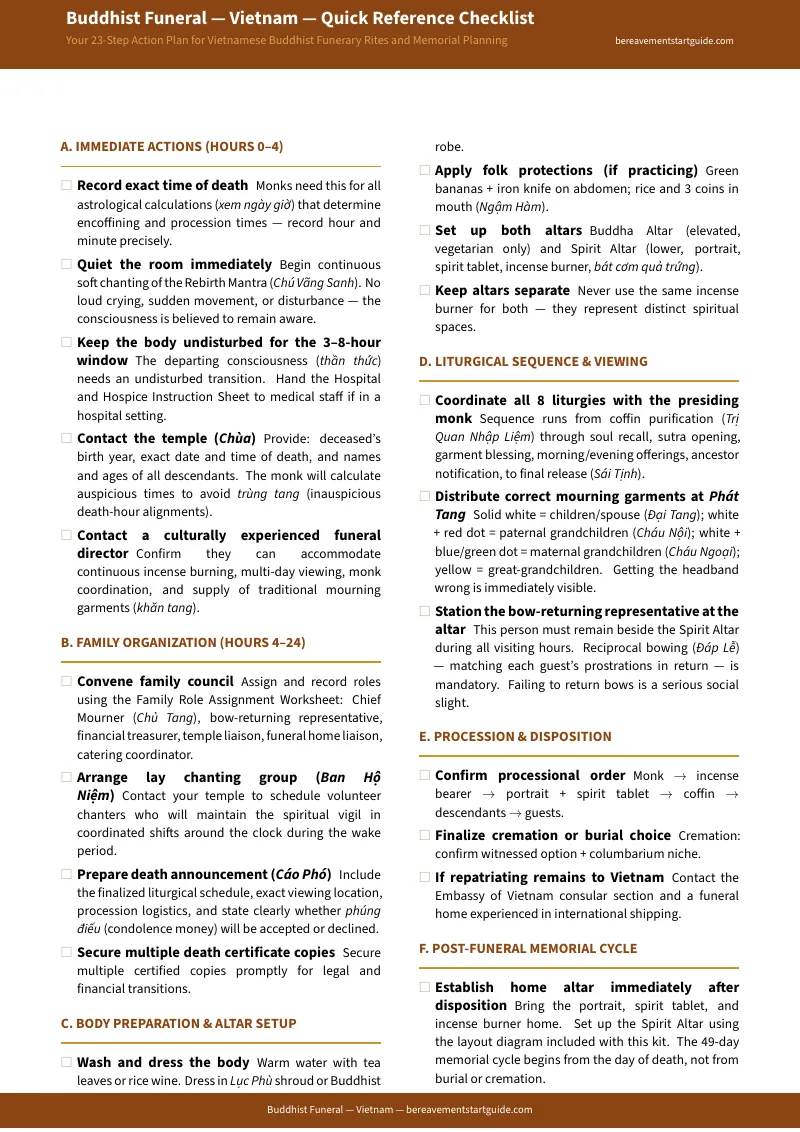
- Quick-reference checklist — 23 chronological action items for the first week, designed to be checked off as you go
- Family role assignment worksheet — a form for designating the Chief Mourner, bow-returning representative, treasurer, and liaison roles so everyone knows their responsibilities before the first ceremony begins
- 49-day memorial planner — pre-formatted calendar for tracking weekly Cúng Thất services, vegetarian meal preparation, and daily altar maintenance
- Funeral director comparison worksheet — side-by-side template for evaluating itemized quotes and identifying unnecessary charges
- Vegetarian meal planning worksheet — weekly meal planner and altar offering supply checklist for the 49-day vegetarian commitment
- Hospital instruction sheet — a one-page document to hand directly to medical staff explaining your cultural need for the body to remain undisturbed
- Altar setup reference — labeled layout diagrams for both the Buddha Altar and Spirit Altar with placement positions for every element
- Communication log — a tabular record for tracking every call and interaction with the temple, funeral director, cemetery, and government offices
Satisfaction Guarantee
If the guide does not help you plan the funeral with more clarity and less unnecessary cost, email us and we will refund your purchase — no questions, no forms, no waiting period.
Start Planning with Confidence
Download the free checklist to see the full task sequence at a glance. When you are ready for the complete guide — with the bilingual scripts, the mourning garment distribution chart, the eight-liturgy walkthrough, the family dynamics chapter, and every planning worksheet — get the complete toolkit. The landing page shows pricing in your local currency.