
The Memorial Operations Playbook — Every Decision, Script, and Legal Rule in One Place
Your funeral director handled the cremation. They did not hand you a ceremony. No one told you how to structure a program, manage an open mic, navigate your sister's demand for a prayer your mother never wanted, or figure out whether you can legally scatter ashes at the lake where your father fished every summer.
You could spend the next two weeks assembling this from funeral-home blogs written to sell caskets, Reddit threads filtered through raw grief, and Etsy program templates that give you beautiful fonts and zero guidance on what to actually say between the songs. You would still end up with gaps — the TSA screening rules that three federal pages contradict each other on, the fact that only USPS can legally ship cremated remains, the EPA registration you did not know you needed for a sea scattering.
The Celebration of Life Planning Guide is the Memorial Operations Playbook: a single document that replaces the structure a funeral home or clergy would normally provide, built specifically for the post-cremation celebration-of-life format that now accounts for the majority of memorial services. Every chapter is organized by the order you need the information — from the first 72 hours after death through the last guest leaving the venue.
What's Inside
First-72-Hours Decision Framework — the disposition, document, and delegation choices that lock in your timeline, budget, and format before you have time to research them. Covers direct cremation vs. burial vs. green burial vs. body donation, with cost ranges stripped of funeral-industry markup language, so you make the foundational decision with real numbers rather than sales pressure.
Venue Comparison and Negotiation Questions — because the venue determines half your logistical constraints. Side-by-side comparison of private homes, public parks, restaurants, community halls, and outdoor spaces, with the specific questions to ask each type: AV capacity, noise ordinances, liability insurance, accessibility compliance, alcohol licensing, minimum-spend traps.
Modular Ceremony Architecture — a flexible program structure (welcome, remembrance, reflections, farewell) with transition scripts between each segment. You assemble the modules that fit your person and your family rather than following a liturgy designed for someone else. Includes timing guidance so a 20-minute crematorium slot and a two-hour memorial at a park both flow naturally.
Interfaith Compromise Frameworks — for families where the deceased's beliefs and the surviving relatives' expectations collide. Word-for-word scripts for including a moment of silence that lets religious guests pray privately without imposing on the room, handling the relative who wants "just one hymn," and managing clergy who arrive uninvited. These are diplomatic de-escalation tools, not debate tactics.
Open-Mic Management System — boundary-setting language for the part that goes wrong at nearly every celebration of life: the uncle who speaks for twenty minutes, the ex who uses the microphone to settle a grievance, the friend who says something the family finds offensive. Includes a pre-event briefing script and a graceful mid-speech redirect.
Cremated Remains Legal Guide — the TSA, USPS, and EPA rules that are genuinely hard to verify through casual searching, consolidated in one place. TSA container requirements (X-ray-scannable materials only; officers cannot open an urn). USPS as the only legal carrier for shipping ashes (not FedEx, not UPS, not DHL). EPA maritime scattering rules (three nautical miles from shore, biodegradable materials only, 30-day registration). State-by-state variations for scattering on public and private land.
Food, Etiquette, and Logistics — catering frameworks comparing professional catering, restaurant private rooms, and self-arranged platters. Dress-code communication templates for when "wear something colorful" leaves half your guests in black. Eco-friendly alternatives to balloon releases. Guest-book prompts that invite stories rather than generic condolences. Memorial display and photo-table setup guidance.
Two Budget Frameworks with Worked Examples — realistic cost breakdowns for a backyard gathering and a catered venue event, built from line-item estimates rather than funeral-industry averages inflated by merchandise markups. Shows where the money actually goes so you can adjust without guessing.
Five Fillable Planning Worksheets — a venue comparison sheet for evaluating up to four venues side by side, a ceremony planning worksheet that becomes your event-day run sheet, a family communication log for tracking every call and decision, a line-by-line budget tracker, and a vendor comparison sheet for caterers, celebrants, A/V companies, and florists. Print them and fill them in as you go.
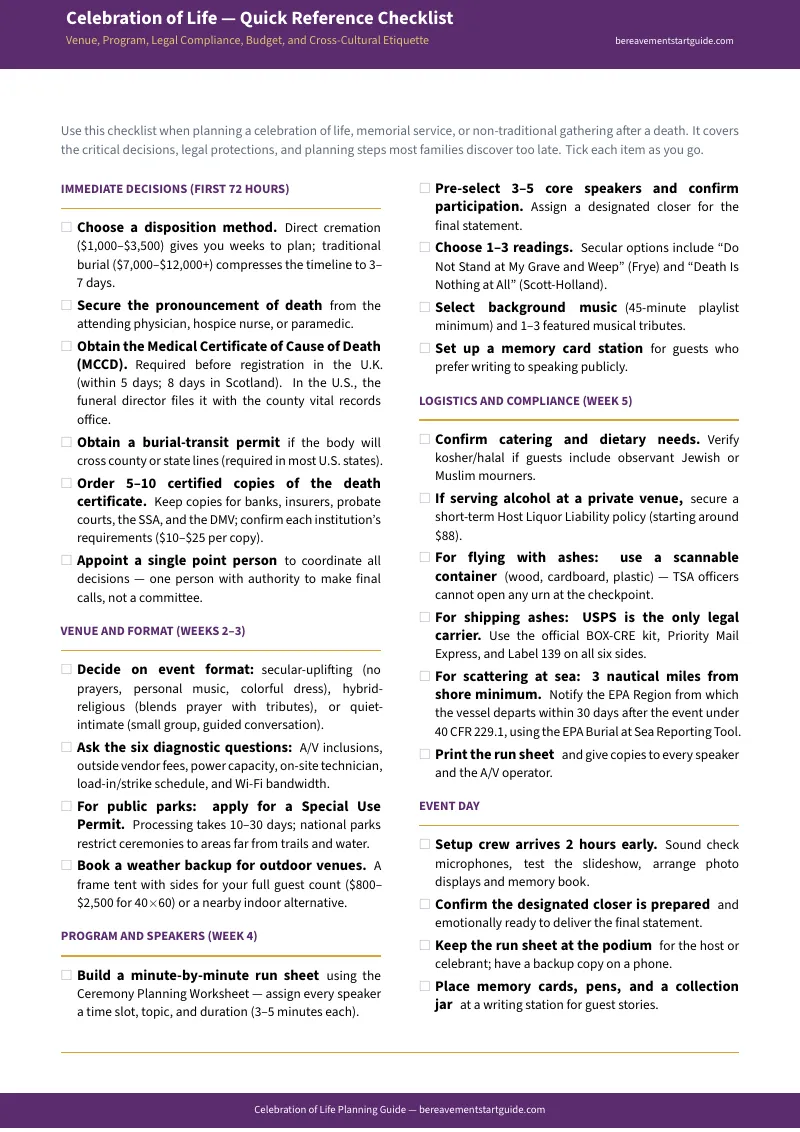
25-Item Companion Checklist — every step condensed into a two-page printable reference you can carry through the entire process.
Who It's For
- Adult children planning a memorial after a parent's direct cremation — no funeral-home program to follow, weeks of planning time, and no structure to fill it
- Interfaith and blended families where the deceased's beliefs differ from the surviving relatives' expectations
- Executors and close friends appointed to coordinate the service because the immediate family is too grief-stricken or too divided to lead
- Diaspora families coordinating across borders — dealing with international repatriation logistics, customs clearances, or airline travel with cremated remains
- Professional celebrants and secular officiants building a repeatable planning framework for non-traditional memorial clients
Why Not Free Resources?
Free tools exist. They are scattered across five categories, and none of them finishes the job.
Funeral-home blogs cover body handling and chapel logistics but steer you toward merchandise — caskets, permanent urns, embalming packages. Their advice on non-traditional venues, family dynamics, and secular ceremonies is either absent or perfunctory, because that is not where their revenue comes from.
Etsy and Canva templates give you program layouts with beautiful typography and zero content. They tell you where the readings go but not what to read. They give you a "Speaker 1 / Speaker 2" slot but no guidance on managing the speaker who will not stop.
Online memorial platforms like Ever Loved and Farewelling offer administrative checklists — cancel subscriptions, notify agencies, file the will. They focus on the estate paperwork, not on the social, cultural, and emotional execution of the memorial itself.
Reddit threads and grief forums offer raw, practical peer advice. Finding it requires reading through hundreds of deeply emotional posts during a period when your own capacity to absorb secondary trauma is at its lowest.
Government agency pages (TSA, USPS, EPA) provide the legal rules in regulatory language — spread across multiple documents that sometimes contradict each other, with no guidance on what the rules mean for a family trying to scatter ashes at a state park next Saturday.
This guide consolidates the verified rules, the operational scripts, the planning frameworks, and the family-management tools into a single document you can use when your ability to research, compare, and synthesize is at its worst.
Satisfaction Guarantee
Full refund, no time limit. If the guide does not give you what you need, email hello@bereavementstartguide.com and we will refund your purchase — no questions, no deadline.
Get Started
Download the free checklist to see the planning steps at a glance. When you are ready for the ceremony scripts, the interfaith frameworks, the legal detail, and the budget worksheets, the full Celebration of Life Planning Guide is available for — instant PDF download.