The funeral director has a package ready. You don't know enough to question it.
A parent dies in a Hong Kong hospital. Within hours, you're in a system designed to move fast — and you're the slowest person in it.
The hospital hands you Form 18. The funeral director walks you through package options ranging from HK$16,800 to well over HK$60,000. Your uncle says the Po Dei Yuk ceremony is non-negotiable. Your sister says she won't kneel at a Taoist altar. Your cousin from Toronto is asking whether the white envelope amount should end in $1 or $01. And somewhere in the back of your mind, you know there's a 14-day registration deadline with criminal penalties — but you can't remember which office handles it or what documents you need to bring.
Free resources cover fragments: the FEHD website lists forms but not rituals. The funeral parlour's website explains their packages but not the markup. Reddit has real advice buried in threads you don't have time to read. Nobody puts the legal track, the cultural track, and the financial track into a single, printable sequence you can act on tonight.
The Cultural Compliance System — every form, every rite, every cost benchmark in one manual
The Traditional Chinese Funeral — Hong Kong guide is a 13-chapter planning manual built for the family member who needs to coordinate a culturally accurate funeral under extreme time pressure — without an elder standing beside them explaining what comes next.
It merges three tracks that every other resource separates: the government paperwork chain (the Form 18 → Form 12 → Form 3 sequence at the FEHD Joint Office), the ritual sequence (body preparation, ceremony selection, mourning obligations, ancestor veneration), and the cost protection framework (FEHD published fees, non-profit comparisons, and the specific questions that expose commercial markup). The result is a single document that lets you walk into a funeral parlour knowing exactly what the government charges, what tradition requires, and what the director is adding on top.
What's inside
- The FEHD Document Chain — the complete Form 18 → Form 2 → Form 12 → Form 3 sequence, mapped step-by-step through the Joint Office system, with the iAM Smart+ digital option, the Coroner's parallel track for unnatural deaths, and the weekend/holiday hours at the Admiralty registry. Because missing the 14-day registration window is a criminal offence, not an inconvenience.
- Body Preparation Protocol — the Mai Sui washing ritual, the Sau Yi longevity clothing system with gendered layering rules (5+3 for men, 4+3 for women), the under-60 exception, the absolute ban on animal hide, and the FEHD casket compliance rules for public crematoria. Because a non-compliant casket gets turned away at the crematorium gates — publicly, with no second chances that day.
- Cremation and Disposition Matrix — the 15-day rolling booking window, public vs. private cremation fees, columbarium niche wait times (four years average for public), the mandatory exhumation policy for public land burials after six years, and the free green burial alternatives. Because disposition in Hong Kong is a land-scarcity problem that affects every family differently.
- Two-Day Funeral Structure — the complete vigil night (Shou Ye) and Grand Departure (Chu Bin) sequence, including auspicious date selection, venue booking, religious service coordination, and the moment-by-moment protocol for Day Two's final procession. Because the two-day structure is the backbone, and getting the sequence wrong derails everything downstream.
- Ceremony Selection Framework — Taoist services (including Po Dei Yuk and Da Zhai), Buddhist sutra chanting and merit transfer, syncretic blending, and hybrid arrangements for interfaith families. Because the theological friction between a Christian daughter and a Taoist uncle is one of the most common sources of funeral conflict in Hong Kong — and neither the funeral director nor the priest will mediate it for you.
- Paper Offerings Navigation — what tradition requires versus what vendors promote, the sourcing options, the crematorium furnace regulations, and the cost range from basic to elaborate. Because the paper offerings category is where commercial upselling is most aggressive and where families without an elder's guidance overspend most consistently.
- Condolence Money System — the Pak Kum protocol (odd-number amounts ending in $1, white envelopes, proper calligraphy format), the host's return Git Yi packet (tissue, candy, HK$1 coin), and the precise rules for consuming the candy and spending the coin before arriving home. Because an even-number Pak Kum amount implies a wish for another death — and nobody will tell you this in the moment.
- Mourning Dress Hierarchy — the colour-coded garment system (white/burlap for immediate family, blue for grandchildren, green for great-grandchildren), the Happy Funeral exception for deaths past age 80, the guest dress code, and the taboo colours. Because a mourning garment in the wrong colour is visible, irreversible, and interpreted as disrespect.
- Attendee Conduct Guide — the forbidden phrases (never say "thank you" or "goodbye"), the photography prohibition, the restrictions for pregnant visitors and infants, and the post-funeral purification protocol (pomelo leaf bath, stepping over a fire basin). Because the social rules at a Hong Kong Chinese funeral carry metaphysical consequences that guests from other cultural backgrounds do not expect.
- Communal Dining Protocol — the Consolation Feast (Gaai Wai Zau), the Red Banquet (Ying Hung Yin) for elder deaths, and the return Lai See envelope. Because the post-funeral meal is both a purification ritual and a social obligation — and skipping it sends a message.
- Vendor Cost Protection — published FEHD fee schedules, TWGHs transparent pricing, and the specific questions to ask before accepting any commercial package. Because families who walk in without benchmarks routinely pay double the government rate for services the funeral director marks up without disclosure.
- Ten printable planning tools — First 48 Hours Action Checklist, Funeral Budget Planning Worksheet, Auspicious Date Coordination Log, Vendor Comparison Sheet, Funeral Director Interview Checklist, Guest Etiquette Guide, Agency Communication Log, Condolence Money Ledger, Government Document Tracker, and Overseas Relative Coordination Sheet. Because delegating tasks is impossible when nobody has a shared checklist.
Who this is for
- The adult child coordinating a funeral without an elder's guidance — you didn't grow up learning the ritual sequence, and now the funeral director, the family elders, and the government all need answers from you at the same time.
- The diaspora relative managing from overseas — you live in Vancouver, London, Sydney, or San Francisco, and you need to authorise a local representative, coordinate across time zones, and understand the permits for exporting remains.
- The interfaith spouse navigating unfamiliar ceremonies — you married into a Cantonese family and the funeral customs conflict with your own beliefs. You need to participate respectfully without compromising your faith.
- The professional funeral planner serving a Cantonese family — you need the cultural reference manual your training didn't cover: the kinship hierarchy, the mourning dress system, the condolence money protocol, and the casket compliance rules.
Why free resources don't solve this
The FEHD website publishes every form number and fee schedule. It tells you nothing about which casket materials the crematorium rejects, how to mediate between a Taoist uncle and a Christian sister, or whether HK$68,000 for a funeral package is fair.
The funeral parlour websites explain their service tiers. They don't mention that the paper offerings they quote at HK$8,000 can be sourced independently for a fraction of that, or that the "standard" package includes items your family's tradition doesn't require.
TWGHs publishes transparent pricing — but their packages are designed for standard situations. They don't address complex interfaith arrangements, diaspora coordination, or the specific cultural details that prevent family conflict.
Forum threads have real, ground-level advice from people who have been through it. They're also unverified, fragmented, and scattered across years of posts. You don't have time to reconstruct a planning sequence from anonymous comments.
This guide consolidates the government track, the ritual track, and the cost track into one structured manual — so you can coordinate a culturally accurate funeral without guessing, without overpaying, and without the silence that follows a visible cultural mistake.
Satisfaction guarantee
Full refund, no time limit. If the guide doesn't give you the clarity you need, email [email protected] and we'll refund the full amount — no questions, no expiry.
Get started now
The guide costs — a one-time download, no subscription. It covers the complete funeral planning sequence from the first hour through ancestral enshrinement, with every FEHD form, every ritual step, every cost benchmark, and every planning worksheet.
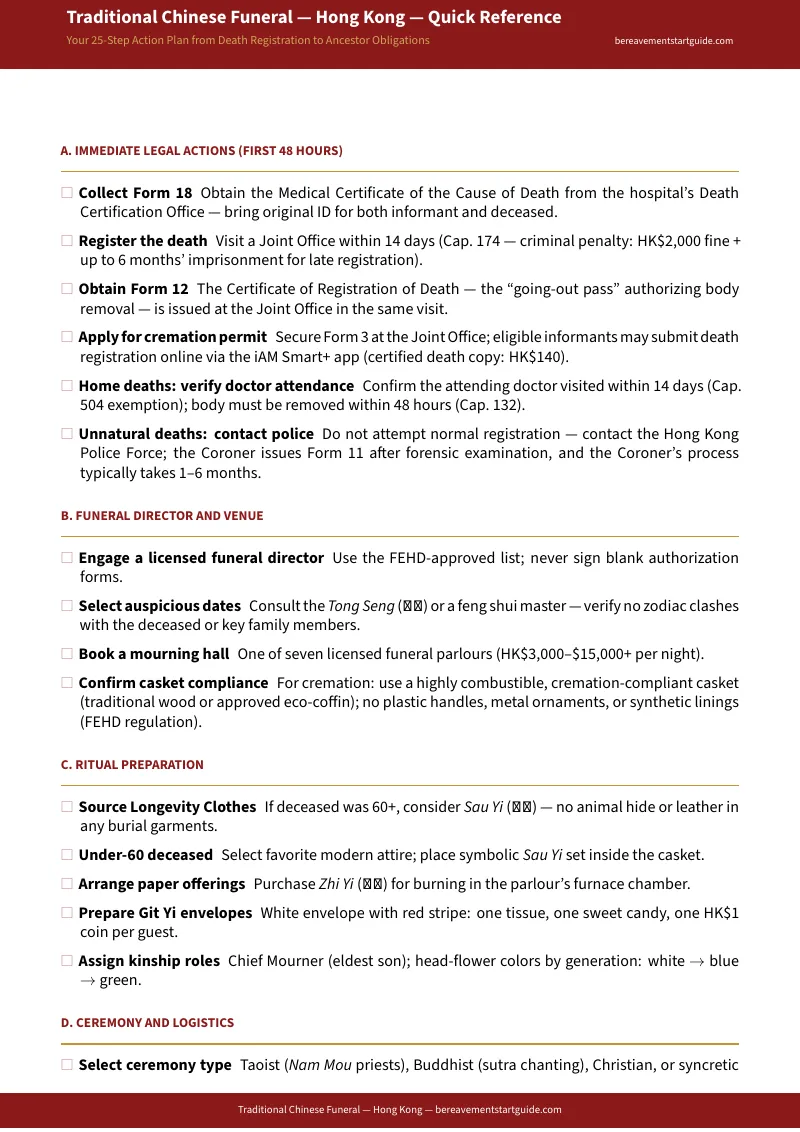
Not ready for the full guide? Download the free Traditional Chinese Funeral — Hong Kong — Quick Reference — a 2-page chronological checklist covering every critical notification, decision, and deadline. The full guide is there when you need the complete framework.