The funeral director is waiting. Your family is watching. And nobody wrote the rules down.
Your parent has died in Taiwan. Within hours, you need to choose between Buddhist sutra recitations and Taoist liturgies, decide whether the body should be returned home for the final breath ritual, and figure out how to register the death with the Household Registration Office before the 30-day legal deadline. The funeral director is quoting packages that range from NT$80,000 to NT$500,000, and you have no way to tell which line items are mandatory rites and which are high-margin add-ons.
Meanwhile, the cultural expectations are stacking up. The maternal uncle must approve the coffin sealing — and he lives in Vancouver. The mourning garments encode your exact relationship to the deceased, and a wrong colour is a public insult. The condolence money envelopes must contain an odd number of New Taiwan Dollars, and nobody told you that rule until your aunt pointed it out in front of the guests. The 49-day memorial cycle starts immediately, and each seventh-day rite has its own altar requirements, food offerings, and prayer schedule.
Free resources exist — government portals with fee schedules, Reddit threads with contradictory advice, academic papers that are fascinating and completely unusable at 3 a.m. when you need to know whether the gong goes on the left or right side of the door. What does not exist is a single document that puts the complete ritual sequence, every administrative deadline, every cost benchmark, and every family coordination protocol into one structured plan you can act on while grieving.
The Ritual Navigation System: every rite, every deadline, every cost — in one printable manual
The Traditional Chinese Funeral — Taiwan guide is a complete planning manual built for the family member who has been thrust into funeral coordination with no preparation and no margin for cultural error. It covers the full ritual sequence from the first hour after death through the 49-day bardo transition and ancestral enshrinement — with Taiwan-specific legal requirements, vendor cost benchmarks drawn from published municipal rates, and printable worksheets that turn each obligation into a delegatable task.
This is not a cultural overview or a spiritual meditation on death. It is an operational framework: step-by-step procedures, specific timelines, exact administrative requirements, and the cultural context behind every decision point so you can verify the funeral director's recommendations against an independent reference.
What's inside
The First 72 Hours — Death Registration and Director Engagement — The guide starts where you are: standing in a hospital or at home, needing to know exactly what to do and in what order. It covers the Death Certificate process (hospital, home, or judicial), the 30-day Household Registration deadline, how many original copies to request (10–15, because running short creates cascading delays), and the specific questions to ask a funeral director before signing any contract — including the 2002 Funeral and Cremation Management Act's 75% escrow requirement for prepaid arrangements.
Body Preparation — Pin Ting, Water Bed, Longevity Clothing — The physical treatment of the deceased follows rules designed to ensure a smooth spiritual transition. The guide covers the room-clearing protocol, the water bed setup (head inward, feet toward the door), the multi-layer longevity clothing system calibrated to the deceased's age, the face cloth and body drape, and the household protection measures — mirror covering, gong positioning, comb breaking — with the cosmological rationale behind each step.
Buddhist and Taoist Liturgies — Selection, Sequencing, and Pricing — Taiwan's funeral rites commonly layer Buddhist and Taoist elements, and the combination varies by family lineage. The guide explains the liturgical differences, the role of the Taoist Fashi versus the Buddhist monk, clergy scheduling logistics, and standard fee structures (NT$30,000–NT$150,000 for the full 49-day cycle) — because knowing the range is how you distinguish a reasonable quote from an inflated one.
The 49-Day Bardo Transition — Complete Zuo Qi Calendar — The funeral is the beginning, not the end. The guide structures the entire memorial cycle: the critical first seventh day (Tou Qi, when the soul is believed to return home), the weekly prayer sessions, the altar maintenance requirements, the mourning-pin colour hierarchy, and the logistics of delegating altar care to a temple when a 49-day home altar is not practical.
Kinship Authority and the Maternal Uncle Protocol — The coffin cannot be sealed without the maternal uncle's explicit permission. The chief mourner kneels and presents a ceremonial golden axe. The uncle drives the final nail. The guide covers the full protocol — and the contingencies when the uncle is overseas, when family relations are strained, and when a proxy must be arranged.
Mourning Dress — The Complete Garment Hierarchy — Mourning attire encodes the mourner's exact relationship to the deceased. Hemp sackcloth for spouses and children. White robes for daughters. Dark garments with coloured armbands for grandchildren and great-grandchildren. The guide maps the full system, the colour prohibitions for general attendees, and the exceptions for "happy funerals" when an elder passes at age 80 or beyond.
Condolence Money and Return Gifts — The envelope economy follows rules that are obvious to those who grew up with them and invisible to everyone else. The guide covers the odd-number denomination rule, the white envelope convention, the timing restrictions, the return-gift protocol (red envelope with coin and candy, consumed immediately by the guest), and the red-envelope convention for paying clergy and funeral workers — with specific NT$ amounts.
Cremation, Eco-Burial, and Columbarium Options — Taiwan subsidises eco-natural burials under the 2002 Act. The guide covers the full range: traditional burial, witness cremation, columbarium niche allocation, tree burial, flower burial, and sea burial — with cost comparisons and municipal booking procedures.
Diaspora Repatriation — When a Taiwanese citizen dies abroad, the TECO authentication chain, the Chinese translation requirements, and the customs codes for remains versus ashes add layers of complexity that the standard funeral planning process does not cover. When someone abroad needs to return to Taiwan for a funeral, the guide covers the delegation strategies for managing a 49-day cycle on a limited leave window.
Vendor Cost Benchmarks — Funeral homes in Taiwan offer tiered packages with high-margin add-ons. The guide provides published municipal rates and standard cost ranges for every major service category — director fees, memorial hall rental, refrigeration, caskets, urns, and clergy — so you can compare quotes against an independent reference instead of accepting "standard package" pricing at face value.
Printable Planning Worksheets — Seven standalone fillable worksheets: the Funeral Planning Timeline Worksheet, Vendor Interview Sheet (15 questions), Condolence Ledger, Altar Maintenance Checklist, Cost Comparison Worksheet, Repatriation Document Tracker, and Agency Communication Log. Print them, hand them to family members, and track progress without needing the full guide open.
Who this is for
The adult child coordinating a parent's funeral with no preparation. You are 30–55, you did not grow up practising, and the extended family expects you to know the ritual sequence. The guide gives you the complete operational framework — every step, every deadline, every cost benchmark — so you can coordinate with cultural accuracy while managing your own grief.
The diaspora relative managing a funeral from overseas. You live abroad, your parent has died in Taiwan, and you have days to coordinate flights, funeral arrangements, and family politics across time zones. The guide covers the administrative deadlines, the TECO documentation chain, and the delegation strategies that let you fulfil your obligations within realistic constraints.
The interfaith or cross-cultural spouse entering an unfamiliar ceremony. You married into a Taiwanese family and the funeral customs are entirely new to you. The guide provides non-participatory alternatives for rites that conflict with your beliefs, and the cultural context to navigate family pressure without creating a rupture.
The professional funeral planner serving a Taiwanese family. You need a cultural reference that covers the liturgical sequences, the kinship hierarchy, the mourning dress system, and the altar specifications — so you can deliver the service with the precision your client's family expects.
Why free resources fall short
The funeral director manages facility bookings, casket selection, and cremation scheduling. They do not explain the cosmological purpose of each rite, help you mediate a religious dispute between family members, or tell you which of their package items are optional upgrades. Their advice is shaped by their business model.
Government portals publish facility fees and registration requirements. They offer zero cultural guidance, no liturgical explanation, and minimal English-language resources.
Consular bereavement pages (AIT, TECO, British Office) are accurate on legal procedures and repatriation logistics. They are completely silent on ritual customs, family etiquette, and the 49-day memorial cycle.
Reddit and expat forums offer real-world anecdotes — valuable but unverified, regionally specific, and scattered across hundreds of threads that may be years out of date.
Academic texts provide deep historical analysis. They are dense, fascinating, and entirely unusable for a grieving family member making decisions under a 24-hour deadline.
Free resources give you fragments. The guide assembles them into a complete, structured plan you can act on immediately.
Satisfaction guarantee
Full refund, no time limit. If the guide does not help you plan the funeral with confidence, email [email protected] and we will refund the full amount — no questions, no forms, no waiting period.
Get started now
The guide costs — one payment, no subscription. Instant download as a printable PDF. Walk into the funeral home knowing exactly what needs to happen, in what order, at what cost, and why.
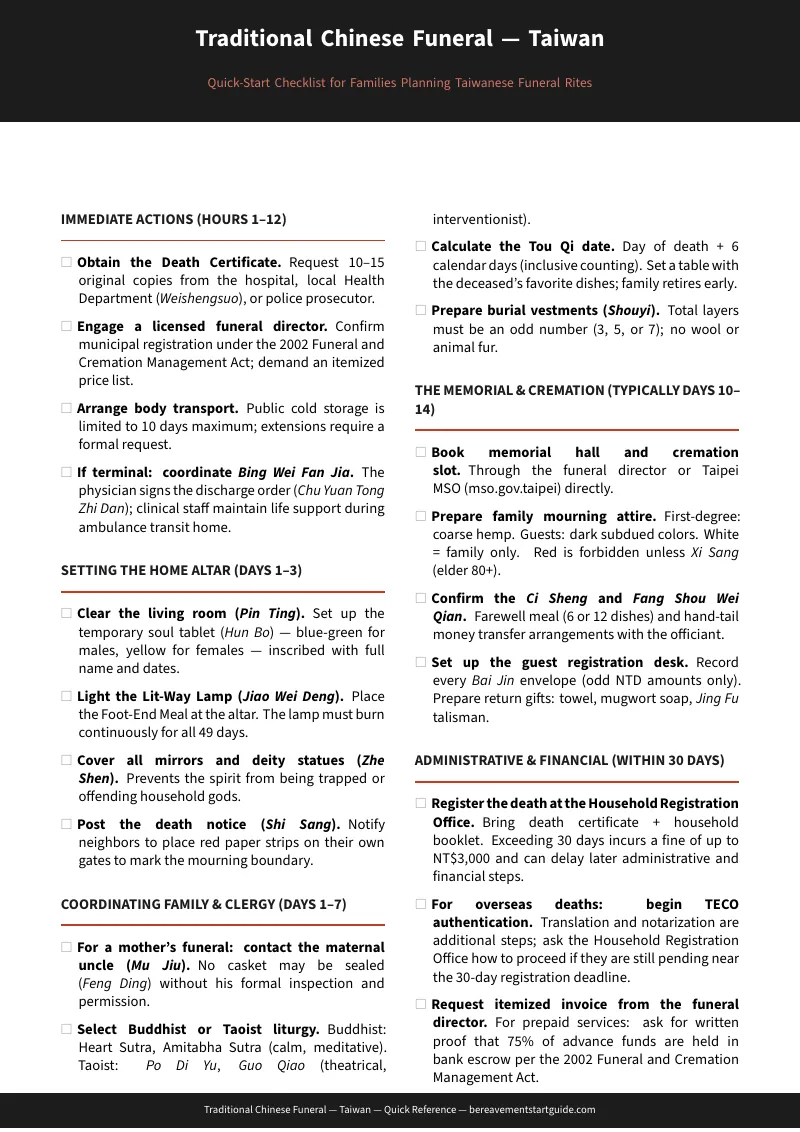
Not ready for the full guide? Download the free Traditional Chinese Funeral — Taiwan Quick Reference — a chronological checklist covering every critical notification, decision, and deadline from the first hour through the 49-day memorial. The full guide is there when you need the complete framework.