Your parent just died. The funeral home needs answers by tomorrow. Nobody in your generation knows the rituals.
Your grandmother carried the entire funeral tradition in her head — which prayers, which offerings, which colours, which sequence. She knew whether your family follows Hokkien, Teochew, or Cantonese customs, and she never wrote any of it down. Now she's gone, or she's the one who just passed, and the extended family is looking at you.
The funeral director needs a decision on the wake schedule. The temple is asking which sutra recitation service to arrange. Your uncle overseas insists on a full three-day vigil. Your sister says she can only get five days off. Someone asks whether the mirrors have been covered. Someone else says the gong goes on the left side because your father was male — or was it the right? You're not sure, and neither is anyone else under sixty.
Free resources won't save you here. Reddit threads contradict each other. Funeral home brochures list packages, not cultural protocols. Academic papers explain the history beautifully — and tell you nothing about whether to use gold or silver joss paper for your father's spirit versus the Jade Emperor. You need a structured plan you can act on today, not fragments from ten different sources that you have to assemble while grieving.
The Dialect-Specific Funeral Navigator — one plan, five traditions, every critical step
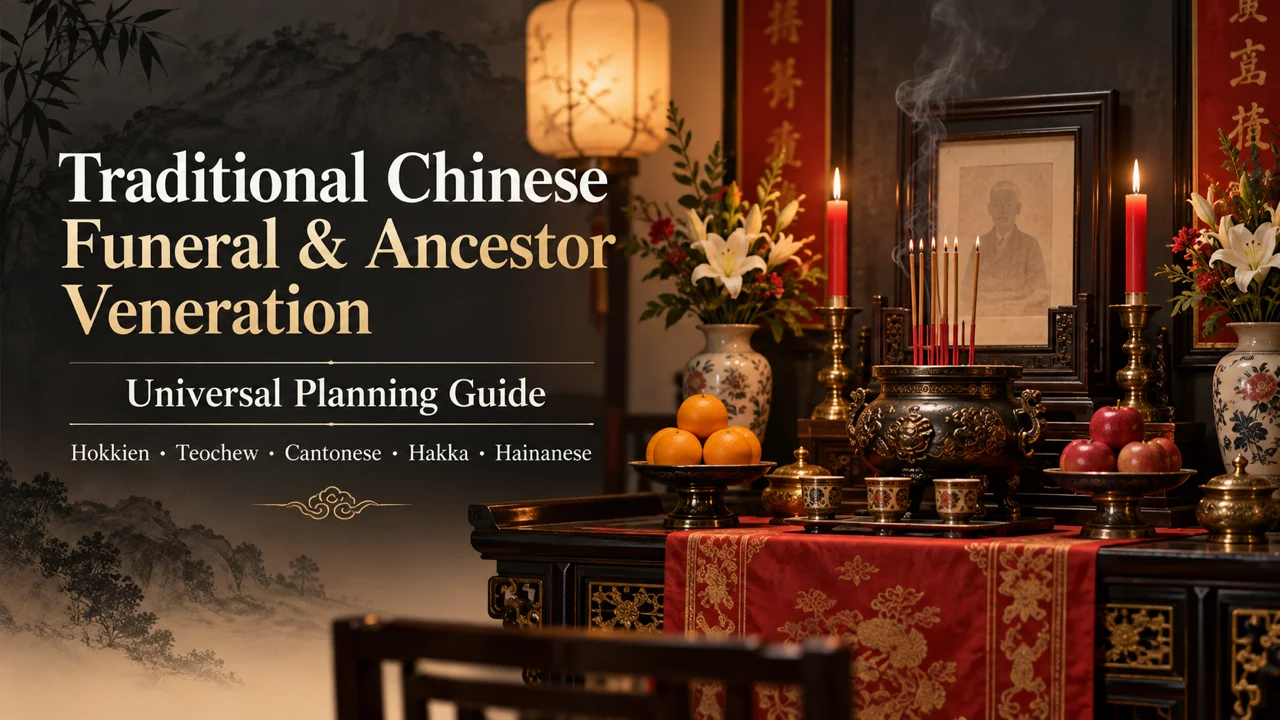
The Traditional Chinese Funeral & Ancestor Veneration Guide is a complete planning manual that organises every ritual stage, every dialect variation, and every coordination decision into a single structured framework. It does not treat Chinese funerals as one uniform practice — because they are not. It maps the distinctive rites across Hokkien, Teochew, Cantonese, Hakka, and Hainanese traditions, so you can identify exactly which protocols apply to your family and communicate them to every vendor, temple, and relative involved.
This is the planning layer that sits above the funeral director and the temple — the coordination framework that helps you manage them effectively, rather than being managed by the process.
What's inside
- Five dialect traditions mapped side by side — Hokkien's elaborate community-facing ceremonies, Teochew's quiet sincerity and Bridge of Sins purification, Cantonese layered Taoist-Buddhist structures with return-gift packets, Hakka and Hainanese family-led chanting and lineage continuity. Each tradition's altar configurations, prayer sequences, offering types, and mourning garment conventions spelled out so you can identify your family's practice and explain it to a Western-trained funeral home.
- Body preparation protocols — the three-wipe ritual washing, shouyi longevity clothing layers (5, 7, 9, or 11 based on the deceased's age), the red-clothing prohibition and its specific exceptions, yellow face cloth and blue body drape placement, coffining safeguards including mirror-covering, doorway signage, gong positioning, and the broken-comb ritual. Every step includes the cosmological purpose behind it, so you can verify the preparation even without an elder present.
- Wake and prayer timeline — the 3-to-7 day vigil structure, monk and priest chanting rotation schedules, family duty assignments, guest reception protocols, altar setup specifications (portrait placement, soul lamp maintenance, food offering arrangement), and the practical decisions that shape the entire downstream timeline.
- Funeral procession logistics — the precise lineup order (eldest son with portrait and joss stick, second son with ancestral tablet), hearse markings (lion for male, crane for female), water-crossing announcements, joss paper scattering protocol, and the coordination required when the route crosses bridges or passes through residential areas.
- The complete 49-day Zuo Qi memorial calendar — every seven-day milestone from the first-seventh-day soul return (house illumination, floor dusting for spiritual footprints) through the weekly prayer sessions, mourning garment conventions by genealogical closeness (black/white for children, blue for grandchildren, green for great-grandchildren), and the final ceremonies marking the transition's completion.
- Condolence money and guest protocols — the odd-number cash rule for bai jin envelopes, Cantonese return-gift packets (candy, coin, tissue), red completion packets after burial, photography and behaviour restrictions, and the social expectations that guests and extended family will hold you to — all in one place instead of scattered across contradictory forum threads.
- Interfaith navigation framework — respectful non-participatory positions for Christian, Catholic, or secular family members expected to participate in Buddhist or Taoist rites. Covers the historical Chinese Rites Controversy, the veneration-versus-worship distinction, and a worked example for handling family pressure when half the relatives are Buddhist and the other half are not.
- Vendor cost protection — realistic cost benchmarks for standard funeral services, a negotiation framework for evaluating package quotes, and the questions to ask before committing. Not anti-vendor — funeral directors provide essential services — but designed so you enter the conversation knowing what standard pricing looks like versus what is an upsell on grief.
- Cremation and remains transport — witness cremation protocols (where descendants watch the casket enter the chamber), standard cremation procedures, and the documentation required for international transport of ashes — bilingual death certificates, authenticated paperwork, carry-on specifications for airport security.
Who it's for
- Diaspora descendants coordinating from overseas — you live in Sydney, Vancouver, London, or San Francisco and need to manage the funeral remotely while juggling flights, family logistics, and a leave window that won't stretch to three weeks.
- Interfaith or intercultural spouses — your Chinese-heritage partner or parent-in-law has died and you're expected to participate in ceremonies you've never encountered, terrified of committing a cultural taboo.
- Secularised adult children — you respect the tradition but didn't grow up practising it, and now you're the one responsible for getting it right.
- Professional celebrants and funeral planners — you've been contracted to manage a Chinese funeral and need a dialect-specific reference to deliver the service with cultural precision.
- Families managing multi-faith ceremonies — Buddhist elders, Christian relatives, and secular siblings all need to grieve together without the funeral becoming a theological argument.
Why not just use free resources?
The funeral director manages the physical logistics — facility, casket, hearse, cremation. They don't coordinate family disputes about dialect traditions, explain the cosmological purpose of the mirror-covering to your non-Chinese spouse, or help you structure the 49-day memorial calendar.
The temple manages the liturgical rites — sutra recitations, monk rotation, merit-transfer prayers. They assume fluency in Mandarin or a Chinese dialect and a level of cultural literacy that many diaspora descendants don't have.
Reddit and forums give you anecdotal, contradictory advice from one family's experience in one region. A thread about Cantonese return-gift packets won't tell you whether your Hokkien family does the same thing.
Academic texts explain the history beautifully. They are completely unusable for a grieving child who needs to know whether the gong goes on the left or right side of the door before the visitors arrive this evening.
Free resources give you fragments. This guide gives you the complete sequence — dialect-specific rites, body preparation, wake timelines, the 49-day memorial calendar, vendor cost protection, interfaith navigation, and printable planning tools — assembled for the family member who has days, not weeks, to prepare.
Full refund, no time limit
If the guide doesn't help you navigate the ceremony, email [email protected] and we'll refund your purchase — no deadline, no questions.
Start planning with confidence
The guide costs — one purchase, no subscription. It covers the complete ritual sequence, every major dialect variation, the vendor cost benchmarks, the interfaith navigation framework, and the 49-day memorial calendar. Plus a printable planning checklist and standalone worksheets you can carry through every stage.
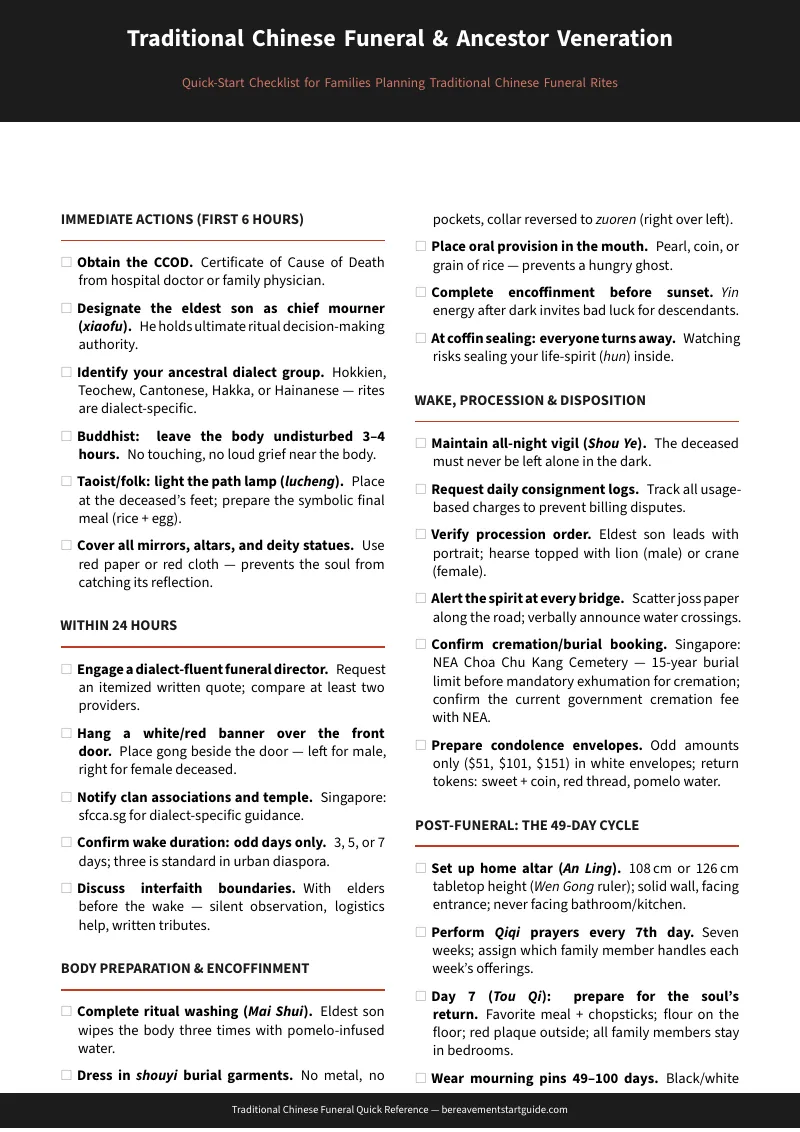
Not ready for the full guide? Download the free Chinese Funeral Planning Checklist — a quick-reference covering every critical notification, decision, and deadline from the first hour through the 49-day memorial completion. The full guide is there when you need the complete framework.