Your Parent Lived by These Traditions. You Shouldn't Have to Guess at Them.
The phone rings. A parent, a grandparent, a spouse — gone. And before you've even processed what happened, the clock starts. The parish priest needs to be called before the funeral home. The body needs to be washed, anointed with olive oil and wine, and wrapped in a Savanon shroud that most mortuaries have never heard of. The casket needs to face east. Funerals cannot happen on Sundays. And someone needs to figure out how to dry boiled wheat for twelve hours without the powdered sugar turning into grey paste in front of the entire community.
If you grew up in the church, some of this might sound familiar. But familiar is not the same as knowing how to execute it under pressure, with grieving relatives pulling in different directions and a parish secretary asking about your stewardship status.
If you married into the family, it may feel like everyone expects you to know things no one ever explained.
The Sacred Rites Coordination System
The Eastern Orthodox Funeral — Greek guide is not a pamphlet of prayers or a generic funeral planning checklist. It is a structured coordination system that walks you through every canonical requirement, cultural tradition, and logistical decision — in the exact order you'll face them — so you can honor your loved one without second-guessing yourself at every step.
Parish handbooks tell you what the Church requires. Funeral home brochures tell you what their packages include. Neither tells you how to navigate the gap between them — the family politics, the financial negotiations, the interfaith sensitivities, the culinary obligations that trip up every family doing this for the first time.
This guide does.
What's Inside
- The Complete Funerary Timeline — a day-by-day breakdown from the moment of death through the three-year memorial cycle, with every scheduling constraint (no Sunday funerals, no Holy Saturday services) built in so you never hit a preventable delay
- Body Preparation Protocol — step-by-step instructions for the ritual washing, olive oil anointing, Savanon shroud placement, east-facing casket orientation, and the barefoot burial custom, written clearly enough to hand directly to a secular mortician who has never worked with an Orthodox family
- Koliva Recipe With Drying Science — not just a list of ingredients but the actual technique that prevents the most common failure: precise drying times, lint-free cloth placement, and assembly sequencing so the powdered sugar stays pristine through the memorial blessing
- Makaria Menu Planning — the symbolic meal requirements (baked fish, no red meat, no celebratory desserts), traditional side dishes, and hosting logistics so you can organize the Mercy Meal without guessing what's appropriate
- Parish Fee Breakdown — typical ranges for church facility fees, clergy honorariums, Byzantine chanter fees, and Koliva preparation charges, including what active stewards pay versus non-members, so you can budget accurately and ask informed questions
- Diplomatic Scripts — exact wording for the conversations nobody prepares you for: explaining the cremation prohibition to a non-observant relative, negotiating casket costs with the funeral home, confirming stewardship status with the parish office, and gently declining to serve red meat at the Makaria when an uncle insists
- Interfaith Guest Etiquette Page — a clean, printable one-page guide you can share with non-Orthodox friends and relatives before the service, covering the open casket tradition, the Kiss of Peace, when to stand, and how to participate respectfully without pressure
- Diaspora Adaptations — specific guidance for communities in the United States, Canada, Australia, and the United Kingdom, including bilingual service options, professional chanter hiring, and cross-border body repatriation logistics for families coordinating between countries
- Exhumation and Ossuary Guide — for families with relatives buried in Greece, where municipal cemetery leases expire after three to five years and remains must be exhumed, washed in wine, and transferred to an ossuary box — a process that catches diaspora families completely off guard
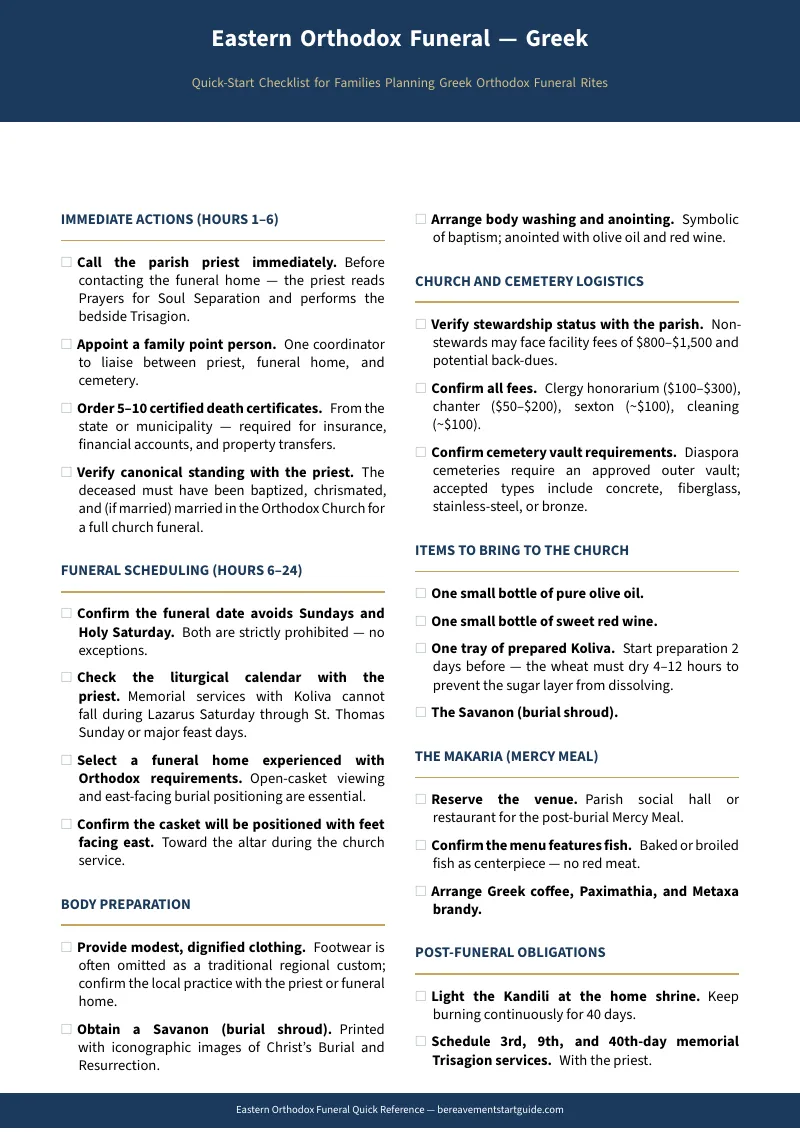
- Printable Checklist — a 25-item action sequence organized by phase (immediate, pre-funeral, day-of, post-funeral, memorial cycle) that you can print and divide among family members so nothing falls through the cracks
- 10 Standalone Worksheets — printable planning tools including an immediate actions checklist, funeral day preparation sheet, parish contact and fee tracker, cost estimator, Makaria planning sheet, Koliva preparation timeline, 40-day memorial calendar, clergy and vendor interview questions, and a diplomatic scripts card with exact wording for every difficult conversation
Who This Is For
- Culturally Greek families who are less observant but need to honor a devout parent's or grandparent's wishes without the anxiety of getting it wrong in front of the community
- Interfaith spouses and partners who have been thrust into coordinating a deeply traditional ceremony they didn't grow up with
- Diaspora families living in the US, UK, Canada, or Australia who are managing logistics across time zones and cultural contexts
- Funeral directors and event planners serving a Greek Orthodox family for the first time and need a reliable protocol reference
Why Free Resources Fall Short
The parish website gives you canonical rules — baptism requirements, cremation prohibitions, Sunday scheduling restrictions. What it doesn't give you is the practical script for telling your father-in-law that his brother's wish to be cremated means the Church will deny the funeral service. It doesn't explain that some parishes charge non-members over a thousand dollars in facility fees, or that the cemetery may require a specific vault material that adds an unexpected cost.
Funeral home brochures offer packages — but their job is to sell you services, not to tell you that the clergy honorarium is customary rather than mandatory, or that the Philoptochos ladies' auxiliary may prepare the Koliva for a fraction of what a professional caterer charges.
Forum threads on Reddit and community boards are full of anxious questions from people in exactly your situation — but the answers contradict each other, because customs vary by region, island, and individual parish, and nobody clarifies which practices are universal canonical law and which are local tradition.
This guide separates canonical requirements from regional customs explicitly, then gives you a "Clarifying Questions" list to take to your own priest and family elders so you can adapt the process to your specific situation without guessing.
The Full Guide vs. the Free Checklist
The free checklist gives you the task sequence — the essential actions in the right order. The full guide gives you the how: the diplomatic scripts, the body preparation protocol, the Koliva drying technique, the parish fee ranges, the interfaith etiquette pages, and the memorial planning templates that turn a stressful process into a structured one.
Get the Eastern Orthodox Funeral — Greek Guide →
You're not just planning a funeral. You're honoring a tradition that has carried families through loss for centuries. This guide makes sure you can do that with dignity — for your loved one and for yourself.
Frequently Asked Questions
What if the rules change after I buy?
We update the guide when the rules change. Email us any time, even years later, and we'll send you the current edition free.