Your family just lost someone. The priest expects you to know what happens next.
Within hours of the death, you're expected to coordinate a parish priest, organize ritual body washing, arrange an overnight Psalter vigil, schedule the Otpevanie, prepare Kutia and a full Pominki meal with the right fasting adjustments — and secure an east-facing cemetery plot before the burial on the third day. The liturgical calendar can block your plans entirely if you pick the wrong date. And your traditional grandmother is insisting on folk customs that the priest may flatly refuse.
You could piece this together from parish pamphlets, Reddit threads, and YouTube videos that confuse Greek, Russian, and Serbian practices. But one wrong step — scheduling on a Great Feast, bringing odd-numbered flowers, requesting cremation without understanding the jurisdictional rules — can delay the service, offend your community, or create family conflict at the worst possible moment.
The Russian Orthodox Funeral Navigator
The Eastern Orthodox Funeral — Russian guide is a complete bereavement system that walks you through every ritual obligation from the moment of death through the one-year memorial cross blessing — organized around the forty-day framework that structures everything the Church expects from your family.
This is not a theology textbook or a generic "Orthodox traditions" overview. It is a step-by-step operational manual built for families who need to act within hours, with clear protocols for every decision that actually trips people up: body preparation customs that Western funeral homes do not understand, the embalming-versus-refrigeration conversation you need to have in writing, Psalter reading shift logistics, Pominki menu planning cross-referenced against the fasting calendar, and the dvoeverie reference that settles disagreements between traditional elders and the parish priest before they escalate.
What's Inside
- The 40-Day Timeline — a chronological framework mapping every spiritual milestone (Days 1, 3, 9, 40, and the one-year anniversary) to the specific liturgical services, family meals, and almsgiving obligations each one requires, so nothing falls through the cracks during the most disorienting weeks of your life
- Body Preparation Protocols — step-by-step instructions for the ritual washing (Omovenie), dressing (Odevanie), and sacred item placement (savano, venchik, icon, hand-cross), with separate protocols for laypeople, clergy, deacons, and monastics
- Funeral Director Liaison Checklist — the exact questions and written instructions to give your funeral home so they handle Orthodox-specific requirements correctly: no embalming, removable casket lid, transport to the church for the overnight vigil, and refrigeration alternatives
- Pominki Menu Planning — the traditional memorial meal structure including Kutia preparation, Blini, Kissel, and the full menu with fasting-rule adjustments by liturgical season, plus the diplomatic way to handle the vodka-and-bread folk custom when the priest objects
- Cremation Guidance by Jurisdiction — a comparison of official positions from ROCOR (absolute prohibition), OCA (strong disapproval with economia), and Greek Archdiocese (explicit disapproval, no sacramental funeral over ashes), with specific pastoral pathways for families facing legal mandates or a loved one's prior cremation request
- Dvoeverie Reference Table — a clear breakdown of which folk customs (covering mirrors, stopping clocks, placing coins) the Church actively opposes, which it quietly tolerates, and how to manage family disagreements when your grandmother's traditions conflict with the priest's canon
- Diaspora Adaptation Guide — practical workarounds for families outside Russia navigating Western legal systems, secular cemeteries, non-Orthodox funeral homes, and distance-coordination challenges, with a worked cost comparison of embalming versus refrigeration
- Guest Etiquette Pages — printable reference sheets covering dress code, standing and crossing protocols, flower rules (even numbers only), photography prohibition, and what non-Orthodox guests should and should not do during the Last Kiss
- Special Pastoral Cases — guidance for suicide (when the bishop may still grant a funeral), lapsed or non-practicing Orthodox (how to approach the priest diplomatically), and interfaith families (which sacraments non-Orthodox family members can and cannot receive)
- Nine Printable Planning Worksheets — funeral director liaison checklist, Pominki menu planner with fasting-rule reference, memorial calendar tracker, Proskomidia and commemoration log, sacred items preparation checklist, guest etiquette sheet, cemetery cost comparison worksheet, Psalter reading volunteer schedule, and dvoeverie reference table
Who This Is For
- Diaspora adult children who need to honor a devout parent's funeral wishes without years of liturgical training — the guide gives you the terminology, the timeline, and the diplomatic scripts to coordinate confidently with clergy and elder relatives
- Non-Orthodox or interfaith spouses who've been thrust into coordinating a funeral in a tradition they do not fully understand — the etiquette sections and behavioral expectations prevent the cultural missteps that strain relationships at the worst possible time
- Executors and close friends managing a rigid three-day timeline under budgetary and paperwork constraints — the vendor checklists, cost comparison worksheets, and body preparation protocols keep the logistics on track
- Funeral directors and celebrants serving a Russian Orthodox family for the first time — the body handling protocols, casket requirements, and chapel setup instructions prevent costly service errors
Why Not Free Resources?
Parish websites assume you already speak Church Slavonic and know the liturgical calendar. Slavic-serving funeral homes give you an overview designed to sell their services, not to prepare you for the home-based rituals and family coordination you're responsible for. Reddit threads mix Greek, Russian, and Serbian practices without distinguishing between them. Traditional manuals like A Christian Ending advocate a level of home-based body care that is often legally impractical for suburban diaspora families.
This guide does what none of those sources do: it puts every decision in sequence, tells you exactly who to call and what to say, distinguishes canonical requirements from regional customs, and gives you printable tools you can hand directly to your funeral director, your non-Orthodox relatives, and your Psalter reading volunteers.
Your Family Deserves Clarity During the Hardest Week
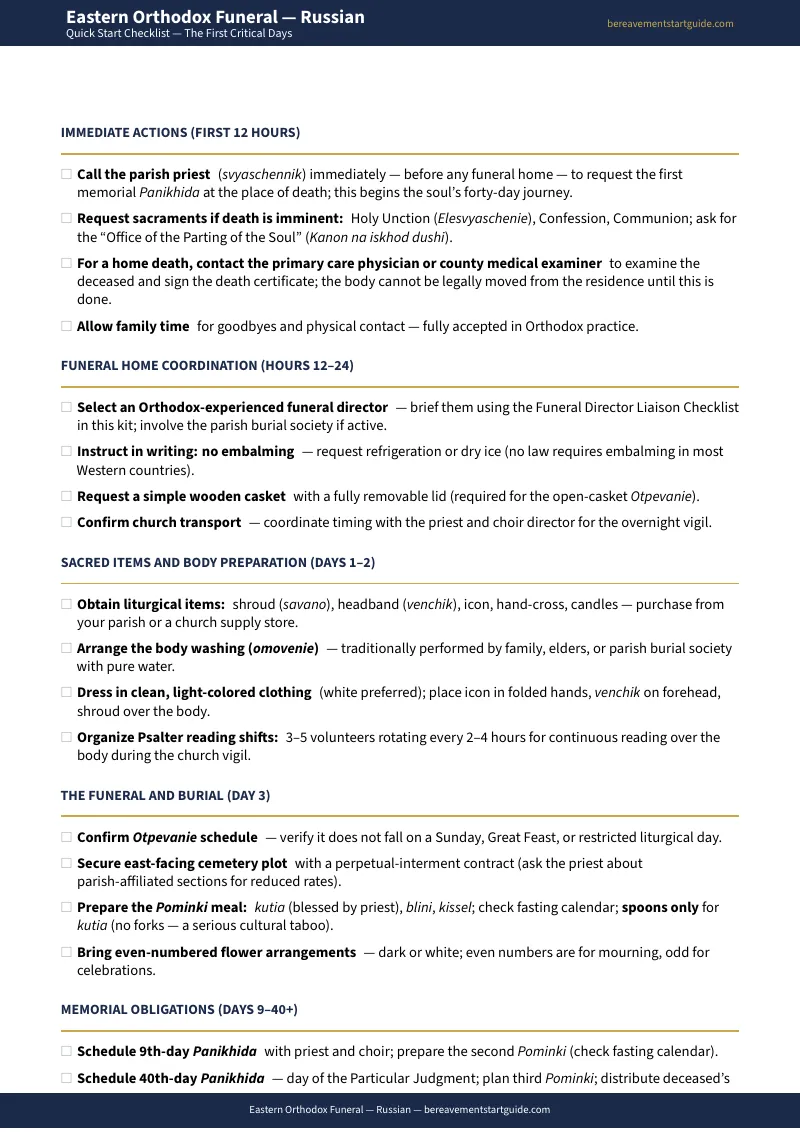
You can download the free checklist right now — it covers the essential timeline and the twenty-one most critical action items. If you need the full system — fourteen chapters, detailed protocols, fasting-rule references, jurisdictional cremation guidance, dvoeverie navigation, and the complete planning toolkit — the full guide is available for less than what a single flower arrangement costs.
Every purchase includes lifetime access to all future updates as jurisdictional policies and pastoral practices evolve.
Frequently Asked Questions
What if the rules change after I buy?
We update the guide when the rules change. Email us any time, even years later, and we'll send you the current edition free.