The funeral home assumes Catholic liturgy. Your family is evangelical. The service is in 24 hours.
When a loved one dies in Latin America, the deathcare system activates around one assumption: the family is Catholic. The funeral home places a crucifix on the casket. The neighbors arrive with rosary beads. The extended family expects a novenario. And the person you are burying spent their entire life in a tradition that explicitly rejects every one of those customs.
You are now the person responsible for replacing the entire default funeral script — the velorio, the chapel service, the music, the prayers, the etiquette, the vendor negotiations — with something that honors evangelical Protestant theology while keeping the community atmosphere warm enough that your Catholic grandmother and your secular cousin both feel welcome.
You do not need a theology degree. You need a Funeral Navigation Framework — a single reference that translates the theological boundaries, the cultural expectations, and the operational deadlines into a step-by-step plan you can execute under grief, under time pressure, and under the watchful eyes of two different faith traditions.
What the Evangelical Funeral — Latin America Toolkit Covers
72-Hour Planning Timeline — Every decision mapped in the order you will face it, from the medical death certificate to the Registro Civil filing to the graveside committal. Latin American municipalities often require burial or cremation within one to two days. The timeline shows which decisions are reversible, which lock in costs immediately, and which must happen before the funeral home closes for the day.
Velorio Framework Without Catholic Sacraments — The velorio is the communal overnight vigil that sustains the family through grief. The guide replaces the rosary recitations, saint imagery, and intercessory prayers with a complete alternative program: scripture readings, congregational hymns, shared testimonies, and hospitality protocols that preserve the warmth and communal presence of the tradition without crossing evangelical theological boundaries.
Interfaith Diplomacy Scripts — When Catholic relatives ask why there is no rosary, when someone insists on saint cards, when an uncle wants to organize the novenario — you need words, not theology lectures. The guide includes polite but firm verbal templates for the most common friction points, designed to redirect the conversation toward honoring the deceased rather than debating doctrine.
Culto de Consolación Liturgy Builder — A modular order of service for the evangelical funeral service, with curated scripture selections (Psalm 23, Juan 11:25-26, 1 Tesalonicenses 4:13-18), a worship music list vetted across conservative and charismatic congregations, and guidance on coordinating with the pastor — including the conversation about preaching the Gospel to the living when the gathered family includes people of other faiths or no faith.
Cremation vs. Burial Conversation Guide — The cremation question is the single most common source of family conflict. The guide presents both scriptural positions, the pastoral consensus that has shifted across most Latin American evangelical denominations, and a practical cost comparison — giving you enough shared language to move the conversation from theology to planning before the funeral home needs an answer.
Six-Country Repatriation Procedures — For diaspora families managing a death from the US or Europe, the guide covers the step-by-step consular requirements, estimated costs, and document checklists for repatriating remains to Mexico, Guatemala, Honduras, El Salvador, Colombia, and the Dominican Republic. Includes the cremation alternative that can reduce costs by 60 to 75 percent.
Funeral Director Vendor Questions — Funeral homes in Latin America default to Catholic liturgical packages. The guide provides specific questions to identify and remove unwanted liturgical items from the quote, request an itemized price list, and verify costs before you sign anything — because the time to negotiate is before the contract, not after the service.
Two Worked Cost Examples — A local burial with church service and a diaspora repatriation with cremation, each broken down line by line: funeral home fees, pastor honorarium, musician fees, church venue costs, cemetery charges, consular fees, and airline cargo costs. The guide shows where the pricing gap between bundled packages and itemized selections creates the largest savings.
Food, Hospitality, and the Alcohol Boundary — What to serve during the velorio, how to set the no-alcohol boundary gracefully when non-evangelical guests expect a traguito, and how to coordinate the community food rotation that keeps an overnight vigil running without overwhelming the family.
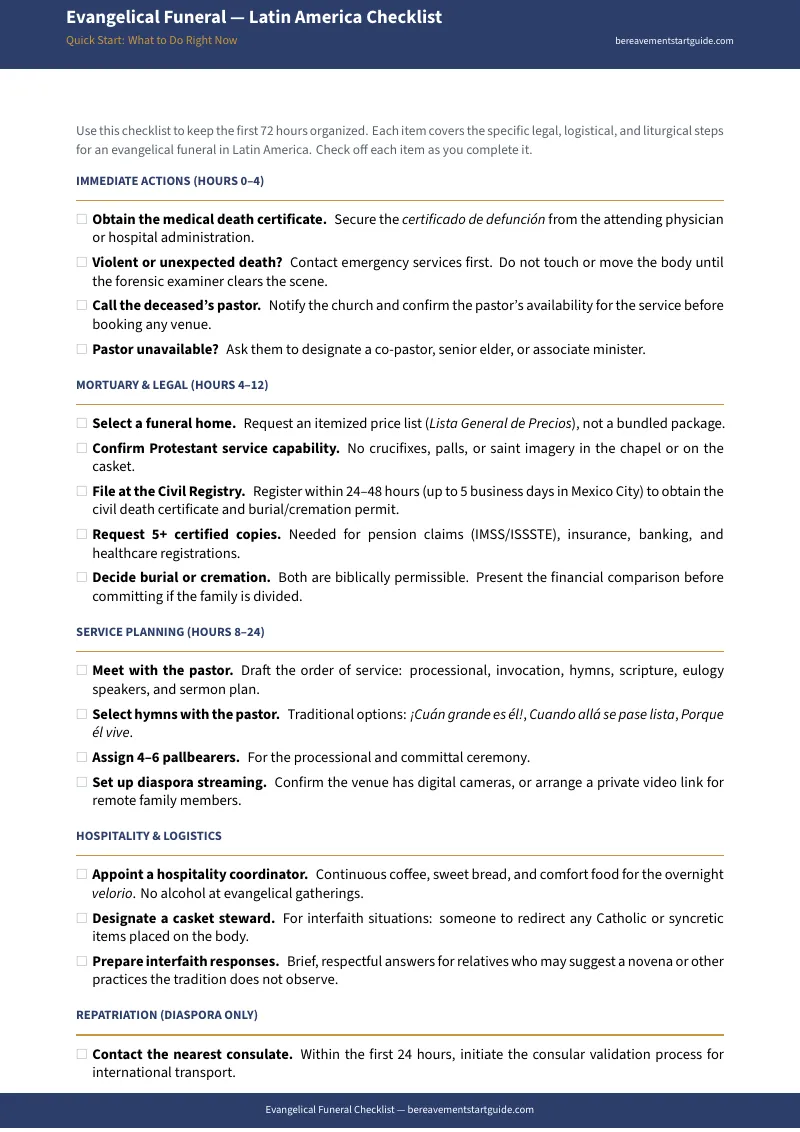
Printable Planning Worksheets — A one-page checklist plus five standalone worksheets: a Culto de Consolación planning form for designing the service with your pastor, a Vendor Comparison Worksheet for evaluating funeral homes side by side, a Repatriation Document Tracker for international transport, a Family Budget Planner for tallying costs against resources, and an Interfaith Communication Planner for assigning family diplomats to each potential friction point. Enough to walk into every meeting — with the funeral home, the pastor, and the family — prepared.
Who This Is For
- The adult child who left the church but must honor a parent's faith — Your mother or father was deeply devout. The funeral must reflect their convictions, not yours. The guide gives you the liturgical and cultural framework without requiring you to share the theology.
- The diaspora coordinator managing a funeral from abroad — A relative has died back home. You are funding the service, arranging the repatriation, and coordinating with people you cannot see in person. The guide covers the consular paperwork, the airline logistics, and the religious service coordination in one reference.
- The interfaith relative who married into the family — Your background is Catholic, secular, or something else. The evangelical church has expectations you have never encountered. The guide translates those institutional norms into plain language.
- The funeral director or celebrant serving an evangelical family for the first time — Your default workflow assumes Catholic liturgy. The guide gives you the theological boundaries and the alternative service framework so you can serve this family competently.
- The family navigating the cremation conversation across generational lines — One side insists on burial, the other on cremation. The guide presents both positions with the scriptural and pastoral reasoning each side uses, plus the practical cost difference.
Why Free Tools Fall Short
Free resources on evangelical funerals in Latin America are fragmented across four types of sources — and each one leaves a critical gap:
- Church liturgical manuals are written for pastors delivering sermons, not for families managing logistics, budgets, and family conflict.
- Funeral home websites blend Catholic and Protestant customs under a generic "Latino funeral" umbrella, which is exactly the theological conflation evangelical families need to avoid.
- Consular portals list the legal documents for repatriation in dense bureaucratic language, without explaining the chronological order, the costs, or how to coordinate the religious service alongside the legal transport.
- Online forums and social media offer anecdotal advice that is unverified, often contradictory, and Anglo-centric in ways that do not translate to the specific cultural dynamics of a Latin American evangelical funeral.
The toolkit consolidates what these sources provide — and fills in what they leave out — in a single, organized, printable reference designed for someone operating under acute time pressure and emotional exhaustion.
What Happens After You Download
You get instant access to the complete guide and the planning checklist. Open the checklist first — it maps the first 72 hours and tells you exactly who to call and in what order. Then work through the relevant chapters of the guide as each decision point arrives: the velorio framework when the family asks about the wake format, the liturgy builder when the pastor asks for the order of service, the repatriation chapter when the consulate needs documents.
The guide costs — once, no subscription. It covers every protocol, every conversation script, every repatriation procedure, and every cost range in one manual.
Not ready for the full toolkit? Start with the free Evangelical Funeral Planning Checklist — a one-page reference covering the critical decisions and deadlines for the first 72 hours.
You did not plan to be the one coordinating this service. But the clock is running, the funeral home assumes Catholic liturgy, and your family is looking to you. The Funeral Navigation Framework gives you the operational confidence to honor the faith, manage the logistics, navigate the family dynamics, and protect the budget — before the first meeting starts.
Frequently Asked Questions
What if the rules change after I buy?
We update the guide when the rules change. Email us any time, even years later, and we'll send you the current edition free.