The Church Has Rules the Funeral Home Won't Mention
Someone in your family has died. They were a person of deep evangelical faith. The funeral must happen within days, and the church where the service will be held has policies you have never seen: an approved music list, a limit on speakers, a slideshow that must be submitted 24 hours in advance in a specific format, non-member rental fees, and a pastor who expects to deliver a Gospel message to the living — including your secular colleagues, your interfaith in-laws, and your cousin who hasn't set foot in a church in fifteen years.
The funeral home wants a meeting tomorrow morning. Your siblings are arguing about cremation. You are searching "evangelical funeral planning" at midnight, and every result is either a 13-week grief curriculum, a funeral home sales page stripped of all theological context, or a church bulletin written for the pastoral staff, not the grieving family member holding the clipboard.
The Church Coordination Toolkit
The Evangelical Funeral — US guide is not a devotional or a grief book. It is an administrative toolkit built for the person coordinating the service — whether you are a lifelong church member, an adult child who left the faith decades ago, an interfaith spouse navigating a tradition you do not share, or a funeral professional serving an evangelical family for the first time.
The pastor serves the church's spiritual mission. The funeral director handles physical logistics. Neither one represents your interests as the person coordinating the family, the schedule, and the budget. This guide does. It gives you the denominational literacy, the sanctuary negotiation language, and the planning worksheets to manage every conversation — from the first phone call to the church office to the last dish at the repast — without guessing, without offending, and without losing control of the timeline.
What's Inside
- First-48-Hour Decision Timeline — every administrative, pastoral, and logistical step sequenced in the order you will actually face them, from the moment of death through the funeral home meeting, the church coordination call, and the family decision on cremation versus burial
- Denominational Service Blueprints — step-by-step order-of-service frameworks for Southern Baptist, independent Baptist, Pentecostal and charismatic, nondenominational megachurch, and historic Black Homegoing traditions, so you know exactly which structure fits the deceased's church community
- Sanctuary Policy Navigator — common church restrictions on music, speakers, slideshows, decorations, and non-member rentals, with guidance on what is negotiable and what is not, and how to ask before assumptions create conflict with the pastor
- Cremation Theology Framework — the scriptural arguments both sides of the family are citing, the pastoral consensus that has shifted in the past two decades, and a practical cost comparison that gives everyone enough shared language to move from argument to decision
- Music and Scripture Selection Guide — curated Old and New Testament readings, a hymn-to-contemporary mapping, the sacred-versus-secular boundary most churches enforce, and where secular tributes can be incorporated without triggering a conflict with the music director
- Livestreaming Compliance Checklist — the copyright licensing requirements (CCLI Streaming License, One License) that the in-person worship exemption does not cover, camera placement rules, congregation privacy protocols, and a practical AV setup guide for churches with limited infrastructure
- Military Honors Integration — eligibility verification (DD-214), how to request honors, the correct sequencing of religious committal rites before military ceremony, the standard and enhanced honors protocols, and civilian etiquette for the rifle salute and Taps
- Two Worked Cost Examples — a traditional casket burial with church service and a direct cremation with memorial, broken down line by line: funeral home charges, clergy honorariums, musician fees, church rental deposits, cemetery costs, and the pricing gap between bundled packages and itemized selections
- Repast and Meal Train Coordinator — church-hosted meal logistics, home delivery protocols with contactless drop-off, the "paper goods" delivery experienced church communities provide alongside food, and the etiquette rules that prevent well-meaning visitors from overwhelming a grieving household
- Printable Planning Worksheets — the Evangelical Funeral Planning Checklist, a funeral planning timeline, a church coordination checklist, a service order planner, a scripture and music selection worksheet, a cost tracker, and a family communication log
Who This Guide Is For
- Adult children who left the church but must honor a parent's faith — the guide gives you the denominational vocabulary to coordinate with the pastor and the congregation without affirming or debating beliefs you no longer hold
- Spouses and siblings navigating a cremation argument — with the theological positions, the pastoral consensus, and the cost comparison assembled in one place, you can move the family conversation from theology to logistics
- Interfaith or secular relatives coordinating with unfamiliar clergy — the sanctuary policy translations and negotiation scripts protect your personal boundaries while showing genuine respect for the deceased's tradition
- Out-of-state relatives organizing remotely — the livestreaming compliance checklist, the remote coordination logistics, and the virtual condolence options that supplement the in-person service without violating church filming policies
- Funeral professionals and independent celebrants — the denominational nuances, liturgical expectations, and cultural etiquette that generic Protestant funeral training does not cover
- Families planning on a limited budget — the guide shows where the largest pricing gaps exist between bundled packages and itemized selections, what you can legally refuse under the FTC Funeral Rule, and how to assemble a dignified service without sacrificing the elements that matter most
Why Free Resources Fall Short
Church bulletins and sanctuary policies are written to protect the institution, not to guide the family. They tell you what you cannot do in the sanctuary — they do not tell you how to negotiate a compromise, how to present a cremation decision to disapproving relatives, or how to prepare an interfaith spouse for the directness of an evangelistic funeral sermon.
Funeral home websites scrub every denomination-specific detail to remain broadly appealing. They treat Baptist, Pentecostal, and nondenominational services as interchangeable. They will not mention that the church bans secular music, that the pastor expects to issue a Gospel invitation, or that the sanctuary has a five-minute slideshow limit and a 24-hour submission deadline.
Grief ministries like GriefShare provide long-term emotional support — structured as 13-week group curricula. They are designed for healing over months, not for the administrative and logistical planning you need to complete in the next 48 hours.
Online memorial platforms handle digital guestbooks and livestream hosting. They offer zero cultural, liturgical, or theological context for working with conservative evangelical clergy or navigating a congregation's expectations.
The information exists. It is scattered across church policy PDFs, funeral home marketing pages, copyright licensing websites, military affairs offices, and denominational handbooks written for seminary students. Assembling it into a usable sequence — one you can act on before tomorrow's meeting — is the part nobody has done for you. Until now.
Satisfaction Guarantee
If the guide does not help you plan with more confidence and less stress, email us and we will refund your purchase — no questions, no forms, no waiting period.
Get Started Now
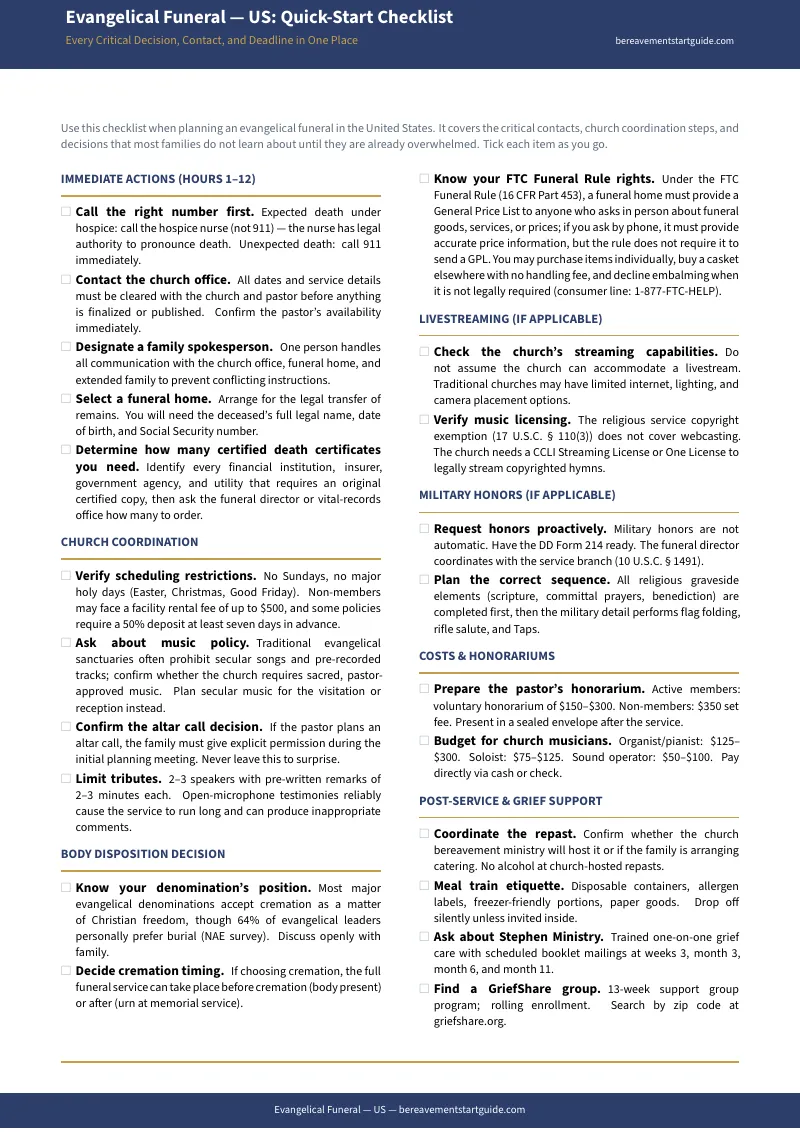
Download the free checklist for a one-page overview of the planning timeline, or get the complete toolkit for the full set of denominational blueprints, sanctuary negotiation guidance, cost breakdowns, livestreaming compliance, and printable worksheets — everything the coordinator needs from the first phone call to the final hymn.
Frequently Asked Questions
What if the rules change after I buy?
We update the guide when the rules change. Email us any time, even years later, and we'll send you the current edition free.