Everyone Expects You to Know What to Do. Nobody Taught You.
Your lola just passed. Within hours, someone asks whether the wake will be at home or in a chapel. Another relative wants to know how many nights the lamay will run. The funeral home is quoting packages you don't understand. Your tita insists you cannot sweep the floor, cannot take leftover food home, and cannot let anyone go straight back to their house after visiting — and if you get any of it wrong, something terrible will happen to the family.
You want to honor your lola the right way. But you grew up hearing fragments of these customs, not the full picture. And now you're supposed to orchestrate a multi-day vigil, nightly prayer sessions, a Catholic funeral Mass, a burial procession, and nine consecutive evenings of the pasiyam — while feeding a hundred people a day, tracking cash contributions in a registration book, and mediating between relatives who disagree about whether card games at the wake are respectful or disgraceful.
The free resources online are scattered across Reddit threads, funeral home marketing brochures, and parish handouts. None of them are complete. The Reddit threads argue. The brochures upsell. The parish handouts cover only the Mass and explicitly condemn the very superstitions your elders consider sacred. Trying to assemble a coherent plan from these fragments while grieving is exhausting, and the cost of getting it wrong — socially, financially, spiritually — is enormous.
The Cultural Bridge System
The Filipino Traditional Funeral Guide is a structured operational manual that bridges the gap between what your elders expect and what you actually know how to do. It treats Catholic liturgy and folk custom as complementary layers of the same tradition — not as contradictions to resolve — and gives you concrete scripts, timelines, budgets, and workarounds so you can honor every custom your family cares about without the panic of figuring it out in real time.
Where funeral home brochures sanitize the difficult parts and parish guides condemn the cultural ones, this guide presents everything — the pamahiin superstitions your lola follows, the Catholic rites your parish requires, the financial realities nobody talks about openly — in one place, organized by the order you'll actually need it.
What's Inside
- Hour-by-Hour First Response Timeline — the exact sequence from the moment of death through the first night of the lamay, so you know what to secure, whom to call, and which decisions can wait until morning (printable Funeral Planning Timeline)
- Multi-Day Wake Operations Guide — 24-hour vigil shift scheduling, nightly hospitality logistics for large rotating crowds, and crowd-feeding strategies that work within the no-takeout food taboo without creating massive waste
- Pamahiin Navigation System — every major funeral superstition cataloged with its cultural origin, what your elders believe will happen if it's violated, and a practical modern workaround for each one (the sweeping ban, pagpag detour, mirror covering, children-over-casket lift, rosary cutting, and more)
- Pasiyam Prayer Structure — complete nine-night novena framework with bilingual Tagalog-English prayer selections, nightly hosting logistics, and guidance for leading when no lay minister is available (printable Pasiyam Prayer Guide)
- Abuloy Management Kit — registration book setup, envelope etiquette, contribution tracking, and how to handle the sensitive math of abuloy totals versus actual funeral costs without creating family conflict (printable Abuloy Tracking Log)
- Funeral Cost Protection — two fully worked cost examples (a 5-day standard funeral totaling ₱298,500, and a ninth-night pasiyam feast at ₱25,500 for 80 guests), a line-by-line breakdown of daily wake overhead, and the specific questions to ask funeral homes (printable Vendor Contact and Comparison Sheet and Funeral Home Interview Questions)
- Mourning Attire Reference — dress code rules for immediate family and guests, barong Tagalog and Filipiniana guidelines for each stage (casual lumbia for nightly visits, formal long-sleeve for interment), mourning pin protocol, and why red is forbidden
- Gambling and Vigil Guide — the cultural role of mahjong, tong-its, and card games during the lamay, table-fee fundraising customs, and the real legal risks under municipal gambling ordinances so you can host or decline without guessing
- 40th-Day and Babang Luksa Protocols — the spiritual milestones after burial, how to host the memorial gatherings, the formal end-of-mourning transition, and what happens when family members disagree about when mourning should end
- Regional Variations Atlas — how traditions differ across Tagalog, Ilocano (including the atang food offering), Bicolano, Cebuano, and Mindanao communities, with the questions to ask your own elders to identify your family's specific branch
- Cremation and Repatriation Guide — current Catholic guidelines on cremation (permitted; ashes may not be scattered or kept at home), international transport logistics for remains or urns, and a printable Repatriation Paperwork Checklist for deaths in the US, Canada, Australia, or the UK
- Diaspora Adaptations — running a culturally authentic Filipino wake abroad when your apartment has no chapel, your HOA bans overnight visitors, and the local mortuary has never hosted a five-day open-casket vigil
Who This Guide Is For
- Filipino diaspora families organizing a funeral in the Philippines from abroad, or adapting traditional customs to a Western setting where the infrastructure was never designed for multi-day wakes
- Younger domestic executors in the Philippines suddenly designated as the primary planner for a parent or grandparent, navigating funeral home contracts, family financial disputes, and the dense web of pamahiin under extreme time pressure
- Non-Filipino spouses and partners who need to participate in or help organize a complex, multi-day wake and prayer cycle without native cultural instincts — and who cannot afford a single mistake that elders would interpret as disrespect
- Overseas Filipino workers (OFWs) funding and coordinating a funeral remotely while managing the emotional weight of being unable to attend in person
- Funeral directors and celebrants serving Filipino communities in multicultural settings who need an English-language operational reference for overnight vigils, folk customs, and Catholic liturgical integration
Why Free Resources Fall Short
Funeral home websites list packages and chapel tiers. They don't mention that hospitality alone averages ₱8,000 per day for food and beverages, that chapel rental typically runs ₱3,000–₱10,000 per day on top of the casket package, or which extras to strike before you sign.
Parish handouts cover the funeral Mass structure and prayers for the dead. They don't address the nightly lamay hospitality, the pasiyam organization when no lay minister volunteers, or the dozens of pamahiin customs that priests officially discourage but that your family considers non-negotiable.
Reddit threads and Facebook groups are raw and real — people sharing stories about family fights at the wake, debates about whether pagpag is legitimate, arguments about gambling at the vigil. But the information is unverified, contradictory, disorganized, and requires hours of scrolling during a crisis when you have minutes to make decisions.
This guide synthesizes all of it — the cultural, liturgical, logistical, and financial dimensions — into a single document you can download, print, and hand to every family member so everyone operates from the same page within ten minutes.
Satisfaction Guarantee
Full refund, no time limit. If the guide doesn't help your family navigate the process with more confidence and less chaos, email [email protected] and we'll refund your purchase. No questions, no time pressure.
Get Started
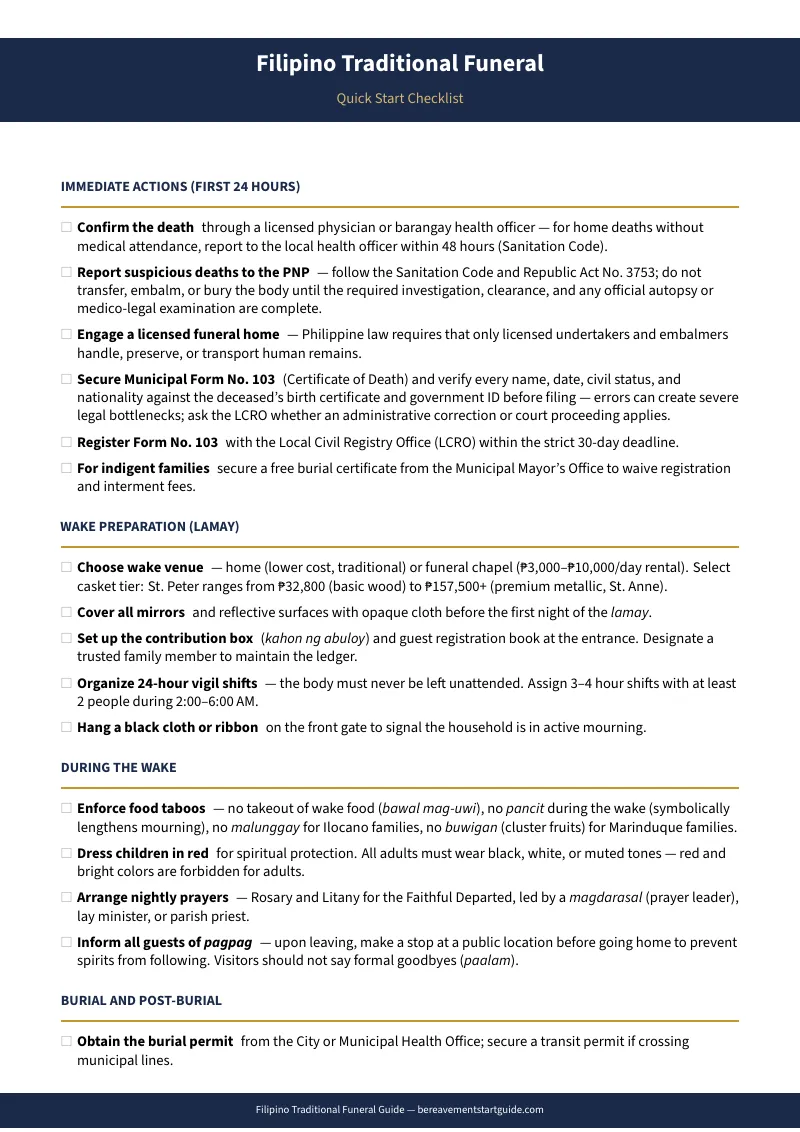
Download the free checklist for a task-by-task overview of the major stages from death through burial. When you're ready for the complete cultural, liturgical, and logistical guide — including the pamahiin workarounds, pasiyam prayer scripts, abuloy management tools, cost protection strategies, diaspora adaptations, and nine printable worksheets — get the full Filipino Traditional Funeral Guide for .