Your Elder Has Passed, the Band Office Is Closed, and the Hospital Wants an Answer About the Body Right Now — While You're Standing Three Provinces Away Trying to Remember Whether the Sacred Fire Has to Start Tonight or Tomorrow
Someone you love has died. Within hours, the hospital is asking whether to transfer the body to a funeral home or release it to the family. Your aunt in the home community says the sacred fire must be lit before nightfall. Your uncle says the body needs to be washed by family, not by the funeral home. The funeral director has never facilitated a smudge ceremony and keeps suggesting "the standard package" — embalming, a lined casket, and a viewing room that seats forty, not the two hundred who will come. You are trying to remember whether you need to call the band council or Indigenous Services Canada first, and whether the ISC funeral funding covers transport back to the reserve.
Funeral directors serve families from over 630 distinct First Nations across Canada, and the vast majority have no training in any of them. Band offices close at 4:30 PM and do not reopen on weekends. Elders carry irreplaceable ceremonial knowledge but do not track airline cargo requirements, provincial embalming timelines, or ISC application deadlines. Government portals explain estate administration under the Indian Act in language designed for lawyers, not for a grieving daughter who just wants to bring her mother home. No single source connects the ceremony to the paperwork to the money to the logistics.
The First Nations Canadian Funeral Guide is a complete Cultural Logistics Bridge built for the gap between your family's traditions and the Canadian systems that stand between your loss and the ceremony your loved one deserves. It maps the hospital discharge, the sacred fire, the body preparation, the transport, the funding applications, and the estate administration into one chronological sequence — so you know what to do, when, and who to call, from the first hour after death through the post-burial giveaway.
What's Inside the Cultural Logistics Bridge
A 14-chapter guide with checklists, planning worksheets, and communication scripts, plus a printable 24-item companion checklist — covering every logistical, administrative, and financial step specific to First Nations end-of-life planning in Canada:
Chapters 1–2: The First Hours — Hospital Release and Bedside Ceremony
How to request a bedside smudge under provincial health authority policies — including the smoke-free alternatives required near oxygen equipment, the 1.5-metre clearance from alcohol-based hand rub dispensers, and the proper disposal of sacred ashes (returned to bare soil, never the trash). The three body-release pathways: hospital, care facility, and coroner. How to notify ISC and your band council simultaneously, even if the office is closed.
Chapters 3–4: Jurisdiction and Estate Administration
The on-reserve versus off-reserve estate split under the Indian Act — when ISC's Estates Unit administers the estate versus when provincial probate applies. What happens when someone with Indian Status dies off-reserve but the family wants burial on ancestral territory. The specific documents the band council and ISC require, and the deadlines that most families miss because nobody explains them during the first week.
Chapters 5–6: Sacred Fire, Ceremony Logistics, and Tobacco Protocol
How to organize firekeeper rotations for a multi-day sacred fire — materials, site preparation, and the strict rules (no garbage, no cigarette butts, no water to extinguish, let it burn down naturally). How to prepare a traditional tobacco tie for inviting an Elder or Knowledge Keeper: the cloth, the tobacco, the left-hand presentation, and the spiritual contract that acceptance creates. What to offer Inuit Elders or Nations where tobacco is not part of the ceremonial tradition. How to secure drumming and singing permissions from designated song keepers.
Chapter 7: Body Preparation and Provincial Law
Embalming is not legally required in Canada — but provincial laws dictate that bodies not reaching their final site within 72 hours must be embalmed, refrigerated, or sealed. How families who prefer traditional washing and natural body preparation can work within these windows without being pressured into services they do not want. The specific questions to ask a funeral director to confirm they can accommodate community-led preparation.
Chapter 8: Transport and Repatriation
Full-body air cargo: the "known shipper" requirement (only a licensed funeral home can book airline cargo), hermetic sealing specifications, and domestic costs ranging from $3,000 to $6,000. Cremated remains: CATSA scan-friendly urn rules (wood, plastic, or cardboard — metal and ceramic will be rejected at the X-ray), Canada Post sift-proof packaging and signature-required shipping. Ground transport across provincial lines. Compassionate travel fares — including Air Inuit's 75% reduction for beneficiaries travelling to funerals outside their community, and national airline bereavement fare programs.
Chapters 9–10: Funeral Funding — Every Dollar Available
The ISC funeral program: eligibility criteria, application steps, and the transport coverage that can reach $10,000 for bringing a loved one back to home territory. Provincial burial and cremation supplements. The CPP death benefit (up to $5,000). Band council emergency funds. How to document expenses for reimbursement when the funeral happens before the funding is approved — because the ceremony cannot wait for a government timeline.
Chapters 11–12: Guest Etiquette, Syncretic Services, and Family Navigation
A printable etiquette reference for non-Indigenous attendees: appropriate dress (muted colours, modest clothing), the strict ban on cell phones, photography, and recording during sacred ceremonies, menstruation protocols observed in some Nations, and how to participate respectfully when the traditions are unfamiliar. A dedicated section on blending traditional Indigenous ceremonies with Christian or other religious elements — how to sequence the service so both traditions are honoured, with practical scripts for navigating family disagreements about which elements to include.
Chapters 13–14: Mourning Timelines, Giveaway, and Post-Burial
The multi-day mourning framework across Nations — four-day and five-day traditions, community feasts, the giveaway of the deceased's belongings, and the one-year memorial. How clan roles and community obligations structure the labour (grave-diggers, cooks, firekeepers, donations managers). The Carrier funeral potlatch budget framework — tracking payouts for dozens of designated workers when the total can reach $10,000. Post-burial estate steps under the Indian Act and provincial law.
Who This Guide Is For
- The urban relative who just lost a parent and has 48 hours to coordinate a traditional funeral on a reserve three provinces away — and needs to know exactly who to call, what to arrange, and which funding applications to file before the ceremony starts without them.
- The non-Indigenous spouse or in-law organizing a service for the first time — who is terrified of committing a cultural offence during the most sensitive days of the family's life and needs a clear, respectful reference for protocols, taboos, and appropriate participation.
- The estate executor navigating the Indian Act and provincial probate simultaneously — particularly when the deceased lived off-reserve but held band membership and the estate includes both on-reserve and off-reserve assets.
- The funeral director serving a First Nations family for the first time — who needs a concise reference on sacred fire logistics, smudging accommodations, traditional body preparation, and large-gathering requirements that mainstream training does not cover.
- The family trying to honour both traditional and Christian practices without conflict — who needs practical sequencing suggestions and communication scripts for navigating disagreements between conservative elders and younger relatives about what the service should include.
Why Free Resources Are Not Enough When Someone Has Just Died
Every institution referenced in this guide has a public website. ISC covers estate administration. Provincial health authorities cover palliative care policy. CATSA covers airport security rules. Band offices handle local burial logistics. Here is why the websites alone fail grieving families:
- No single source connects ceremony to paperwork to money to logistics. ISC handles estates and stops. FNHA handles palliative care and stops. The band office handles burial plots and stops. CATSA handles cargo rules and stops. A family following one agency's instructions to completion before starting the next misses deadlines, loses funding eligibility, and arrives at the ceremony without the body.
- Band offices operate on business hours; death does not. When a parent dies at 9 PM on a Friday, the band office reopens Monday morning. The hospital wants an answer about the body now. The family needs to know immediately whether they are dealing with ISC or provincial probate, what the body-handling timeline is, and who authorises burial on reserve land — and none of those answers are on a website that closes at 4:30.
- Government portals are written for administrators, not grieving families. The ISC Estates Unit documentation explains jurisdiction under Sections 42–50 of the Indian Act in language designed for lawyers and case officers. The family needs to know: "Do I call ISC or a provincial court?" — one sentence, not six pages of legislation.
- Mainstream funeral industry content treats Indigenous traditions as a checkbox. Funeral home websites offer "cultural accommodation" as a menu item alongside Hindu, Jewish, and Muslim services. They do not explain tobacco protocol, sacred fire logistics, body preparation preferences, guest etiquette, or the reality that two hundred community members will attend and the viewing room seats forty.
Free resources give you one institution at a time, with no cultural context, no funding roadmap, and no way to coordinate the ceremony, the law, and the logistics simultaneously. The Cultural Logistics Bridge maps every step into one chronological sequence — so you know what to do, when, and who to call, from the hospital to the giveaway.
— Less Than One Night's Accommodation While You Search for Answers
First Nations families lose money to the system every week — not because the funeral was extravagant, but because nobody told them what funding was available, what the funeral director was not required to charge for, or how to get the body home before the provincial timeline forced an unwanted embalming. A family approves embalming because the funeral director called it "standard" — when it is not legally required. A daughter misses the ISC transport benefit because she did not know the application existed until after she paid out of pocket. An executor navigates months of provincial probate when the estate should have been handled by ISC's Estates Unit. This guide costs less than any one of those mistakes.
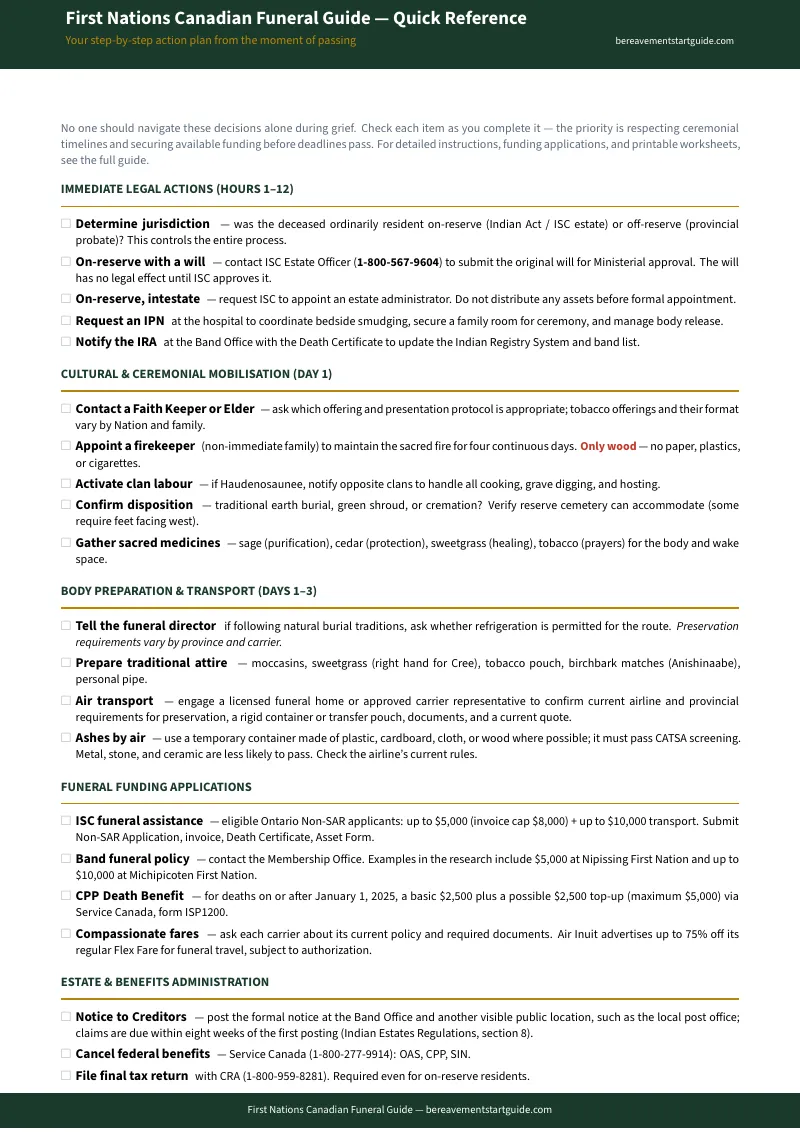
Your download includes the complete 14-chapter guide, the First Nations Canadian Funeral Checklist (24 priority actions), plus 6 standalone printable tools: a Firekeeper Rotation Schedule, a Funding Application Tracker, a Body Transport Planner, Funeral Director Question Scripts, a Ceremony Coordination Log, and a Guest Etiquette Handout — 8 PDFs total.
Full refund, no time limit. If the guide does not give you a clear path from the hospital to the ceremony to the estate settlement — covering jurisdiction, funding, transport, ceremony logistics, and guest etiquette — email hello@bereavementstartguide.com for a full refund. No questions asked.
Not ready for the full guide? Download the free First Nations Canadian Funeral Checklist — a two-page summary of the most urgent actions, funding deadlines, and logistics decisions that most families do not discover until the ceremony has already started without them.
You did not choose this loss. But you can choose to walk into every conversation — with the hospital, the funeral director, the band office, and ISC — knowing exactly what to ask, what to refuse, and what your family is entitled to. The guide gives you the protocols, the funding roadmap, and the logistical tools — so you can focus on honouring your loved one instead of fighting the system.