When Someone Who Converted Dies — And Two Families Want Two Different Funerals
Your parent converted to Islam twenty years ago. Now they've died, and the mosque community is preparing for Ghusl and burial within twenty-four hours — no embalming, no viewing, no open casket. Your Christian grandmother doesn't understand why she can't see her child one last time. Your aunt is calling a funeral home to arrange the viewing anyway. The hospital is asking who has legal authority to release the body. You have hours to figure this out, not days.
There's information available for Muslim funerals. There's information for Christian funerals. There's nothing that tells you what to do when the Muslim funeral and the Christian funeral are competing for the same body at the same time.
The Funeral for a Convert guide is a Dual-Tradition Navigation System — a structured planning framework that helps families move from a two-sided conflict over the body to a funeral that honors the deceased's chosen faith without permanently fracturing the family they were born into.
What Makes This Different from Free Resources
Mosque and synagogue websites give you detailed ritual instructions — for families who already share the faith. They don't explain how to tell a non-Muslim mother that embalming would violate her son's religious law, or how to help a Christian sister understand why she can't sit with the men during the Janazah prayer.
Funeral home sites provide generic checklists and pricing. They don't address the question of what happens when the person who holds legal authority over the body — usually the next of kin — belongs to the faith the deceased left behind.
Forum threads offer raw empathy from people who've been through it, but the advice is contradictory, legally unreliable, and impossible to organize into a plan when the funeral director needs answers by morning.
This guide fills the gap with a specific approach: structured sequencing and legal clarity. It establishes who has the lawful right to direct disposition, lays out each tradition's non-negotiable body preparation requirements, and provides mediation tools for the conversations that tend to break families apart — so you walk into the funeral home, the clergy meeting, and the family discussion with a framework, not a panic attack.
What's Inside the Guide
Legal authority over the body — jurisdiction by jurisdiction — the designated agent laws in the U.S. (California's funding requirement, New York's written instrument, Texas's notarized appointment, Michigan's 48-hour acceptance window), the UK common law framework where funeral wishes in a Will are advisory only, Canada's province-by-province executor rules, and Malaysia's dual Shariah-civil system where computerized registration as a Muslim convert gives religious authorities absolute control over the body regardless of the family's objections. This chapter prevents the single worst outcome: the body being embalmed, cremated, or claimed by the wrong authority before you've had time to think.
Body preparation rules across six traditions — Islamic Ghusl and Kafan (ritual washing by same-gender Muslims, white cotton shrouds, Qibla positioning), Jewish Taharah and Tachrichin (Chevra Kaddisha purification, Shomer vigil, all-wood casket without metal), Hindu Antyesti (the eldest son's fire ritual and ash immersion), Buddhist undisturbed consciousness protocols, the Christian embalming and viewing tradition, and the specific points where each practice physically contradicts another. When you understand why the imam refuses embalming — not just that they do — you can explain it to the birth family without it sounding arbitrary.
Timeline collision resolution with a worked example — Islam and Judaism require burial as soon as possible, typically within twenty-four hours. Christian and secular traditions plan around multi-day viewings and travel logistics. Buddhist practice calls for the body to remain completely undisturbed for hours after death. The guide walks through a realistic worked example — a Muslim convert from a Christian family — showing how to sequence events so the chosen-faith community's timeline requirements are met while the birth family still gets a meaningful gathering.
Three service structure models — the parallel rites approach (two sequential ceremonies, each tradition receiving its own complete block), the shared-space liturgical blend (when it works and when it backfires), and the memorial-only model for families who cannot agree on a single service format. Includes inclusive language frameworks so that shared-space elements don't accidentally violate either tradition's theological boundaries.
Prayers, music, and liturgical elements across traditions — the key funeral prayers for Islamic, Jewish, Hindu, and Buddhist services, what non-adherent family members may and may not participate in (such as the Halakhic restrictions on observant Jews entering a church sanctuary), and non-dogmatic readings and symbolic actions that work across faiths.
Family mediation tools for the conversations that fracture families — the neutral mediator appointment protocol, the Zabla (rabbinic-style arbitration) system, chaplaincy mediation pathways, an active listening protocol for mediators, and word-for-word de-escalation scripts for the flashpoints that trigger permanent estrangement: burial versus cremation disagreements, fights over who performs the ritual washing, disputes about the obituary name (legal name, childhood name, or spiritual name), and the moment when an elder demands that the funeral "correct" the conversion.
Mourning customs and the convert's dilemma — the Islamic Hidad (three-day condolence period and the widow's four-month Iddah), Jewish Shiva through Yahrzeit, Hindu Sutaka and Shraddha cycles, Buddhist 49-day transition observances, and the specific question that haunts every convert's family: what are the rules for mourning a birth-faith parent under the adopted tradition? The guide addresses this directly, including the rabbinic guidance on converts reciting Kaddish for a non-Jewish parent.
Dress, food, seating, and guest etiquette — tradition-specific dress codes (head coverings, modesty standards, color norms), gender segregation and physical contact rules, condolence language and gifting protocols, and dietary planning for dual-tradition receptions where one side requires halal or kosher catering.
Estate planning traps that catch converts' families — Malaysia's Shariah inheritance default that routes a Muslim convert's entire estate to the Baitulmal (Islamic treasury) if no Muslim heirs exist, the Jewish Halachic Will and its relationship to civil estate law, and worked examples showing how to structure trusts, beneficiary designations, and inter vivos gifts to protect non-Muslim family members from losing their inheritance.
Advance planning documents — the disposition directive, advance health care directive, pre-need funeral contract, identity-affirming deathcare directives, and a document storage and access plan. These are the instruments that prevent the statutory next-of-kin hierarchy from delivering the body to people whose traditions the convert left behind — and the guide explains why a Will alone is not enough.
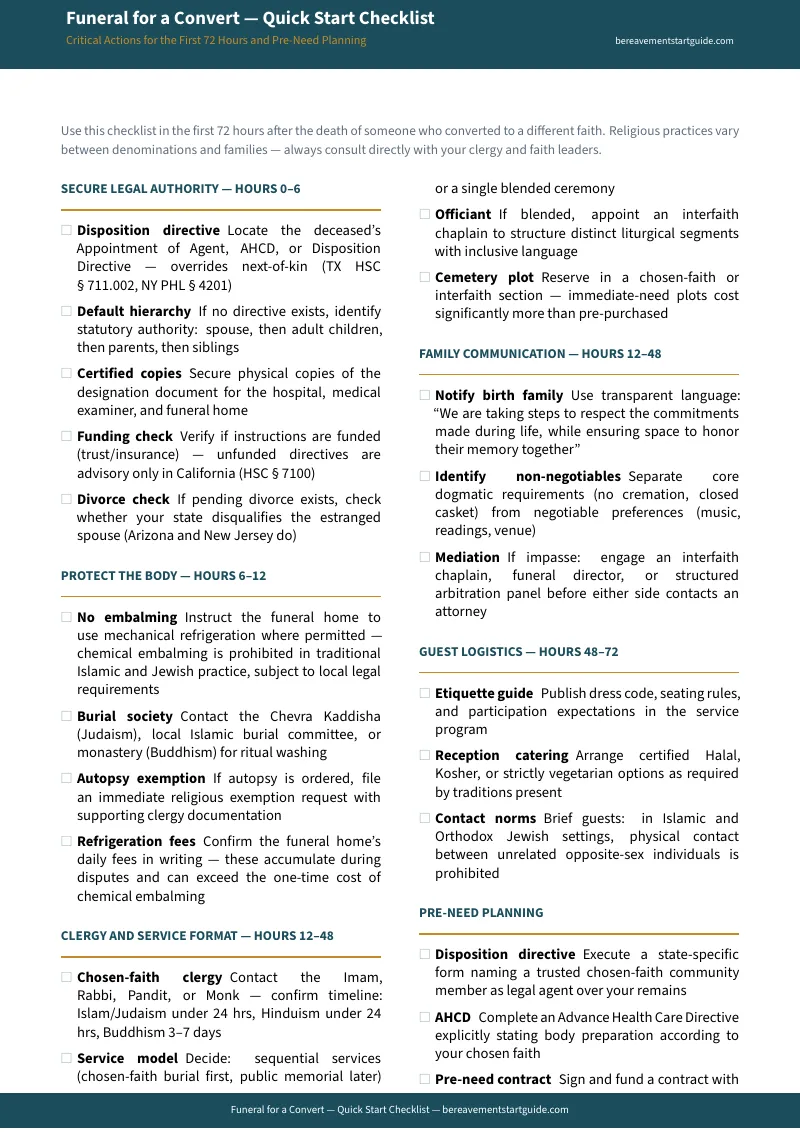
24-item printable checklist — with decision points, timeline markers, and contact prompts. Designed to be printed and brought to your first meeting with the funeral director, the clergy, or the family.
Who This Guide Is For
- Adult children whose parent converted and whose birth-family elders view the funeral as their last opportunity to reclaim the person they lost to conversion
- Interfaith spouses facing a chosen-faith community that expects full religious rites and a birth-family that sees the conversion as a betrayal that death should finally undo
- Siblings divided along religious lines, where the disagreement over the funeral is a proxy for every unresolved tension the conversion created
- Executors and designated agents who hold legal authority but lack the theological vocabulary to evaluate competing claims from religious communities
- Chosen-faith community members and close friends who may be the only people advocating for the deceased's actual wishes
- Funeral directors, celebrants, and chaplains handling the specific scenario where a convert's dual identity creates conflicts that single-faith manuals don't cover
Why Free Tools Fall Short
Clergy websites and congregational guides provide excellent instructions for their own tradition — and nothing at all for the family members who don't share it. They tell you how to perform Ghusl, but not how to explain to a Christian mother why she can't see her child's body before burial. They tell you the rules for sitting Shiva, but not whether a convert should sit for a non-Jewish parent.
Funeral home websites offer checklists designed to sell a service package. They avoid the conversations that actually determine whether the funeral preserves the family or destroys it.
Reddit and forum threads are where the raw pain lives — real converts, real families, real crises. But the advice is unverified, the legal information varies by jurisdiction, and you can't hand a funeral director a Reddit thread and expect a plan.
The Dual-Tradition Navigation System fills the space between these sources: verified legal frameworks, faith-by-faith ritual requirements, structured mediation tools, and printable planning documents — independent of any funeral home, religious institution, or commercial interest.
Our Guarantee
If the guide doesn't help you navigate your family's situation, email hello@bereavementstartguide.com for a full refund, no time limit. No forms, no conditions. We read every message.
Start Planning
Download the free checklist to get the 24 critical action items with timing and decision points — or get the full Funeral for a Convert — Navigating Two Traditions kit — a 44-page guide plus 5 printable planning tools: the dual-tradition decision matrix, clergy consultation question list, family communication scripts, advance directive preparation worksheet, and cost comparison worksheet.
Two traditions don't have to mean two funerals. This guide gives you the framework to honor both — and keep your family intact on the other side.