When Your Family Doesn't Share One Faith — and You Have Days to Plan a Funeral
Your mother-in-law wants a Catholic Mass. Your brother converted to Islam and insists on burial within twenty-four hours. Your father was Jewish, and his sister says embalming would dishonor everything he believed. You're somewhere in the middle — grieving, exhausted, and Googling "can two clergy co-officiate a funeral" at midnight.
Every religion has funeral guides. None of them tell you what to do when your family spans several of them.
The Interfaith Funeral Planning Guide is a Conflict-to-Ceremony Framework — a structured planning system that helps multi-faith families move from disagreement to a service that honors every tradition, within the tight timeline that grief and religious law demand.
What Makes This Different from Free Resources
Free funeral planning checklists tell you what to arrange. Church websites tell you their rules. Forum threads give you conflicting advice from strangers. None of them solve the core problem: how do you build a single service when the traditions involved disagree on body handling, timeline, ceremony structure, and who's allowed at the altar?
This guide solves that problem with a specific method — sequencing over blending. Instead of trying to merge rituals into a diluted ceremony that satisfies no one, the framework shows you how to give each tradition its own intact block within the service. The result is a ceremony where every family member sees their faith respected, not compromised.
What's Inside the Guide
The faith-by-faith body handling reference — who performs ritual washing (Jewish Taharah, Islamic Ghusl, Hindu bathing), which traditions strictly prohibit embalming and why, casket versus shroud norms by faith, and the specific conditions under which cremation is permitted, forbidden, or required. This is the section that prevents the single most common interfaith funeral mistake: assuming one tradition's preparation practices are universal.
Clergy boundary maps — Catholic canon law permits a non-Catholic minister to read scripture at a vigil or committal, but bars them from presiding at the funeral Mass. Reform Judaism allows non-Jewish spouse burial in Jewish cemeteries under specific conditions. Islamic jurisprudence prohibits participation in prayers from other theological traditions. The guide lays out these boundaries for every major faith so you know what to propose before you contact clergy — not after you've already been turned down.
Timeline collision resolution — Islam and Orthodox Judaism mandate burial within twenty-four to forty-eight hours. Christian traditions plan around multi-day viewings. Diaspora relatives may need several days of international travel. The guide shows you realistic compromises — including private immediate burial followed by a broader memorial service — so you stop trying to force incompatible timelines into one event.
The Non-Negotiable Worksheet — a structured exercise where each family faction names their single most important ritual element. When everyone has one non-negotiable on the table, you can see where the true conflicts are and where there's more flexibility than anyone expected. Families who use this before their first planning meeting report dramatically fewer arguments during the process.
De-escalation scripts for the five worst flashpoints — burial versus cremation disagreements, elder disapproval of secular elements, sibling conflict over remains handling, in-law boundary negotiations, and disagreements about who gets to officiate. These aren't theories about communication — they're word-for-word conversation frameworks tested against the specific emotional dynamics of interfaith funeral disputes.
Two fully worked cost analyses — a traditional funeral home service and a green burial alternative, broken down line by line. The guide teaches you how to read the General Price List that funeral homes are legally required to provide under the FTC Funeral Rule, which charges are truly non-declinable, where embalming can be replaced by refrigeration, and how casket pricing works. The average traditional funeral costs between $7,000 and $12,000 — families who understand these dynamics before their first meeting with the funeral director routinely avoid thousands in unnecessary charges.
Universal readings and symbolic actions — a curated collection of non-dogmatic poetry, interfaith-safe scripture passages, and symbolic gestures (candle-lighting, water-pouring, silent reflection) that offer genuine comfort across traditions without crossing any clergy boundary.
Diaspora logistics guide — death certificate timelines by jurisdiction, international transport permits, consular notification requirements, and cross-timezone coordination when rapid burial traditions collide with long-haul travel realities.
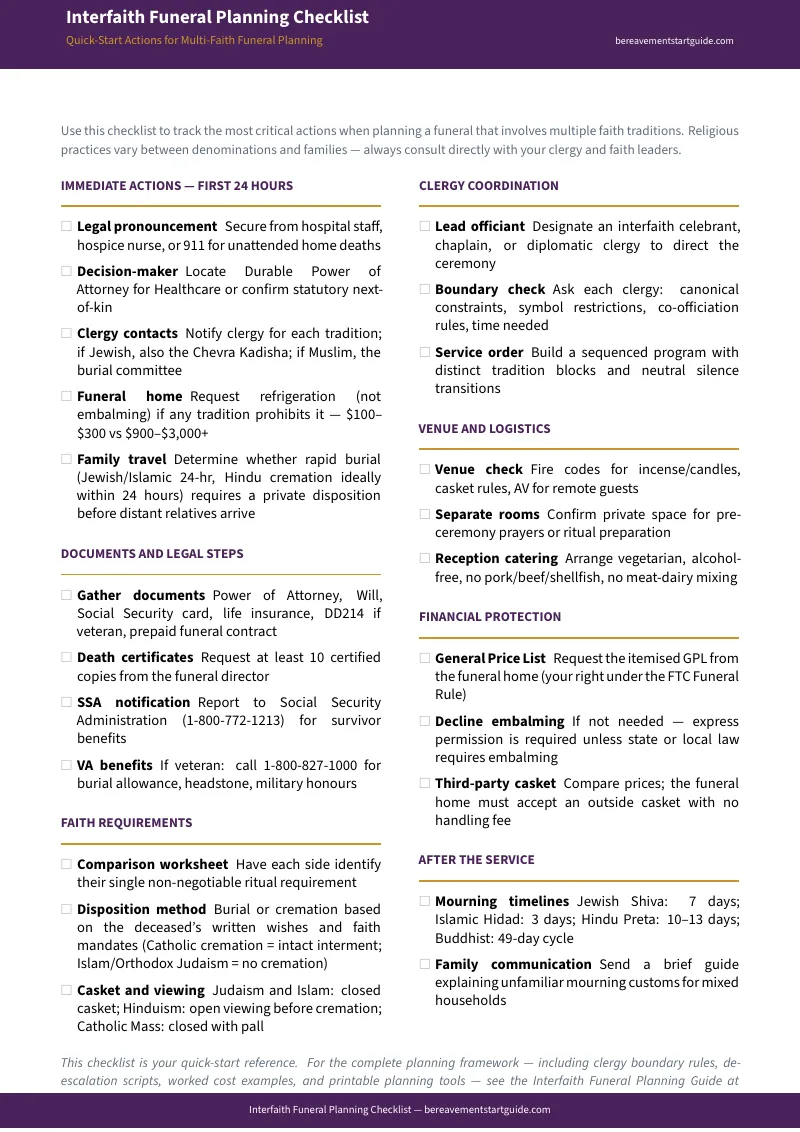
23-item printable checklist — with decision points, timeline markers, and contact prompts. Designed to be printed and brought to your first meeting with the funeral director or clergy.
Six standalone fillable worksheets — the non-negotiable mapping worksheet (one row per family faction), a clergy coordination form for each officiant, a venue evaluation scoring sheet, a funeral cost comparison grid mirroring the General Price List, a family communication log for recording every decision, and printable de-escalation script cards for the five worst flashpoints. Each worksheet is a separate PDF — print only the ones you need for the meeting you're walking into.
Who This Guide Is For
- Adult children who are less religiously observant than their parents and need to organize a service that satisfies elders on both sides
- Interfaith spouses navigating a partner's funeral traditions with in-laws for the first time
- Sibling groups where each person has a different level of observance or has converted to a different faith
- Executors and next of kin who need a neutral, unbiased reference for coordinating logistics across competing expectations
- Diaspora relatives coordinating across countries, legal jurisdictions, and time zones under urgent burial deadlines
- Funeral directors and celebrants looking for a cross-faith ceremonial reference that goes beyond single-tradition manuals
Why Free Tools Fall Short
Funeral home websites give you checklists designed to guide you toward their chapel, their caskets, and their pre-paid plans. They don't explain how to handle the moment your brother refuses to enter the church, or why the imam declined to participate in the prayer service.
Church, synagogue, and mosque websites are designed to preserve the purity of their specific tradition. They provide excellent guidance for families who share that faith — and nothing at all for families who don't.
Forum threads offer real empathy from real people, but the advice is unverified, disorganized, and impossible to turn into a planning document at 2 a.m. when the funeral director needs answers by morning.
The Conflict-to-Ceremony Framework fills the space between these sources: verified religious requirements, structured compromise tools, and printable planning documents — independent of any funeral home, religious institution, or commercial interest.
Our Guarantee
If the guide doesn't help you navigate your family's situation, email hello@bereavementstartguide.com for a full refund, no time limit. No forms, no conditions. We read every message.
Start Planning
Download the free checklist to get the 23 critical action items with timing and decision points — or get the full Interfaith Funeral Planning Guide with the Conflict-to-Ceremony Framework, de-escalation scripts, cost analyses, six standalone fillable worksheets, and the complete faith-by-faith reference.
Every family is different. This guide gives you the tools to design a service that fits yours — without compromising anyone's faith or your own sanity.