Your Family's Traditions Aren't "One Size Fits All" — and Neither Is This Guide
When a Persian parent or grandparent dies in the diaspora, the person who steps forward to plan the funeral faces a problem that no generic checklist can solve. Iranian heritage spans five distinct religious traditions — Shia Islam, Zoroastrianism, the Baha'i Faith, Persian Judaism, and secular cultural practice — and each one carries its own mandatory body-handling rules, its own burial timeline, its own prayers, and its own definition of what constitutes a respectful farewell.
The second-generation adult child suddenly in charge often knows the traditions matter but not the specifics. They know burial should be fast — but not whether "fast" means twelve hours or forty-eight depending on the denomination. They know halva is served — but not how to prepare it while simultaneously coordinating a same-sex ritual washer with a funeral home that has never heard of a mordeh shoor. They know the family expects a chehelom on the fortieth day — but not how to host sixty people in a two-bedroom apartment in Los Angeles.
Getting it wrong is not just an organizational failure. In a culture built on taarof and deep communal obligation, a mishandled funeral creates rifts that last for years.
The Five-Tradition Planning Framework
The Iranian/Persian Funeral Customs Guide is the only resource that covers all five major Persian bereavement traditions in a single, structured document — not as a shallow overview, but as a complete planning companion with side-by-side comparison tables, tradition-specific protocols, and printable worksheets.
Instead of spending hours piecing together fragments from mosque websites, Reddit threads, Baha'i FAQs, and funeral home brochures — fragments that frequently contradict each other — you download one guide and hand it to every family member so everyone operates from the same information.
What's Inside
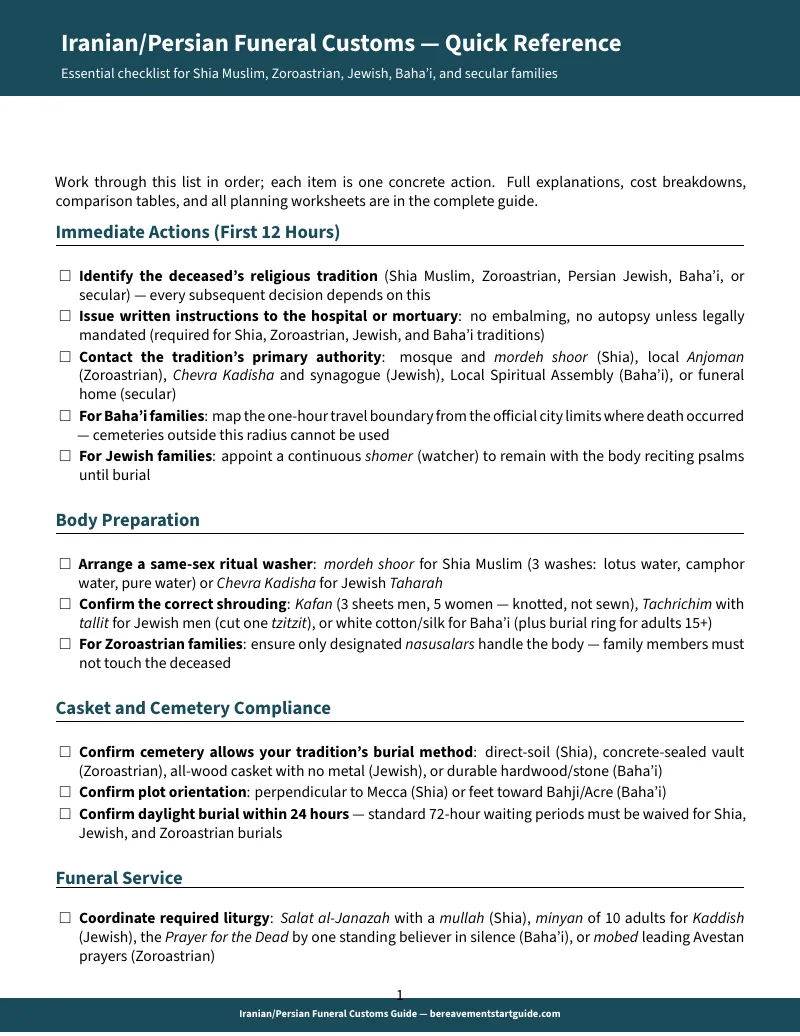
- First-hours emergency protocols for each tradition — exactly who to call, what to tell the hospital to prevent unauthorized embalming, and the specific burial windows you cannot miss (the Baha'i one-hour travel limit alone has caught families off guard when a pre-purchased plot turns out to be outside the boundary)
- Ritual body preparation, step by step — the three-stage Shia ghusl with lotus, camphor, and pure water; the Zoroastrian nasusalar purity system; the Jewish Tahara washing and Tachrichim shrouding by the Chevra Kadisha; the Baha'i shroud and burial ring inscription; and the exact language to use with a Western mortuary that has never handled these procedures
- Burial rules and casket compliance charts — direct-soil facing Mecca (Shia), concrete-sealed vaults (Zoroastrian), unadorned all-wood with no metal (Jewish), durable hardwood or stone (Baha'i), and why getting the wrong casket means the cemetery rejects the burial on the day of the funeral
- Prayers and liturgy with phonetic transliterations — the Salat al-Janazah, Avestan prayers, the Mourner's Kaddish, and the Baha'i congregational Prayer for the Dead, each with side-by-side English translations for family members who read English more fluently than their liturgical language
- The complete mourning calendar — Sevom (day 3), Haftom (day 7), Chehelom (day 40), and Sal (one year) for Shia and secular families; the seven-day Shiva, Shloshim, and the Sal Dar Overi henna ceremony for Persian Jewish families; the three-day Sedosh and multi-decade remembrance cycle for Zoroastrians
- Consolation food preparation and hosting logistics — saffron halva, walnut-stuffed dates, nazri charitable food distribution, the Jewish Seudat Havra'ah first-meal protocol with kuku sabzi, and the practical math of feeding sixty to a hundred mourners across multiple memorial gatherings
- Cross-tradition dress codes — black for Shia, white for Zoroastrian, dark modest with kippah for Jewish, no restriction for Baha'i — plus headscarf and modesty guidance for non-Persian guests attending for the first time
- Funeral home coordination scripts — printable question sheets for explaining same-sex washing, rapid burial timelines, embalming refusals, and denomination-specific casket requirements to funeral directors who are working with a Persian family for the first time
- Diaspora adaptation strategies — hosting traditional mourning gatherings in modern apartments, virtual Chehelom coordination with relatives in Tehran, the sofreh-ye tarhim memorial table setup, and elegant hybrid formats that blend secular poetry with selective religious elements for interfaith families
- Common mistakes that cause lasting damage — the five most frequent diaspora errors, from failing to prevent automatic embalming to misidentifying the family's denomination to breaking Zoroastrian purity boundaries, with the specific corrective action for each
- Six printable planning worksheets — the Immediate-Action Checklist, a Funeral Home Question Sheet, a Mourning Timeline Tracker, an Elder Interview Sheet for capturing family-specific customs, a Food and Hosting Planner, and an Agency Communication Log
Who This Guide Is For
- Second-generation diaspora families organizing a parent's funeral in the US, Canada, UK, or Australia — who grew up knowing the traditions matter but never learned the operational details
- Interfaith spouses and in-laws supporting a grieving partner through Persian bereavement customs they have never encountered and need to navigate without offending the family
- Secularized Persian families who want to honor their heritage through poetry, music, and traditional foods without committing to a fully religious service — and need a framework for building a hybrid ceremony that both generations accept
- Funeral directors and celebrants serving Persian families in cities with large Iranian populations who need a reliable reference for five different sets of body-handling laws, casket rules, and memorial customs
- Guests attending a Persian funeral who want to know what to wear, what to bring, what to say, and what behaviors to avoid — without having to ask the grieving family
Why Free Resources Fall Short
The mosque website explains Shia ghusl but says nothing about what happens when the deceased's Zoroastrian son-in-law objects to Islamic rites. The Baha'i FAQ covers burial laws but not the Persian cultural expectations that surround a Baha'i funeral. Reddit threads offer sincere advice — but it is unverified, disorganized, and impossible to hand to your aunt in a crisis. Funeral home brochures handle body logistics but leave you on your own for the multi-day home hosting, the mourning food preparation, the taarof etiquette, and the forty-day memorial calendar.
The information exists in fragments scattered across five different religious communities, dozens of cultural websites, and hundreds of forum posts — none of them organized, none of them cross-referenced, and none of them written for the person who has twelve hours to figure this out.
This guide puts all five traditions in one structured document with comparison tables that show exactly where customs align and where they diverge, so you can plan with confidence instead of guessing.
Full Refund, No Time Limit
If the guide does not help you plan the funeral with clarity and confidence, email [email protected] for a full refund — no time limit, no questions, no conditions.
Get Started Now
Download the free Quick Reference Checklist to see the essential action items across all five traditions — or get the full 49-page guide with detailed rituals, comparison tables, funeral-home scripts, and six printable planning worksheets for .