The cremation window is 24 hours. There is no clergy to manage it. The family handles everything.
When a Jain family member dies, the sequence that follows is governed by principles most Western institutions have never encountered. Chemical embalming is rejected on grounds of ahimsa. Fresh flowers are prohibited — cutting a living plant is an act of violence. The cremation must happen during daylight hours to avoid killing nocturnal insects with the pyre's heat. And every step from body washing to ash disposal must honor both Jain doctrine and a secular legal system that was not designed for any of it.
If you are coordinating this from outside India — without a local Sangh, without an elder who has done this before, without any written manual — you are making irreversible decisions under extreme time pressure with incomplete information. The funeral director does not know Jain customs. The well-meaning Hindu relatives are suggesting rituals your tradition explicitly rejects. And the crematorium operates on a multi-day backlog that conflicts with your 24-hour obligation.
The Ahimsa Funeral Framework
The Jain Funeral Guide is a structured operational reference — built to coordinate the Jain spiritual process with the Western legal and logistical system, so nothing falls through the gap during the most compressed funeral timeline in any major religious tradition.
The guide maps the full cycle from the moment of death through the Sog Utaarvaanu ceremony, with parallel tracks for the ritual sequence (managed by the family and Sangh volunteers) and the legal process (death certificates, cremation permits, coroner releases). Where those tracks collide — embalming decisions, body release from hospitals, crematorium scheduling — the guide provides the exact scripts, reference tables, and regulatory citations you need to resolve the conflict without violating ahimsa.
What's Inside
- 24-Hour Cremation Timeline — hour-by-hour benchmarks from the moment of death through the cremation, calibrated for diaspora families dealing with coroner holds, hospital release paperwork, and crematorium scheduling backlogs. You know what should be happening at each stage, who is responsible, and where the common delays occur.
- Ahimsa-Compliant Body Preparation — the complete non-violent preparation ritual: damp-cloth washing, sandalwood paste application, white cotton shroud dressing, and the explicit instructions for declining chemical embalming with legal backing. Separate protocols for family-directed preparation and funeral-home-managed preparation.
- Svetambara and Digambara Customs Side by Side — where the two major sects diverge (pearl and gold placement, women's presence at cremation, post-cremation ash handling), the guide provides both variants with the theological reasoning behind each. Subsect coverage includes Deravasi, Sthanakavasi, and Terapanthi traditions.
- Funeral Director Communication Scripts — pre-written emails and phone scripts for requesting no-embalming, mechanical refrigeration, simple biodegradable caskets, and viewing access for the Viddhi ceremony. Grounded in the FTC Funeral Rule so you can decline unnecessary services with regulatory authority, not just religious preference.
- Prarthana Sabha Planning Guide — step-by-step setup for the prayer assembly: venue selection, sound system, seating arrangement, photograph display protocol, donation box setup, and songbook distribution. Includes the Navkar Mantra and Kshamaapanaa Sutra with transliterations and plain-language explanations.
- Chaas Pivanu Meal Coordination — the strict dietary rules governing the post-cremation communal meal: no root vegetables, no garlic or onion, no after-sunset serving. Includes catering coordination templates and scripts for explaining restrictions to non-Jain caterers.
- Five Standalone Worksheets — printable planning tools: Funeral Timeline Tracker, Prarthana Sabha Planning Worksheet, Ritual Kit Checklist (Viddhi Kit, Sabha Kit, Cremation Kit), Funeral Director Communication Log, and Roles and Responsibilities Worksheet. Designed for letter-size paper so you can bring them to the funeral home, the Sangh meeting, or the crematorium.
Who It's For
Diaspora families without a local Sangh — you live in a city where there is no Jain temple, no community elder, and no one who has managed these rites before. When your parent or grandparent passes, this guide replaces the missing guidance with step-by-step instructions aligned with JAINA and Vanik Council standards.
Second-generation children and interfaith spouses — you understand that Jain funerals reject flowers, reject embalming, and reject Hindu-origin practices like shraddh and pind daan, but you do not know how to execute each step, navigate the sectarian differences, or explain these restrictions to confused relatives and well-meaning non-Jain friends who want to send wreaths.
Funeral directors and death-care professionals — you need a certified reference for declining chemical embalming under the FTC Funeral Rule, accepting third-party biodegradable caskets, accommodating the deevo lamp, and setting up a dignified space for communal chanting — without conflating Jain customs with Hindu ones, a mistake that damages community trust.
Why Free Resources Fall Short
The information exists — scattered across JAINA PDFs from 2004, Vanik Council web pages, forum threads on Reddit, and funeral home websites that conflate Jain rites with Hindu ones. The problem is not scarcity. It is fragmentation, contradiction, and the conflation of Jainism with Hinduism that pervades almost every Western funeral-industry resource.
Temple Sangh leaders are invaluable on ritual specifics, but their availability is inconsistent and they rarely address secular regulatory requirements. Sectarian organizations publish liturgical references, but they assume familiarity with Prakrit texts and do not reconcile Svetambara and Digambara differences in a single document. Commercial funeral home websites that offer "South Asian packages" routinely suggest Tulsi leaves in the mouth and Ganga Jal — practices that orthodox Jain families explicitly reject.
The guide brings all three sources — ritual, legal, and logistical — into a single reference organized by timeline, so you can act decisively in a situation where every hour of delay generates the very harm your tradition exists to prevent.
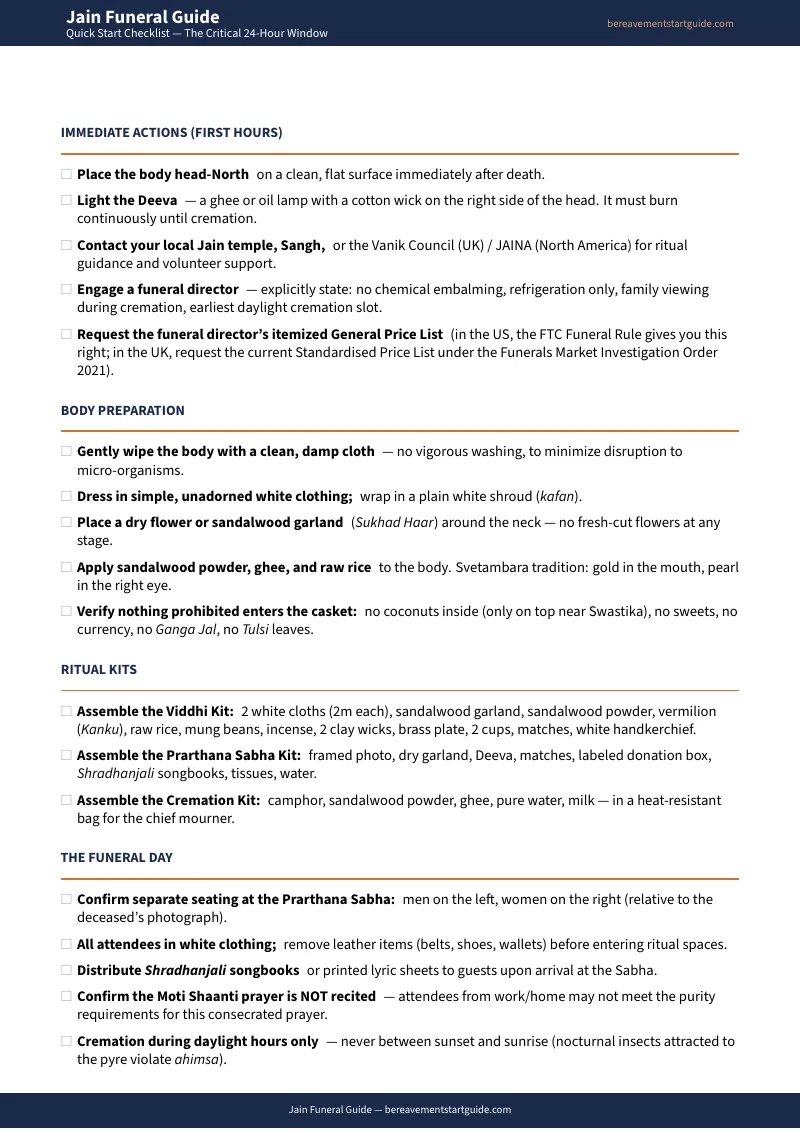
Start with the free checklist, or get the full guide
The free checklist covers the essential actions across every phase of a Jain funeral — from the immediate post-death steps through the post-cremation mourning period. It tells you what to do.
The full guide tells you how — with the sect-specific customs, the funeral director scripts, the Prarthana Sabha planning worksheets, the dietary rules for the Chaas Pivanu, and the legal citations that turn a compressed, high-stakes timeline into a sequence your family can manage with confidence. Get the full Jain Funeral Guide →
Both options include a satisfaction guarantee. If the guide does not give you the clarity you need, email us and we will make it right.