You have 72 hours. Every decision is yours.
Someone in your family just died — or will soon — and you are the one making the calls. The rabbi's office needs your answer on body preparation by tomorrow morning. Your Orthodox uncle is insisting on tahara. Your non-Jewish spouse doesn't know whether they're allowed to speak at the service. And you haven't been to temple since your bat mitzvah.
Reform Judaism respects your right to choose. But right now, in grief, that freedom means you're carrying every decision that Orthodox families never have to make: cremation or burial, traditional shrouds or personal clothing, seven days of shiva or one evening, Hebrew prayers or English readings — all of it, fast, while your family watches.
The Reform Funeral Decision System
This is not a theology textbook repackaged as a checklist. The Jewish Reform Funeral & Mourning Guide is a structured decision system that maps every choice you face — from the moment of death to the unveiling a year later — onto the specific practices, timelines, and options that Reform congregations actually follow.
Where synagogue pamphlets assume you're a dues-paying member with clergy on speed dial, this guide assumes you might be navigating all of this for the first time with no congregation at all. Where funeral home websites walk you toward a sales conversation, this guide explains your rights under the FTC Funeral Rule and tells you exactly which services are optional. And where academic books like Lamm's The Jewish Way in Death and Mourning default to Orthodox halakha, every page here reflects the CCAR's responsa and the lived practice of Reform communities.
What's Inside
- 72-Hour Planning Timeline — a decision-by-decision roadmap from the first phone call through the graveside service, because "handle the funeral arrangements" is not a plan
- Body Preparation Decision Tree — tahara, simplified washing, or no preparation at all; cremation, green burial, aquamation, and traditional interment; when each option is available and what to tell the funeral home
- Complete Funeral Liturgy — Psalm 23, El Malei Rachamim, and the Mourner's Kaddish with Hebrew text, phonetic transliteration, and English translation side by side, so everyone in the room can follow along
- Interfaith Participation Guidelines — exactly what non-Jewish spouses, children, and friends can do at the funeral, the shiva, and every mourning observance, based on CCAR guidelines rather than your uncle's opinion
- Shiva Host Coordinator — visiting hours, meal coordination, the hand-washing station setup, and a clear explanation of what guests should and should not do, so your friends can run the house while you grieve
- FTC Consumer Rights Section — which funeral home charges are legally required and which are not, what the Funeral Rule actually says about embalming, and how to ask for an itemized price list without feeling adversarial
- Full Year of Mourning Calendar — aninut, shiva, shloshim, and yahrzeit explained with Reform-specific guidance on duration, restrictions, and memorial observances including Yizkor services
Who It's For
This guide was written for families where Jewish identity runs deep but ritual knowledge doesn't — and for the people who step in to help them.
- Adult children who need to honor a parent's heritage without pretending to be more observant than they are
- Interfaith spouses navigating an unfamiliar religious system under time pressure, with family members expecting them to get it right
- Close friends and extended family handling the logistics — food, visitors, notifications — so the mourners can focus on grief
- Remote relatives and executors coordinating arrangements from another state or country within Reform's 72-hour window
- Independent funeral planners and celebrants who need a reliable reference to avoid cultural missteps when working with a Reform Jewish family
Why Not Piece It Together for Free?
You can find fragments of this information scattered across synagogue PDFs, funeral home FAQs, Reddit threads, and a few academic books. The problem is not access — it's assembly. Each synagogue guide assumes you're a member of that specific congregation. Each funeral home FAQ steers you toward their services. Reddit threads give you ten conflicting opinions on whether cremation "counts." And the academic books were written for Orthodox practice with no Reform-specific guidance.
Assembling all of those fragments into a coherent plan takes hours you do not have. The burial is in two days. Your family is arriving tomorrow. And you still don't know whether the cemetery will accept an urn next to a non-Jewish spouse.
This guide gives you one structured resource that answers every question from one consistent Reform perspective, in the order you'll need the answers.
What You Get
Your purchase includes 10 files, ready for immediate download:
- The Complete Guide — 53 pages covering 15 chapters, from aninut through yahrzeit, with worked examples, comparison tables, and Hebrew/English liturgy
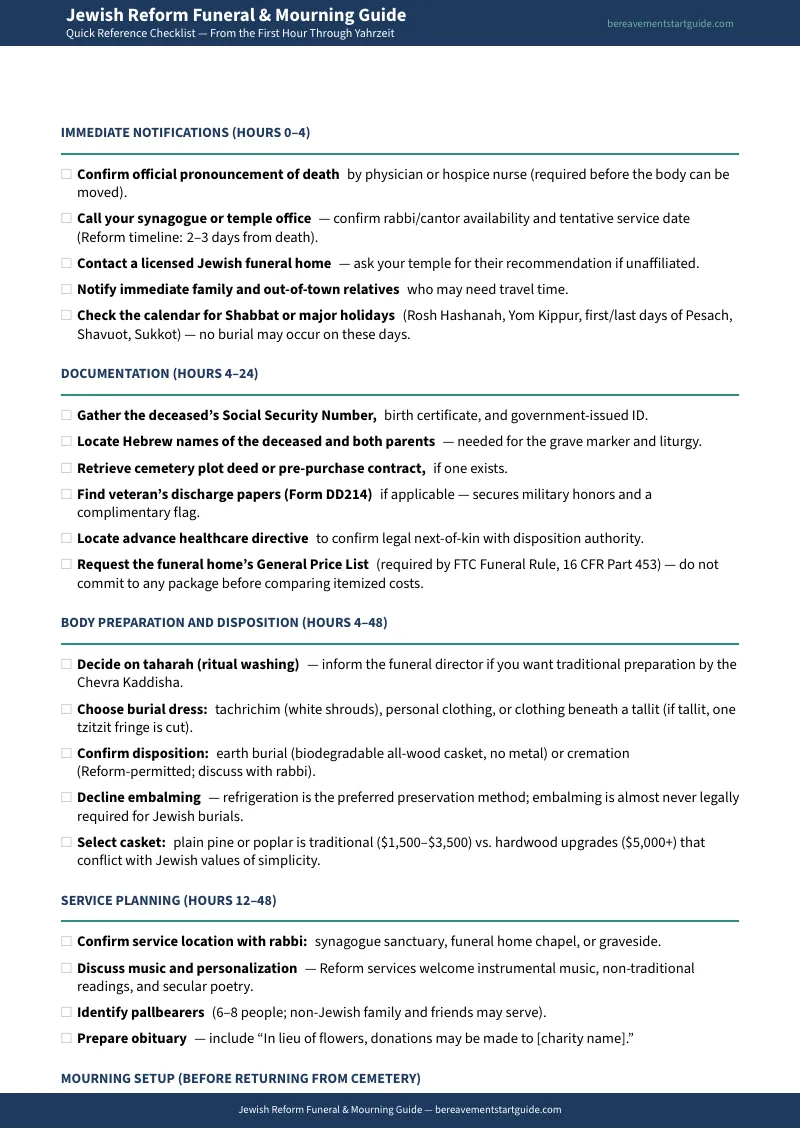
- The Mourning Phase Checklist — a printable 2-page reference covering all 24 action items across the five mourning phases, designed to be kept at your side during the first 72 hours and beyond
- 72-Hour Planning Timeline — a fill-in timeline from the first phone call through the graveside service, with checkboxes and space to record when each action was completed
- Funeral Wishes Worksheet — record burial preferences, service choices, and notification contacts before they become urgent decisions
- Vendor Comparison Worksheet — side-by-side comparison of funeral home quotes, with line items matching the FTC's General Price List categories
- Shiva Host Coordinator — hand this to the friend running your shiva: meal coordination, setup checklist, guest reminders, and visiting hours tracker
- Mourner's Kaddish Reference Card — Hebrew transliteration and English translation on a printable card everyone at the service can follow
- Yahrzeit Date Record — multi-year tracker for Hebrew and secular anniversary dates, Yizkor service dates, and memorial donations
- Agency Communication Log — record every call to the funeral home, cemetery, temple, and insurance company so nothing said on the phone is forgotten
- FTC Funeral Rights Reference — your three core rights under the Funeral Rule, the questions to ask the funeral director, and common unnecessary charges for Jewish burials
Satisfaction Guarantee
If the guide doesn't give you the clarity you needed, email us at any time for a full refund. No forms, no questions. We read every message at hello@bereavementstartguide.com.
Start With the Free Checklist
Not sure yet? Download the free quick-reference checklist — it covers the essential sequence of tasks so you can start organizing immediately. When you need the full context behind each decision, the complete guide is here.
Frequently Asked Questions
What if the rules change after I buy?
We update the guide when the rules change. Email us any time, even years later, and we'll send you the current edition free.