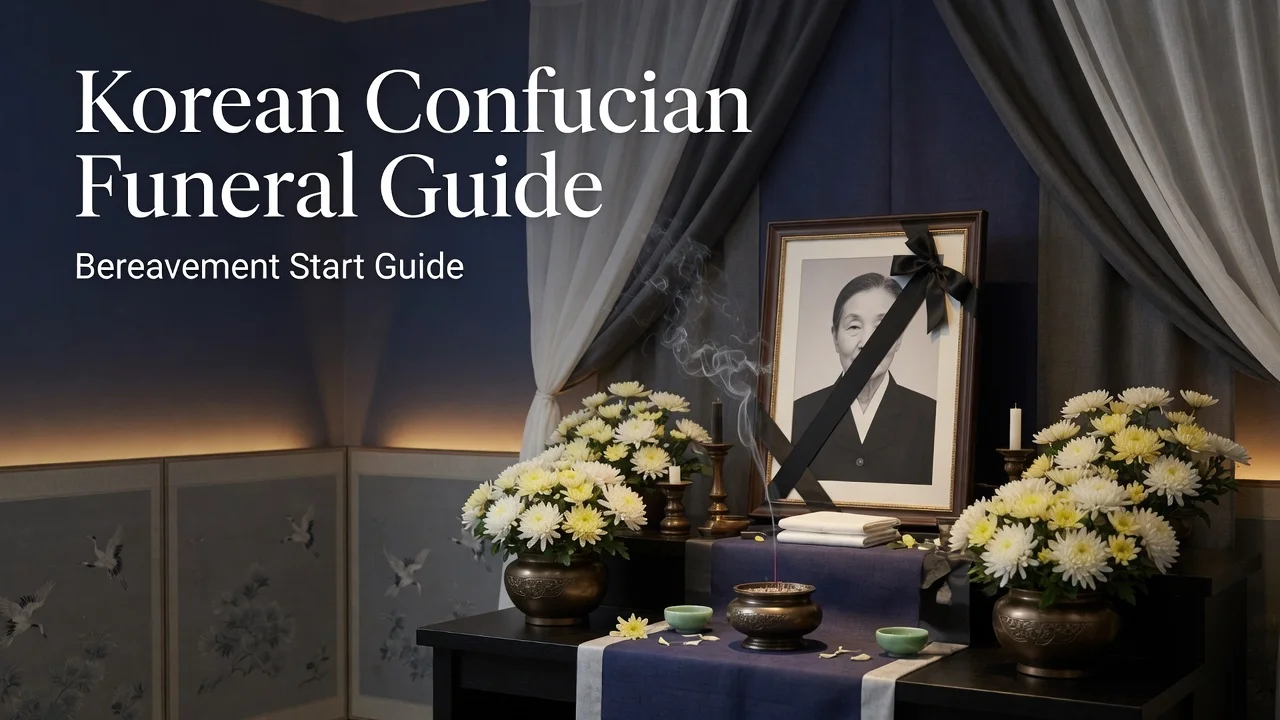
Your parent just died. The three-day clock is already running.
In the next seventy-two hours, you will need to designate a chief mourner, book a cremation slot that fills up within hours, send a death notice with your bank details to hundreds of people, set up an altar room that visitors will silently judge, prepare food offerings where one wrong ingredient is read as an insult to the dead, and receive condolence guests using bowing techniques you may never have learned — all while grieving the most devastating loss of your life.
If you grew up outside Korea, married into a Korean family, or are a daughter facing elders who insist that only a man can lead the funeral, the distance between what tradition demands and what you actually know can be terrifying.
Free resources exist, scattered across Korean-language hospital brochures, Reddit threads with contradictory advice, and academic texts nobody can read during a crisis. None of them answer the questions that actually paralyze families: Which armband stripe count is mine? Can I refuse my uncle's demand to appoint a male cousin as Sangju? What do I say when my Christian sister won't bow? How do I set up the Jesasang table without making a mistake that humiliates the family?
The Samiljang Companion — one reference for every decision in the three-day window
This is a 57-page guide built for the person who is organizing the funeral, not studying it. It covers the complete Korean Confucian funeral from the first hour after death through the annual Jesa memorial ceremonies — structured so you can look up what you need in the moment and act on it immediately.
The guide works as an offline reference. Print it. Pull it up on your phone in the funeral hall basement where there is no reception. Hand it to your non-Korean spouse so they understand what is happening and why.
What's Inside
- Hour-by-hour Samiljang timeline — Day 1 altar setup and Bugo notice, Day 2 body preparation and encoffinment, Day 3 departure ceremony. Not a summary of customs — a sequence of decisions mapped to who makes each one and when.
- Sangju authority and duty — the historical weight of the chief mourner role, the modern armband stripe system (two stripes for the eldest son, one for other married sons, none for grandsons), and a dedicated section on how daughters can lead with cultural authority when tradition says otherwise.
- Yeomseup purification and Suui shrouding — what happens during the body washing and wrapping, the pocket taboo on burial garments, and concrete workarounds for Western mortuaries that cannot accommodate these rites.
- Three liturgical frameworks — pure Confucian Chukmon prayers, the Buddhist forty-nine-day cycle with its seven-by-seven Cheondobulgyo structure, and Christian overlay options — so your family can choose the ritual depth that fits without a theological crisis at the altar.
- Bowing protocol decoded — hand placement rules for men and women (funeral bowing reverses celebratory hand positions), the correct number of prostrations to the deceased versus to the bereaved family, and respectful alternatives for guests whose faith prevents prostration.
- Condolence money rules — why amounts must start with an odd number, how to write the envelope calligraphy vertically with Chinese characters, the standard tier amounts by closeness, and the reciprocal ledger system that makes every contribution a long-term social contract.
- Jesasang memorial table — the five-row configuration from Chu Hsi's Family Rituals, the banned ingredients (no garlic, no peaches, no fish whose Korean name ends in -chi), orientation rules for rice, fish heads, and fruit colors, and the most common regional variations including Jeju Island's Castella cake tradition.
- Jesa ceremony — eleven steps — from the initial spirit summons through the offerings, prostrations, and communal Eumbok feast. Includes the modern shortened alternatives for families that observe annual memorials without full classical formality.
- Costs and negotiation points — cremation fees, funeral hall suite pricing, shroud costs, catering, and the five areas where families routinely overpay because they do not know the typical range.
- Diaspora adaptations — ROK Consulate paperwork, family registry updates, sourcing traditional materials abroad, and how to run a culturally authentic funeral in the United States, Canada, Australia, or the UK.
- Bilingual scripts — polite, culturally grounded phrases in English and Korean for difficult conversations: declining an uncle's Sangju override, negotiating with a funeral director, asking a Christian family member to participate respectfully, and notifying the community.
- Eight printable worksheets — Three-Day Funeral Timeline Planner, Sangju Duty Roster, Funeral Cost Estimator, Jesasang Table Layout Sheet, Condolence Ledger Template, Post-Funeral Memorial Calendar, Clergy and Vendor Interview Questions, and Bilingual Conversation Scripts. Print them and fill them in at the funeral hall.
Who This Is For
- Second-generation and diaspora children — you love your parents deeply and want to honor them correctly, but you did not grow up watching these rites and your Korean is not strong enough to navigate a crisis in the language
- Intercultural spouses — your partner is grieving and their family expects you to help coordinate rites you have never encountered; you need a fast, respectful crash course
- Daughters and female heirs — you provided the care, you are organizing the funeral, and you need clear cultural language to assert your right to lead when elders push back
- Funeral professionals — you serve Korean-diaspora families and need an English-language operational reference that goes beyond the basics your existing materials cover
Why Not Free Resources?
A hospital funeral hall hands you a Korean-language brochure that assumes you already know the Sangju hierarchy, the bowing sequences, and the Jesasang layout. Reddit gives you fifteen contradictory answers about armband stripes. Academic texts explain the Joseon dynasty origins but say nothing about how to book a cremation slot on Day 1 or handle a Christian-Confucian family split at the altar.
This guide exists because none of those sources solve the actual problem: you have seventy-two hours, you are grieving, and you need one place that tells you what to do, when to do it, who does it, and what to say when someone disagrees.
Satisfaction Guarantee
If the guide does not help your family navigate the funeral with more confidence and less confusion, email [email protected] for a full refund, no time limit.
Start With the Free Checklist or Get the Full Guide
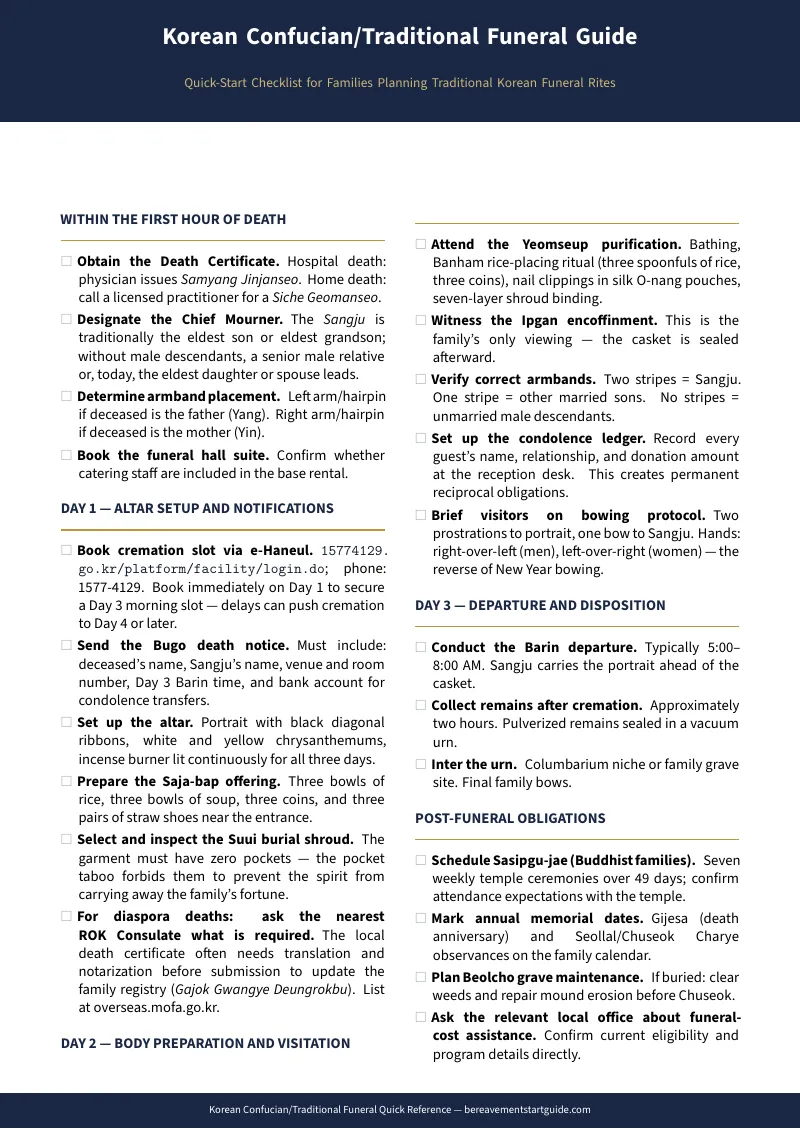
The free checklist gives you a task-by-task action list for the three-day timeline — enough to avoid the worst mistakes. The full guide gives you the reasoning, the cultural context, the liturgy options, and the difficult-conversation scripts that make the difference between getting through the funeral and honoring your family with genuine confidence.
Get the Korean Confucian/Traditional Funeral Guide — for , you get the 57-page reference, the quick-start checklist, and eight fill-in worksheets, ready to print or pull up on your phone the moment you need them.