
The Hospital Says "Next of Kin." The Person Who Shows Up Is the One Who Disowned Them.
Your partner just died, and within minutes the system starts working against you. The healthcare proxy you signed together expired the instant the doctor called time of death. The right to decide what happens to the body — who dresses it, who plans the service, whose name goes on the headstone — defaults to a statutory next-of-kin hierarchy that prioritizes biological relatives over the person who shared a life with the deceased for twenty years.
If the biological family is supportive, the hierarchy is a formality. If they are not, it is a weapon. Estranged parents have claimed bodies, rewritten obituaries in deadnames, excluded partners from viewings, and conducted services that erased the deceased's identity in full view of the people who loved them most.
The free resources online — advocacy toolkits, funeral home landing pages, grassroots PDFs — each cover a slice of the problem. But none of them consolidate the legal instruments, the mortuary protocols, and the ceremony logistics into a single document you can act on under time pressure. And when you are planning a funeral in forty-eight hours, scattered information is nearly as useless as no information.
The Identity Protection Toolkit
The LGBTQ+ Funeral & Memorial Planning Guide is a consolidated operational toolkit built for the specific legal, logistical, and emotional terrain that LGBTQ+ families navigate after a death. It covers the disposition agent forms that override next-of-kin defaults, the trans-affirming body preparation protocols that most funeral homes have never been trained on, and the cost transparency that commercial providers are structurally disincentivized from offering.
It is organized by timeline — from the first hour after death through the final memorial — so you find what you need in the order you need it, not in the order a textbook would teach it.
What's Inside
- First-48-hours crisis protocol — what to do when death occurs in a hospital, hospice, at home, or in a jurisdiction where the deceased was not a legal resident, including securing the residence, personal property, and digital accounts before hostile relatives can intervene
- Disposition agent form walkthrough — the one legal document that overrides default next-of-kin hierarchies, with state-by-state execution requirements, the traps that silently invalidate forms, and the disinheritance clause that explicitly excludes hostile relatives instead of relying on silence
- Death certificate identity protection — how to navigate the "failname" and "failgender" errors that halt vital records when a funeral director enters a chosen name but the Social Security database contains a birth name, plus the two-file strategy that separates legal records from public-facing documents
- Trans-affirming body preparation protocols — chest binding for transmasculine decedents, prosthetics and grooming specifications, embalming alternatives, and the material restrictions (synthetic fabrics, rubber soles, certain glitters, metal components) that crematoriums and green cemeteries enforce under emissions regulations
- Funeral home vetting and negotiation — the specific questions that reveal genuine cultural competency behind marketing language, a directory of affirming provider networks, and a negotiation script for managing pricing conversations without damaging the working relationship
- FTC Funeral Rule consumer rights — the four rights every family has under federal law, how to read a general price list, and a line-by-line cost comparison between traditional burial and direct cremation showing exactly which services are legally optional
- Religious and interfaith ceremony navigation — how to find affirming clergy across traditions, interview scripts for setting boundaries on sermon content, and guidance on the Metropolitan Community Church and other denominations with explicit LGBTQ+ affirmation policies
- Chosen-name obituary template — a customizable template that protects the deceased's authentic identity in the permanent public record, with an obituary control protocol to prevent unauthorized edits by estranged relatives
- Conflict and safety management — seating protocols for services where conservative and affirming guests will both be present, photography and social media privacy protections, and gender-inclusive dress guidelines
- Disenfranchised grief resources — why LGBTQ+ grief is structurally different from other bereavement, identity-affirming mourning practices, and a curated directory of culturally competent therapists and support groups
- Six fillable planning worksheets — an immediate action checklist, a trans-affirming mortuary preparation form, a funeral home vetting scorecard, a funeral cost comparison worksheet, a ceremony planning template, and an agency communication log — all designed to be printed and handed to the right person at each stage
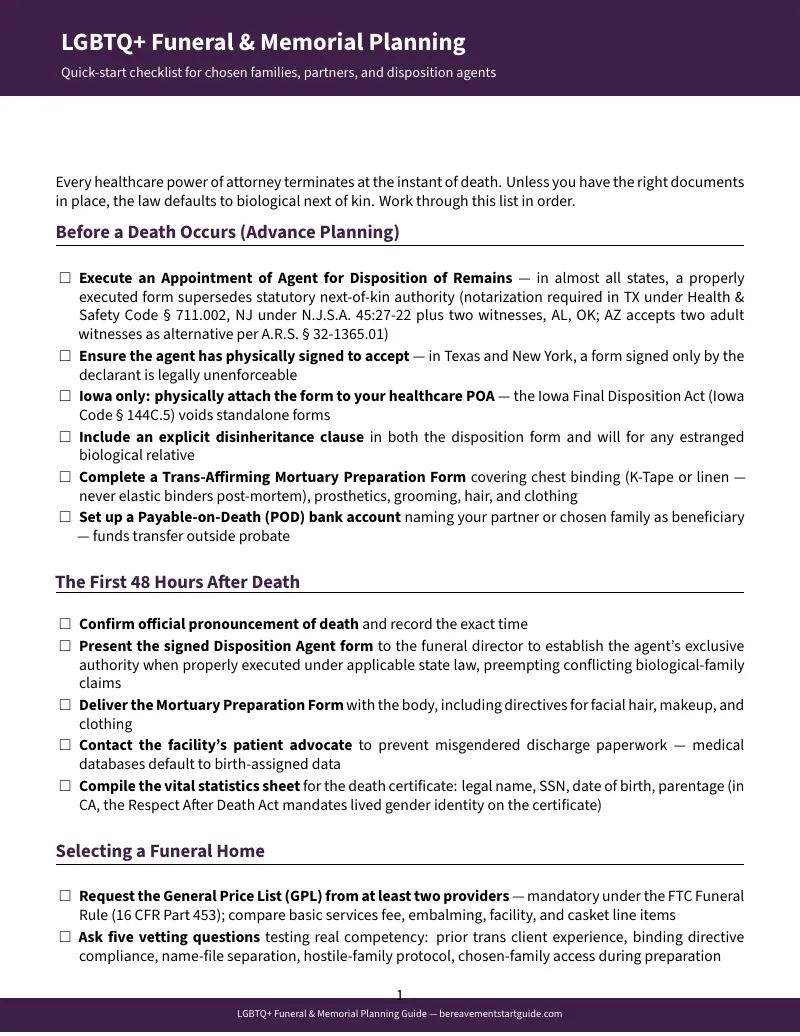
- Printable two-page companion checklist — every step condensed into a portable reference you carry to every meeting with funeral directors, clergy, and family members
Who This Guide Is For
- Surviving partners and chosen family who need to establish legal authority over funeral arrangements before biological relatives intervene — especially when no disposition agent form was executed in advance
- Families of transgender and non-binary loved ones who want to protect authentic identity on death certificates, memorial programs, obituaries, and headstones against administrative systems designed for binary, legal-name-only processing
- Executors and estate administrators coordinating services for an LGBTQ+ decedent across conflicting family dynamics, multiple jurisdictions, or conservative religious communities
- Pre-planners completing their own disposition agent forms, body preparation instructions, and ceremony preferences while healthy and legally competent — so their chosen family never faces the default hierarchy
- Funeral directors, celebrants, and death doulas serving LGBTQ+ clients who need a reliable, legally grounded reference for trans-affirming protocols instead of improvising from incomplete training
Why Free Resources Leave Gaps
National advocacy groups like SAGE, Lambda Legal, and the Transgender Law Center produce excellent eldercare and pre-planning toolkits — but they focus on advance directives and healthcare proxies, not the at-need crisis of coordinating a funeral under time pressure when the protective documents were never executed or have already expired.
Grassroots community guides — like the UK-based Queer Funeral Guide — offer compassionate, detailed body preparation and cultural guidance, but they are geographically locked to a single country's legal framework and sometimes literally cut off mid-instruction.
Progressive funeral homes publish affirming landing pages and testimonials, but they are commercial entities. They will not explain how to bypass their markups, perform a home funeral, or negotiate third-party pricing — the very cost-saving strategies that can save a family thousands of dollars.
Generic legal portals like Everplans and LegalZoom offer standardized templates built on heteronormative, cis-binary defaults. Their disposition forms lack the specific clauses needed to direct pronoun usage, mandate affirming body preparation, or legally exclude hostile biological relatives from the decision-making process.
This guide consolidates what those sources scatter across jurisdictions, formats, and commercial interests into a single toolkit — organized by timeline, built for crisis-speed execution, and free from any funeral home's sales funnel.
Full Refund, No Time Limit
If the guide does not meet your needs for any reason, email hello@bereavementstartguide.com for a full refund. No time limit, no questions asked.
Start Planning With Confidence
Download the free checklist for a quick-reference overview of the key steps, or get the full guide for the complete Identity Protection Toolkit — including the disposition agent walkthrough, trans-affirming body preparation protocols, funeral home negotiation script, and all six fillable worksheets that the checklist does not cover.
The system defaults to erasing the people it was not designed for. This guide gives you the tools to override the defaults.