The memorial tree everyone pictures. The soil chemistry nobody mentions.
You have seen the idea everywhere — plant a tree with your loved one's ashes and watch something beautiful grow in their place. What you have not seen is what happens when cremated ashes meet soil without preparation: a pH near 11.8, sodium levels hundreds of times higher than any root system can survive, and a memorial sapling that browns and dies within months.
That is the gap between the vision and the reality. Blog posts skip the chemistry. Urn manufacturers assume you know what their product needs. Memorial forest companies start at four figures and lock you into a single location. Religious community resources present blanket rejections of cremation without mentioning the pastoral compromises that exist within every tradition.
The Living Memorial Soil-to-Canopy System is a 49-page coordination manual built for the space between wanting a memorial tree and actually growing one — the soil science, the legal permissions, the product comparisons, the interfaith diplomacy, and the three years of seasonal care that turn a sapling into an established tree.
What makes this different from a blog post or a bio urn instruction sheet
Free resources give you one slice of the picture — usually the slice that sells their product. This guide is product-neutral and covers the full lifecycle:
- Ash treatment protocol with exact dilution ratios — because raw ashes form a cement-like block that kills roots, and the 1:10 minimum compost ratio is not a suggestion, it is the difference between a living tree and a dead one
- Side-by-side product comparison — Bios Urn, The Living Urn, Capsula Mundi, and independent planting methods evaluated for what they include, what they leave out, and which local cemeteries refuse to accept them
- Tree species selection framework — matched to your climate zone, soil type, and sunlight, with the hard data on why a container-grown sapling outperforms raw seeds by an order of magnitude
- Cemetery and private-land rule matrix — natural cemeteries, hybrid cemeteries, conservation burial grounds, and backyard plantings each have different permits, deed restrictions, and container policies, and buying the wrong product before checking the rules wastes money and time you do not have
- Interfaith compatibility guide across four traditions — Catholic, Jewish, Islamic, and Hindu doctrinal positions on cremation, ash handling, and tree planting, with the specific compromise options that exist within each and conversation scripts for difficult family discussions
- Ceremony design toolkit — readings, order-of-service templates, guest communication scripts, outdoor dress code guidance, and alternatives to flowers and decorations that most natural settings restrict
- Cost comparison worksheets — two worked examples breaking down living memorial expenses against traditional burial and direct cremation line by line, plus negotiation language for conversations with funeral homes
- Three-year seasonal stewardship calendar — watering, mulching, bark protection, wildlife guards, and the triggers that mean it is time to call an arborist, so the tree establishes the deep root system it needs to survive independently
Who this is built for
- Families who have chosen cremation and want to plant a tree with the ashes — in a backyard, a memorial forest, or a cemetery green section
- Adult children honoring a parent's wish to return to nature while managing traditional family expectations about burial
- Pre-planners writing advance directives that specify a living memorial
- Interfaith families reconciling green burial wishes with religious doctrines that restrict cremation or ash handling
- Executors coordinating a memorial planting across state or national borders
- Death doulas, celebrants, and planners advising families on nature-based alternatives
Why not piece it together from free sources?
You can find fragments of this information online. A forum post about ash pH. A manufacturer's planting guide for their specific product. A state regulatory page written in statutory language. A religious FAQ that says "no" without explaining the exceptions.
The problem is not finding information — it is verifying it, sequencing it, and acting on it during the most compressed decision window of your life. A family that follows a blog post, skips the ash treatment step, plants in the wrong season, and uses a product their cemetery does not accept has lost weeks and hundreds of dollars they cannot recover. This guide consolidates the science, the rules, the interfaith guidance, and the practical logistics into one document you can read in under 20 minutes and act on with confidence.
What is included
- 49-page planning guide (PDF) — soil chemistry, legal rules, product comparisons, interfaith guidance, ceremony design, stewardship calendar
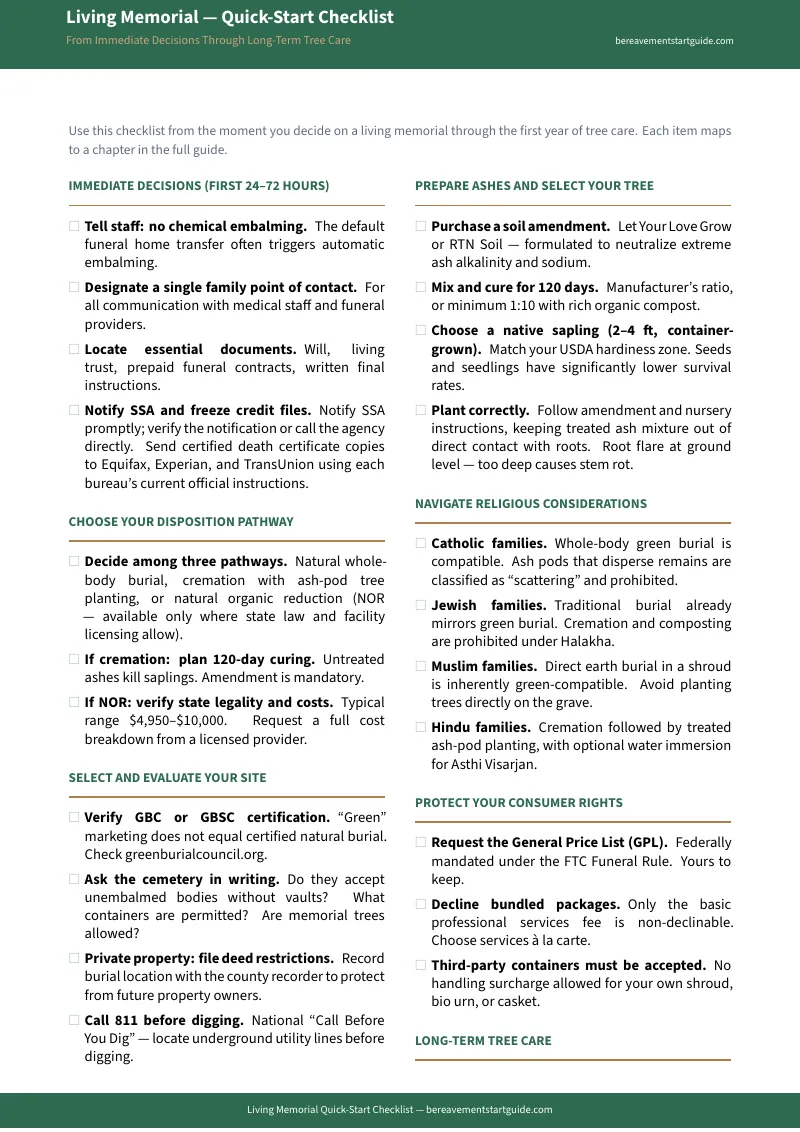
- Printable quick-reference checklist (PDF, included free) — 24 critical tasks from disposition decision through first-anniversary visit
- 8 standalone planning worksheets (PDF) — disposition pathway comparison, cemetery evaluation worksheet, soil preparation log, tree selection checklist, memorial ceremony planner, family communication scripts, provider comparison sheet, and three-year tree care calendar
Satisfaction guarantee
Full refund, no time limit. If the guide does not give you what you need, email hello@bereavementstartguide.com and we will refund you — no forms, no waiting period, no questions.
Download the free checklist to see if this approach matches what you need. When you are ready for the full soil science, legal framework, and planning tools, the complete guide is here.