Someone You Love Has Died, and Three Different Relatives Just Told You Three Different Things About What Has to Happen Next
One elder says the body must be buried within four days or the spirit will not rest. Another family member wants a Christian chapel service first. A third insists on a sacred fire that has to burn continuously for three nights — but you live in the suburbs and don't know who the firekeepers are or what wood is permitted. The hospital is asking about embalming. The funeral director has never worked with a tribal family before. And someone just mentioned a BIA burial assistance form that must be submitted before the funeral home gets paid — not after.
You want to honour the traditions. You want to hold the family together. But the traditions vary by nation, by region, by family — and every free resource you can find either lumps 574 tribal nations into a single "Native American" summary or covers one nation so narrowly it doesn't apply to yours.
The Tribal Protocol Navigation System
The Native American Funeral — General Guide is a structured funeral planning framework organized by cultural-linguistic region — Plains, Southwest, Northeast Woodlands, Pacific Northwest, and Southeast — so you see exactly how your nation's practices differ from others instead of guessing from a pan-Indian overview. It does not replace your family's elders. It prepares you to approach them with the right questions, the right paperwork, and a clear financial plan so you can focus on what actually matters: grieving together as a family.
Every section includes Custom Verification Checklists — the precise questions to bring to your own family's elders and traditional leaders about localized variations. You confirm protocol with the people who hold it, not with a website.
What's Inside
- Region-by-Region Protocol Comparison — Diné four-day burial timelines, Anishinaabe sacred fire obligations, Haudenosaunee ten-day mourning feasts, Cherokee purification practices, and Pacific Northwest cremation traditions mapped to the decisions you face in each tradition's first twenty-four hours.
- Body Preparation Customs Guide — yucca root and willow washes, "dead clothes" preparation, chindi avoidance protocols, and how to communicate non-embalming preferences to funeral directors who default to state-mandated procedures that may not be legally required.
- Sacred Fire Management — which wood and offerings are appropriate, who tends the fire, what must never approach the fire space, and how diaspora families in urban settings can adapt the practice when a reservation is hours away.
- BIA Burial Assistance Walkthrough — the full application sequence for up to $3,500 in direct-to-vendor federal assistance, including income eligibility, documentation deadlines, and the critical detail that the BIA pays the funeral home directly and will not reimburse families who pay out of pocket first.
- Tribal Grant Stacking Guide — how Muscogee (Creek), Choctaw, Chickasaw, and other tribal supplemental programs combine with BIA assistance to cover $5,000–$7,000 in burial costs, plus supplemental grants for funeral food and grave house construction.
- AIPRA Land Burial Navigator — Bureau of Indian Affairs probate procedures for burial on individual trust or allotment land, including fractionated heirship rules and local health department coordination.
- Family Mediation Scripts — tested conversation frameworks for resolving disputes between traditional elders who require ancestral ceremony and modernized relatives who prefer simplified or Christian services. The key is sequencing — which elements happen first, who presides over each portion, and where the boundaries fall.
- Attendee Briefing Sheet — a printable one-pager for non-Native friends, colleagues, and extended family covering dress code (including colour symbolism — some nations associate red with satisfaction at the death), photography prohibitions, gift and food protocols, and the strict ban on recording sacred ceremonies.
- Giveaway Protocol Guide — the cultural significance of distributing the deceased's personal belongings, star quilts, and traditional items at the end of mourning, with guidance on timing, recipients, and what to do when the family is divided about letting go.
Who It's For
- Families who live away from their ancestral community — you carry the obligation to honour tradition but don't have the local knowledge. The Custom Verification Checklists bridge that gap before you approach the elders.
- Interfaith or multi-ethnic descendants — when half the family expects a traditional ceremony and the other half expects a chapel service, the Mediation Scripts give you a structured path through the conflict without forcing either side to yield completely.
- Executors and estate administrators — managing a deceased tribal member's estate under both state probate and federal Indian land law requires navigating two legal systems simultaneously. The AIPRA Navigator walks you through the intersection.
- Non-Native funeral directors and celebrants — you serve families whose protocols you were never trained on. The guide gives you structured cultural-competency guidance that goes far beyond "be respectful."
- Less-observant next-of-kin — you want to honour your relative's traditional wishes, but work leave is limited, the budget is tight, and you haven't attended a traditional ceremony since childhood. The guide meets you where you are.
Why Free Resources Leave You Stranded
Tribal offices and cultural committees publish burial assistance applications and contact sheets for clan leaders — but these materials assume the reader grew up with a lifetime of cultural literacy. They are written for community members, not for diaspora families learning under crisis pressure.
Federal agencies (BIA, OHA) provide forms for AIPRA estate planning and Individual Indian Money accounts — in dense bureaucratic legalese with no cultural context, no etiquette guidance, and no explanation of how the ceremonial timeline intersects with the probate timeline.
Funeral home websites offer generalized "Native American traditions" summaries that group 574 nations into a single category. Their primary intent is marketing, not accuracy. And community forums (Reddit, Facebook) provide raw peer advice — valuable, but fragmented, unverified, and often specific to one nation's practice presented as universal.
The Native American Funeral Guide consolidates these scattered sources into a single framework: the cultural depth families need, the administrative precision government forms demand, and the practical directness of peer advice — organized by region and by decision sequence so you find what you need in the moment you need it.
Our Guarantee
If the guide does not give you the confidence and clarity you need, email hello@bereavementstartguide.com for a full refund, no time limit. We would rather refund you than have you feel unsupported during one of the most difficult experiences of your life.
Get Started Now
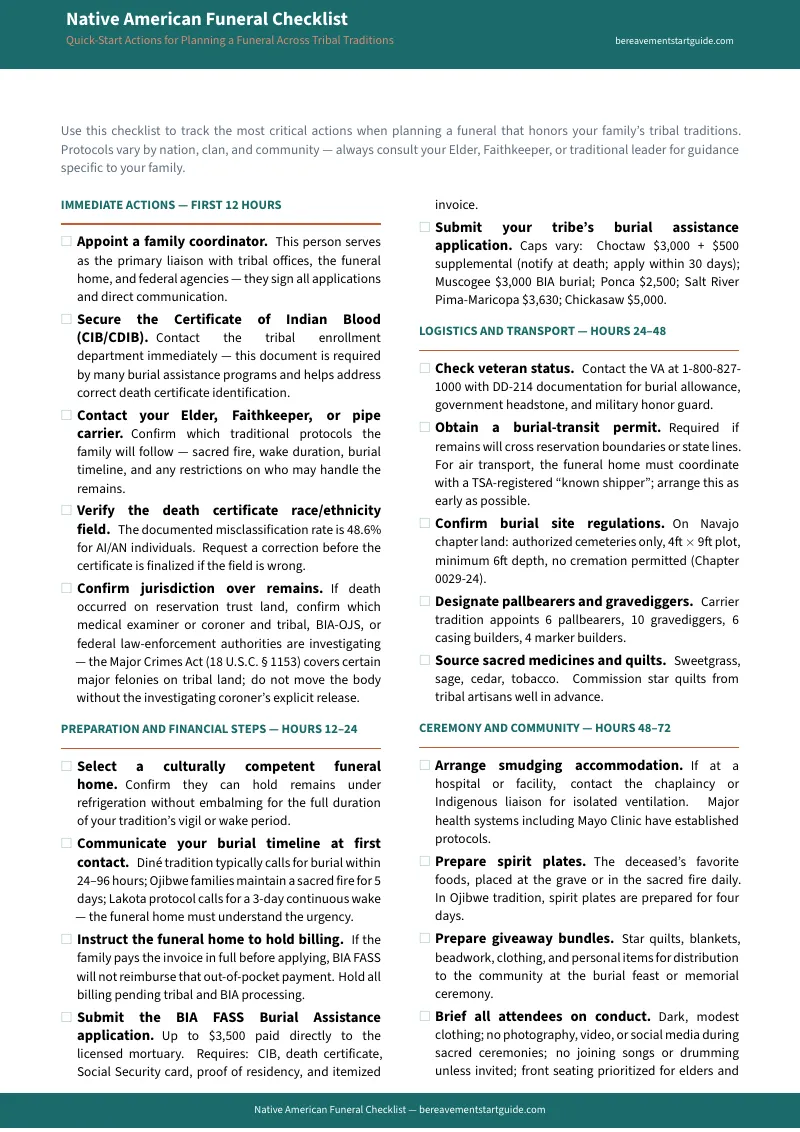
Download the free checklist to see the sequence at a glance. When you're ready for the full framework — the region-by-region protocols, the financial assistance walkthroughs, the family mediation scripts, the printable planning tools, and the Custom Verification Checklists — the complete Native American Funeral Guide is and available immediately.