Your elder walked on. The community expects you to know what to do next.
Within 96 hours, you need to coordinate a multi-day wake, secure a medicine man for the pipe ceremony, source Star Quilts for the giveaway, organize meals for hundreds of guests, file tribal burial assistance paperwork, and make sure the body is prepared with chei, eagle feathers, and handmade moccasins — all while your closest relatives are in protected grief and cannot help with logistics.
The knowledge used to flow through generations of oral teaching. But geographic distance, boarding-school disruptions, and urban diaspora life have broken the chain for many Lakota families. When death arrives suddenly, you're left scrambling through conflicting Reddit threads, dense anthropology textbooks, and generic "Native American funeral" articles that erase the difference between Lakota, Navajo, and Ojibwe traditions.
The Bicultural Navigation Toolkit
This guide is not a spiritual text and does not attempt to replace your family's medicine man or elders. It is an operational companion — a structured bridge between traditional Lakota protocols and modern administrative demands. It handles the logistical, financial, and coordination burden so you can be fully present for the sacred dimension.
Every chapter was built around the actual crisis points that families face: the 96-hour window, the financial pressure of the giveaway, the communication gap with non-Native funeral directors, and the year-long mourning obligations that no generic funeral guide covers.
What's Inside
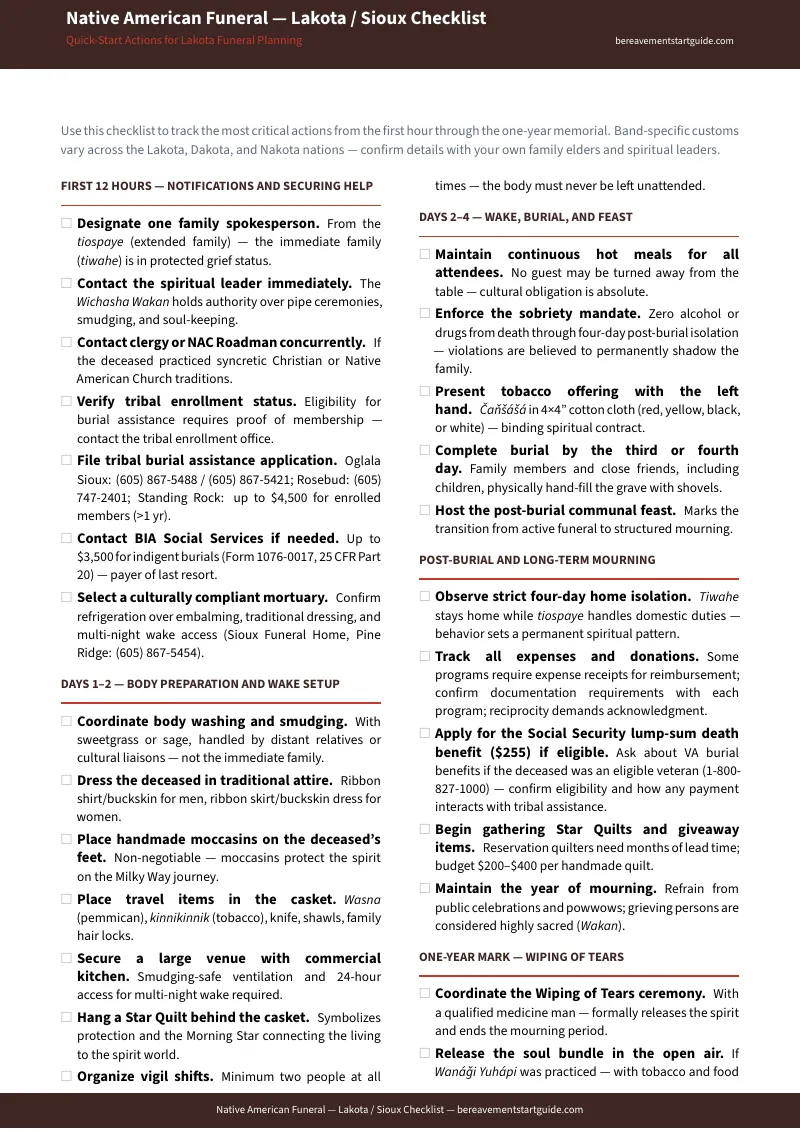
- 96-Hour Emergency Timeline — hour-by-hour actions from the moment of death through burial, with on-reservation and diaspora tracks side by side. You will know exactly what needs to happen, who handles it, and in what order — without the panic of figuring it out in real time.
- Sacred Body Preparation Guide — the traditional washing and smudging sequence, dressing in regalia, tying hair with eagle feathers, applying chei (red ochre face paint), and placing travel items in the casket. Includes word-for-word scripts for communicating these needs to non-Native funeral directors who have never handled a Lakota preparation before.
- Tribal Burial Assistance Toolkit — program-by-program documentation checklists for Oglala Sioux, Rosebud Sioux, Standing Rock (up to $4,500 for enrolled members), and BIA Social Services (up to $3,500 for indigent burials). A worked dollar example shows one family combining programs to cover $6,500 of funeral costs.
- Otúhan (Giveaway) Planner — sourcing Star Quilts from reservation quilters (budget $200–$400 per handmade quilt, months of lead time), gift-tracking tables, budgeting worksheets, and the precise etiquette for draping, displaying, and transitioning quilts from funeral drape to high-honor gift.
- Drum Group and Elder Coordination — how to construct a proper tobacco tie (čaŋšášá), present it with the left hand (the hand connected to the heart) to initiate the binding spiritual contract, set appropriate monetary honorariums, and arrange seating and hospitality. Includes a clear list of songs that are sacred and prohibited from public or recorded settings.
- Multi-Night Wake Operations — venue requirements (commercial kitchen, smudging-safe ventilation, 24-hour access), vigil shift scheduling, continuous meal coordination for hundreds, sobriety mandate enforcement, and kitchen volunteer management.
- Syncretic Service Navigation — scripts for families blending Lakota ceremonies with Catholic, Episcopal, evangelical, or Native American Church services. Dual-track scheduling templates so the chapel mass and the traditional gravesite pipe ceremony happen in the right order without forcing anyone to choose.
- Diaspora Adaptation Checklist — modified protocols for urban families in Minneapolis, Denver, Seattle, or other cities who cannot return to the reservation within the four-day window. Covers adapted mourning periods, remote coordination with reservation relatives, and what is spiritually non-negotiable versus what can be respectfully adjusted.
- Mourning Year and Wiping of Tears — the year-long behavioral expectations, soul-keeping bundle protocols (Wanáǧi Yuhápi), and step-by-step coordination for the Istamniya Wicakicipakinta Pi ceremony that formally releases the spirit and ends the mourning period at the one-year mark.
Who This Is For
- Diaspora relatives who grew up off-reservation and are now coordinating a traditional funeral from hundreds of miles away — overwhelmed by protocols you were never taught directly
- Non-Native spouses and in-laws tasked with logistics who fear overstepping cultural boundaries or mishandling sacred objects
- Reservation coordinators — the sibling, aunt, or family friend who became the default organizer and needs to source quilts, feed hundreds, and file paperwork under impossible pressure
- Funeral directors and celebrants serving Lakota families who need a Lakota-specific reference, not a generic indigenous overview
Why Free Resources Fall Short
Generic "Native American funeral" articles on corporate funeral sites treat hundreds of distinct tribal nations as one monolithic culture. They blend Lakota protocols with Navajo, Ojibwe, and Cherokee traditions, erasing the specific linguistic, spiritual, and operational differences that matter when your family is watching.
Reddit threads and community forums carry authentic voices, but they are unorganized, unverified, and require hours of scrolling to extract one actionable detail. Academic texts provide deep historical context but are written for scholars, not for someone who just lost an elder and has 96 hours to act.
Reservation funeral homes coordinate the practical logistics beautifully — but they do not provide downloadable cultural planning guides, giveaway budgeting tools, or scripts for communicating traditional body preparation needs to off-reservation mortuaries.
This guide consolidates what takes 40+ hours of research into one structured resource — verified, Lakota-specific, and designed for the moment of crisis.
Satisfaction Guarantee
If the guide does not meet your needs, email us for a full refund — no time limit, no questions. Contact hello@bereavementstartguide.com.
Get Started
Download the free one-page checklist to see the most critical actions at a glance. When you are ready for the complete toolkit — fourteen chapters, worked examples, coordination scripts, and six printable planning worksheets — the full guide is available for .