You have 96 hours. The silence around you is deafening.
Your elder has passed. Traditional teachings forbid anyone from discussing what comes next — speaking of the dead risks pulling the ch'įįdii back to the living. Your relatives may refuse to answer direct questions. The Chapter House closes in hours. And somewhere between the yucca wash and the burial application, you realized nobody ever told you how to do this.
You are not failing. This is exactly what happens when an entire culture's funeral knowledge is transmitted through oral tradition and spiritual silence — and you are the generation that got caught in the gap between ancestral wisdom and modern tribal law.
The Silent Sanctuary System
This guide exists because the information you need right now is scattered across tribal resolutions, bordertown mortuaries, Chapter House bulletins, and the memories of elders who cannot speak of it. The Silent Sanctuary System consolidates everything into a single private resource — cultural protocols, legal requirements, financial assistance programs, and hour-by-hour timelines — so you can coordinate the funeral your family deserves without forcing anyone to break the taboo of speaking about the dead.
It is not a replacement for your Hataałii, your clan elders, or your spiritual authorities. It is the logistical bridge that lets you walk into every conversation — with the mortuary, the Chapter House, the Land Department, the VA — already knowing what to ask, what to demand, and what to refuse.
What's inside
- 96-Hour Emergency Timeline — every action mapped hour by hour against the traditional four-day burial window, with parallel tracks for on-reservation and diaspora families
- Ch'įįdii Protection Protocols — the complete body preparation sequence (yucca wash, red ochre face marking, opposite-foot moccasins, jewelry destruction), handler isolation procedures, and home contamination responses for both traditional hogans and modern residences
- 2024 NNBCR Legal Guide — burial location rules, cremation prohibitions, sexton authorization requirements, the Legislation 0035-25 waiver status, and the new Chapter cemetery plot fee caps
- Burial Assistance Toolkit — complete documentation checklists for P.L. 93-638 ($3,500), VA benefits, NNVA Trust Fund ($500), and Chapter emergency funds, with two worked dollar examples showing how families reduce out-of-pocket costs by combining programs
- FTC Funeral Rule Advocacy Scripts — word-for-word questions for bordertown mortuaries in Gallup, Farmington, and Flagstaff to decline unnecessary embalming, reject casket upcharges, and exercise your right to use an outside casket with no handling fee
- Clan Role Matrix — who handles the body, who speaks for the family, who performs the yucca wash, and how to coordinate when maternal relatives are spread across multiple states
- Interfaith Navigation Scripts — exact language for blending traditional Diné, Christian, LDS, or Native American Church practices at a single service without creating rifts between traditional elders and modernized relatives
- Diaspora Adaptation Checklist — modified protocols for families in Phoenix, Albuquerque, Denver, or Salt Lake City managing a reservation-based burial from hundreds of miles away
- Ceremony Guide — when and how to respectfully request a Blessingway, Enemy Way, or Ghostway ceremony, including the traditional offering protocol for a Hataałii
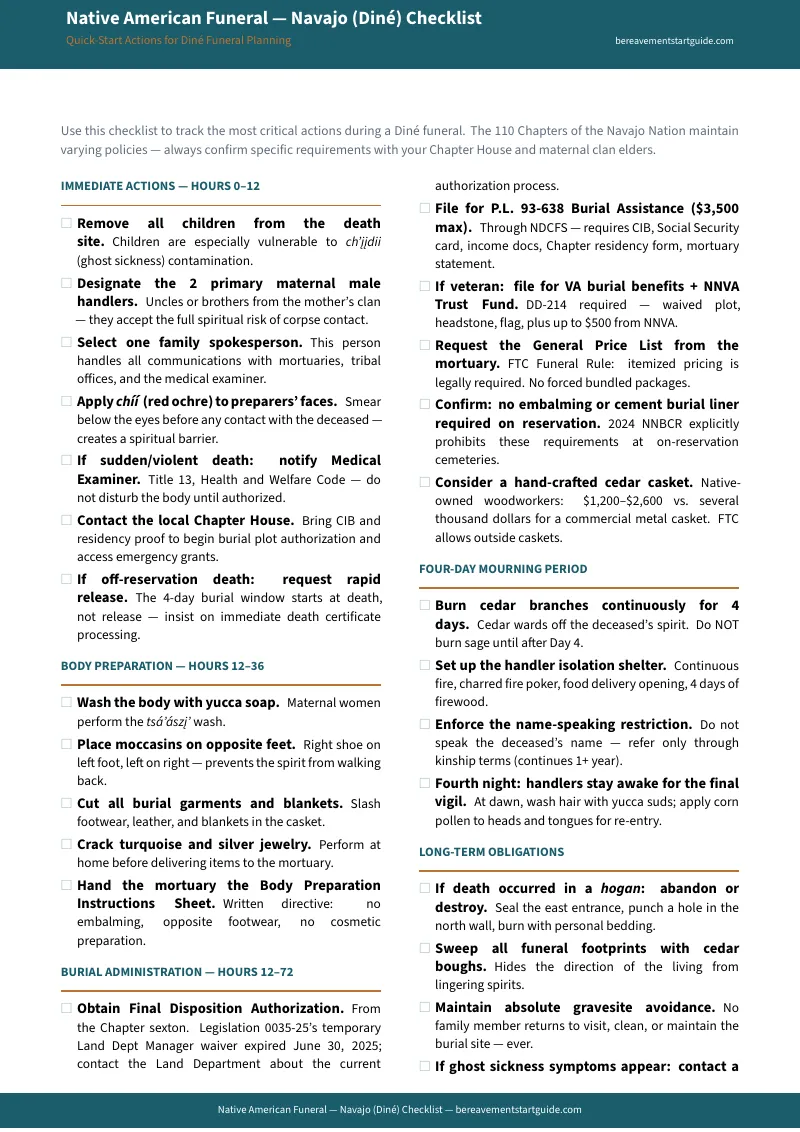
- Printable Checklist — a quick-reference covering every action item, so you can hand it to a family member and keep everyone aligned
- Seven Standalone Printable Tools — a 96-hour timeline planner, mortuary comparison worksheet, burial assistance documentation tracker, body preparation instruction sheet for the funeral director, handler isolation supply checklist, attendee etiquette guide for non-Native guests, and FTC advocacy script cards
Who this is for
- Adult children and siblings coordinating the funeral of a traditional elder — especially if your family never discussed end-of-life plans because traditional teachings prohibit it
- Diaspora relatives managing a reservation-based burial from an urban center, navigating Chapter permits and body transport logistics from hundreds of miles away
- Non-Navajo spouses and in-laws tasked with funeral logistics who need clear cultural guardrails to avoid causing offense during the most vulnerable moment of their family's life
- Executors and close friends responsible for arrangements when no immediate family is available on the reservation
- Funeral directors and celebrants serving Diné families who need a single, reliable cultural and regulatory reference
Why free resources leave you stranded
The information exists — scattered across dozens of sources, each covering a fragment. Navajo Nation official portals publish dense legal text with no cultural guidance. Reddit threads mix Diné-specific customs with Plains Indian traditions from entirely different nations. YouTube elders explain the why of death taboos beautifully but offer no checklists, no legal templates, no vendor scripts. Bordertown mortuaries hand you a price list that assumes you want embalming and a polished metal casket.
And all of it assumes you have weeks. You have four days.
The Silent Sanctuary System pulls those fragments into a single, sequenced document organized around the timeline you are actually living — from the first twelve hours through the permanent name-speaking restriction. Every protocol comes with the specific tribal regulation or cultural principle behind it, so you are never guessing whether something is a suggestion or an obligation.
Satisfaction guarantee
Full refund, no time limit. If the guide does not serve your family's needs, email hello@bereavementstartguide.com and we will make it right.
Start with the free checklist — a quick-reference of the most urgent actions and contacts. If you need the full nine-PDF kit — twelve-chapter guide, seven standalone printable tools, legal scripts, worked dollar examples, and clan coordination frameworks — upgrade anytime at .