Your family is counting on you to get this right — and the internet is not helping
Someone in your family has died, and within hours the weight of a Samoan or Tongan funeral is on your shoulders. You need to coordinate a multi-day ceremony involving dozens of relatives, reciprocal gift exchanges that could cost thousands of dollars, church protocols that vary by denomination, and legal requirements you have never navigated before — all while grieving.
You search for help and find a funeral home's marketing page with a three-paragraph summary of "Polynesian customs." You find a church handbook that covers the chapel service but says nothing about the vigil, the gift exchange, or the kinship seating order. You find a Facebook group where five people give five contradictory answers about whether the ie toga goes to the minister or the Fahu first.
None of it tells you what to do tomorrow morning.
The Kinship Coordination System — built for diaspora families planning under pressure
The Pacific Islander Funeral — Samoa & Tonga guide is a structured planning framework that walks you through every stage of a Samoan or Tongan funeral, from the first phone call after death through the final memorial gathering months later.
It is not a list of customs. It is an operational system — timelines, role maps, budget worksheets, and communication templates — designed specifically for English-speaking diaspora families who need to coordinate complex cultural ceremonies while navigating Western legal, institutional, and financial systems.
It covers both Fa'a Samoa (Samoan) and Anga Fakatonga (Tongan) traditions side by side, clearly labelling which practices belong to each culture, so you follow the protocols your family observes without confusing the two.
What's inside
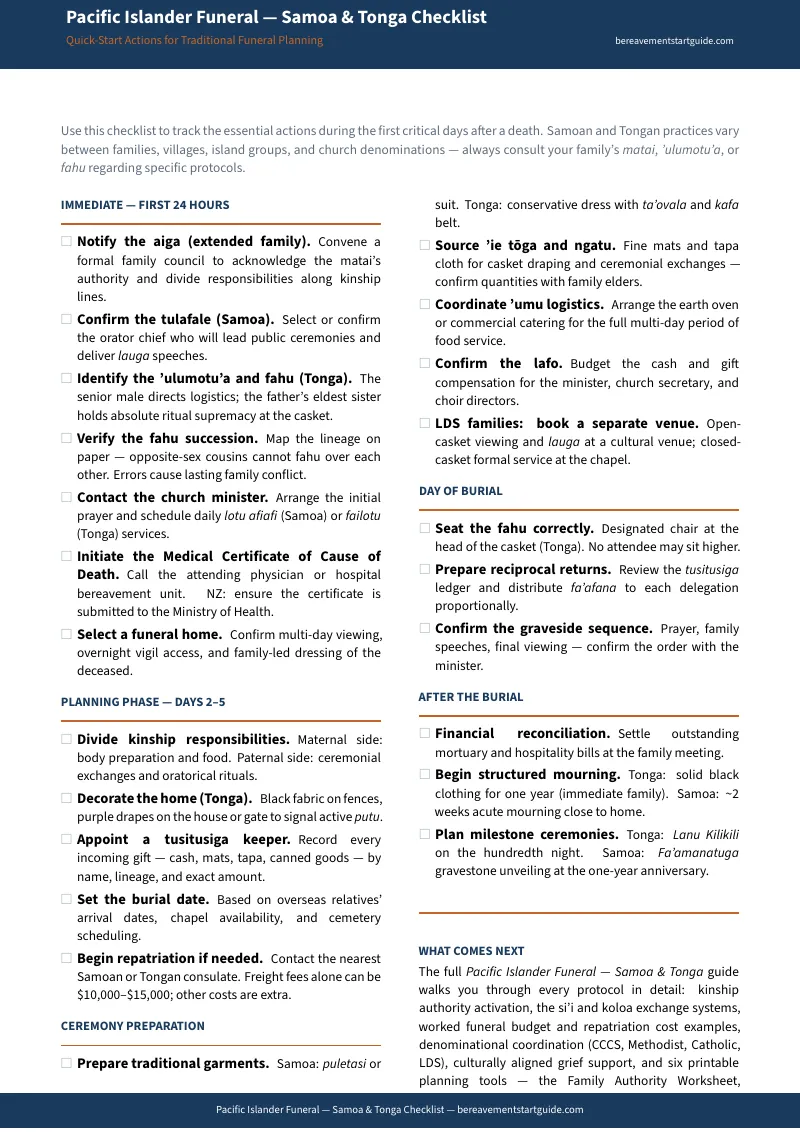
Immediate post-death protocol — because the first 24 hours set the tone for the entire funeral. A step-by-step sequence for notifying family chiefs and church ministers, coordinating with the funeral home, securing legal documents, and convening the initial family planning meeting. Parallel timelines for Samoan and Tongan customs so you do not miss a critical early step in either tradition.
Kinship authority maps — because a seating mistake or a gift misstep can cause a family rift that outlasts the funeral. Visual role charts covering the Tongan Fahu, mehikitanga, and liongi hierarchy, and the Samoan matai, tulafale, and faifeau system. Guidance on identifying the correct authority figures in your own family and understanding who makes which decisions.
Vigil planning chapter — because organizing an all-night leo or apo involves far more than booking a venue. Covers who leads the hymns, how to organize food for dozens of unannounced mourners, tent and hall setup, and how to adapt the vigil when local noise ordinances or venue rules prevent a full overnight gathering.
Reciprocal gifting system with budget worksheets — because the financial obligations of fa'alavelave and kavenga can spiral without a plan. Explains who gives what to whom, in what order, with a fa'atupe monetization framework showing respectful cash-envelope ranges for different categories of attendees. Includes a tracking ledger and budget planner so you can manage costs before they become unmanageable.
Denominational coordination templates — because your church service has rules that may conflict with traditional ceremony elements. Covers LDS chapel restrictions (closed casket, no open-mic sharing), Catholic and Protestant liturgical requirements, Methodist and Congregational customs, and practical strategies for integrating traditional hymns, speeches, and mat draping within a structured order of worship.
Repatriation logistics — because sending a loved one home to be buried in Samoa or Tonga is a process most families navigate for the first time under extreme time pressure. Covers embalming requirements, casket specifications for air freight, consulate documentation, airline coordination, and realistic cost expectations.
Mourning period guide — because the funeral itself is only the beginning. Covers sa mourning restrictions, dress codes at each stage (including Tongan ta'ovala requirements by family rank), and the memorial milestones that mark the transition back to daily life.
Six printable worksheets — a family authority worksheet, a timeline planner, a gift-tracking ledger, a budget planner, a vendor question checklist for funeral directors, and a diaspora adaptation planner. Print the right worksheet, hand it to the right person.
Who it's for
- Diaspora adult children planning a parent's funeral in New Zealand, Australia, or the United States — fluent in English, not fluent in ceremonial language or kinship protocol
- Interfaith or intercultural spouses who married into a Samoan or Tongan family and are expected to help coordinate a ceremony they have never experienced
- Extended family coordinators managing logistics between older relatives in the Islands and younger relatives in the diaspora — group communications, international travel, budget negotiations
- Funeral directors and celebrants serving Pacific Islander communities who need an authoritative cultural reference to avoid body-handling, seating, or scheduling errors
- Families facing generational disagreements between elders expecting full traditional rites and younger relatives dealing with financial constraints and limited bereavement leave
Why the free resources are not enough
Church leaders manage the liturgical service — but they do not coordinate the si'i procession, manage the kitchen hierarchy, handle municipal cemetery paperwork, or tell you how much to put in each cash envelope. Funeral home websites offer three paragraphs of "Pacific culture" marketing copy — but they avoid specifics on kinship hierarchy, gifting protocols, and denominational conflicts to prevent liability. Facebook groups give personal advice based on one family's experience in one village — but your family's customs may differ by island, lineage, and denomination.
This guide fills the gap between what those sources cover and what you actually need to know. It gives you the structural framework so you can ask the right questions of your own elders with confidence — instead of guessing and hoping nobody notices.
Full refund, no time limit
If the guide does not help you, email hello@bereavementstartguide.com and you will receive a full refund. No time limit, no conditions.
Get started now
Download the free checklist for a two-page quick-reference summary of the key steps. When you are ready for the full framework — with kinship maps, budget worksheets, communication templates, and the denominational coordination guide — get the complete Pacific Islander Funeral — Samoa & Tonga toolkit for .