
No clergy. No script. No one to call.
When a Quaker dies, there is no pastor who takes over the arrangements. No printed liturgy arrives. No deacon schedules the hymns. The family and the local Monthly Meeting share every organizational responsibility — and if you have never navigated the quiet authority of a Ministry and Counsel committee, the first seventy-two hours feel like freefall.
You search online and find scattered Faith and Practice chapters written for lifelong elders, funeral home pages that treat Quakerism as a historic curiosity, and forum threads that contradict each other on whether you even need a funeral director. None of it gives you a single, clear path from the first phone call to the handshake close.
The Friends Memorial Roadmap — one manual for both traditions
The Quaker / Friends Funeral Guide is a step-by-step operational manual built for the person who needs cultural fluency fast. It covers both unprogrammed (liberal) and programmed (pastoral) traditions with a clear branching structure, so you follow only the steps that apply to your meeting — and never prepare for the wrong kind of service.
This is not a theology essay or a history lesson. It is the practical confidence layer between you and two very different worlds that rarely talk to each other: the spiritual jurisdiction of the Monthly Meeting and the commercial logistics of the funeral industry.
What's inside
- The first-hours notification sequence — exactly who to call, in what order, before the public obituary goes out. The Presiding Clerk, the Ministry and Counsel committee, the Care and Counsel committee, the Burial Ground Liaison — each has a specific role, and notifying them in the wrong sequence creates confusion that compounds for days.
- Unprogrammed vs. programmed comparison matrix — a side-by-side breakdown of how each tradition handles clergy, service structure, silence, readings, and the facilitating Elder's role. If you are unsure which tradition the deceased's meeting follows, this table prevents the single most stressful planning mistake families make.
- State-by-state embalming and transport rules — no U.S. state mandates routine chemical embalming for every death, but funeral home staff routinely present it as mandatory. The guide names the narrow exceptions (New Jersey's 48-hour rule, Alabama's cross-state-line requirement) and the nine states that restrict family transport of the body, with the specific statute for each so you can decline unnecessary services with confidence.
- Green burial and cremation decision trees — because the simplicity testimony steers most Friends toward natural disposition, and the logistics are more complex than any funeral home brochure admits. Biodegradable casket sourcing, cemetery vault-waiver policies, shroud burial depth regulations, and the legal requirements for each option in your state.
- Complete service templates for both traditions — the unprogrammed template includes silence timing, vocal ministry etiquette, and a word-for-word welcome script the facilitating Elder can read to non-Quaker visitors so no one sits in confused silence. The programmed template covers hymn placement, scripture selection, and the structured tribute.
- The Memorial Minute process — a Memorial Minute is a permanent spiritual biography, not a newspaper obituary. It requires seasoning across at least two consecutive monthly meetings for business before going to the quarterly and yearly meetings. The guide explains who initiates it, what biographical details to provide, and why the one-to-three-month timeline is normal and not a sign something went wrong.
- Budget worksheets and the Jeanes Cremation Fund — a line-item cost comparison showing how Quaker simplicity saves families thousands over the national median funeral cost. Plus a walkthrough of the Anna T. Jeanes Cremation Fund — a restricted grant through the Philadelphia Yearly Meeting that most secular family members and remote executors do not know exists, including the documentation and Care Committee Clerk signature required to apply.
- Meetinghouse reception planning — how the post-service social hour works, whether the meeting or the family manages food, facility fee ranges for members and non-members, and template wording for "in lieu of flowers" donation requests directed toward Quaker values.
Who it's for
You do not need to be a Quaker to use this guide. Most buyers are people on the periphery of the tradition who are suddenly responsible for everything:
- Adult children raised in a Quaker home but no longer active — honoring a parent's wishes without personal knowledge of meetinghouse etiquette
- Non-Quaker spouses and siblings who have attended Meeting for Worship as visitors but never planned one
- Executors and close friends with zero prior Quaker experience, named in a will and legally responsible for coordinating the service
- Funeral directors and celebrants serving a Quaker family for the first time — the guide delivers rapid cultural competence without the steep learning curve of reading centuries of Faith and Practice documents
- Remote family members managing logistics from another state or country, including hybrid memorial setup and remote financial-asset coordination
Why not free online resources?
Free Quaker funeral information exists in fragments. Yearly Meeting Faith and Practice books are written for lifelong elders and dense with jargon — "clearness," "seasoning," "facing benches" — that means nothing to the non-Quaker family member making decisions under time pressure. Local meeting handbooks like Newtown's or Concord's are excellent but assume access to specific regional committees, properties, and funds that do not apply outside their geography. Funeral home websites treat Friends funerals as a historical footnote. Reddit threads are anecdotal and contradictory.
The guide consolidates eight to twelve hours of scattered research into a single resource you can digest in thirty minutes. It translates the jargon, maps the legal landscape across jurisdictions, and gives you fill-in-the-blank planning templates so you walk into the first meeting with Ministry and Counsel already knowing what questions to ask.
Satisfaction guarantee
If the guide does not give you the practical confidence to plan a respectful, organized memorial, email us and we will make it right. No conditions, no awkward conversations.
Start with the free checklist — or get the complete guide
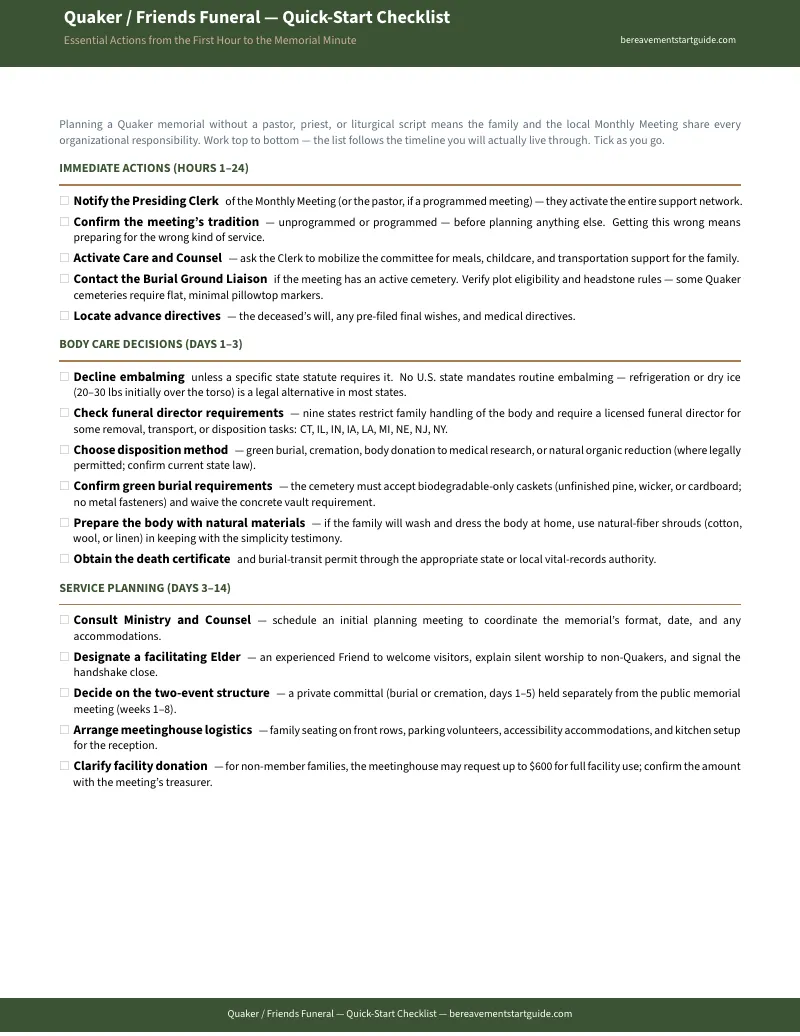
The free Quick Start Checklist gives you the essential actions organized by timeline — from the first phone call through the Memorial Minute. It is enough to keep you moving in the right direction.
The full Quaker / Friends Funeral Guide — priced at — goes deeper: both traditions covered in full, state-by-state legal breakdowns, service templates with word-for-word scripts, budget worksheets, and the Jeanes Fund application walkthrough. Everything you need to coordinate confidently with the meeting, the funeral home, and the family.
Frequently Asked Questions
What if the rules change after I buy?
We update the guide when the rules change. Email us any time, even years later, and we'll send you the current edition free.