You have hours to plan a funeral you have never seen performed
A parent has died, the family wants a Shinto funeral, and you are now the chief mourner. The twenty-stage shinsōsai liturgy is almost entirely absent from English-language resources. Japanese-language references exist, but they are published in formal, archaic prose by shrine associations — and they cover theology, not logistics. The funeral director's estimate bundles Buddhist-standard items you do not need. Your traditionalist relatives are watching every ritual choice you make. And the municipal ward office needs paperwork filed before the crematorium will schedule a slot.
The free tools and forum threads that come up in a search will tell you to "hire a good funeral director" and leave it at that. They will not tell you which line items on the estimate are Buddhist defaults that do not belong in a Shinto service, how to position the body and set up the makura-kazari bedside altar before the priest arrives, or what happens if you clap audibly during the tamagushi offering instead of performing the silent shinobi-te.
The Shinsōsai Planning System
This guide is built around the operational reality of planning a Shinto funeral in Japan — the twenty ritual stages in the order you will face them, the municipal paperwork sequence, the vendor decisions where money is actually saved or wasted, and the etiquette rules that carry real social consequences if broken.
It is not a theological essay or a cultural overview. It is a planning system that tells you what to do, when to do it, who handles each step, and what the alternatives are when your situation does not match the textbook version.
What's Inside
- Complete 20-rite liturgical walkthrough — every stage from matsugo no mizu (lip-moistening at the bedside) through kika-sai (the homecoming ceremony), with bilingual Japanese-English terminology so you can follow along with the priest and communicate with the funeral director without a translator.
- Kegare purification framework — the spiritual impurity rules that determine where the funeral can be held (never on shrine grounds), when the kamidana altar must be sealed, and how mourners purify themselves before re-entering daily life. Explained in practical terms, not academic abstractions.
- Tamagushi offering sequence — the physical mechanics of receiving, rotating, and placing the sakaki branch, including the silent shinobi-te claps that replace regular shrine worship clapping. Illustrated step by step so you can rehearse before the service.
- Vendor negotiation benchmarks — two fully worked cost examples (a mid-scale family funeral at approximately ¥970,000 and a budget-conscious small family service at approximately ¥409,000, excluding casket, cremation, and grave) with line-by-line breakdowns, so you can identify Buddhist-default upsells in the funeral director's estimate and ask informed questions instead of accepting the package price.
- Shigō naming system — how Shinto post-mortem names work and why they avoid the steep tiered pricing of Buddhist kaimyō. Includes the age-specific titles and the correct way to discuss naming with your priest.
- Municipal paperwork checklist — a printable tracker for filing the Shibō Todoke death notification (within 7 days of learning of the death) and obtaining the Kasō Kyokasho cremation permit at the ward office, with Japanese–English terminology for each filing.
- 50-day mourning calendar — the complete memorial schedule with rites at every tenth day (not the Buddhist seventh-day cycle), through the gōshisai enshrinement ceremony where the spirit moves to the household mitamaya shelf as a permanent guardian deity.
- Diaspora logistics section — cross-border coordination for families managing a death in Japan from abroad, including airline ash-transport documentation, consular requirements, and ward-office proxy procedures.
- Dress code and etiquette rules — the mofuku mourning attire standards, the absolute prohibition on Buddhist prayer beads (juzu), the kōden condolence-money envelope rules (pale ink, correct fold direction, musubikiri knot), and the taboo words (imi-kotoba) that must never be spoken near the deceased.
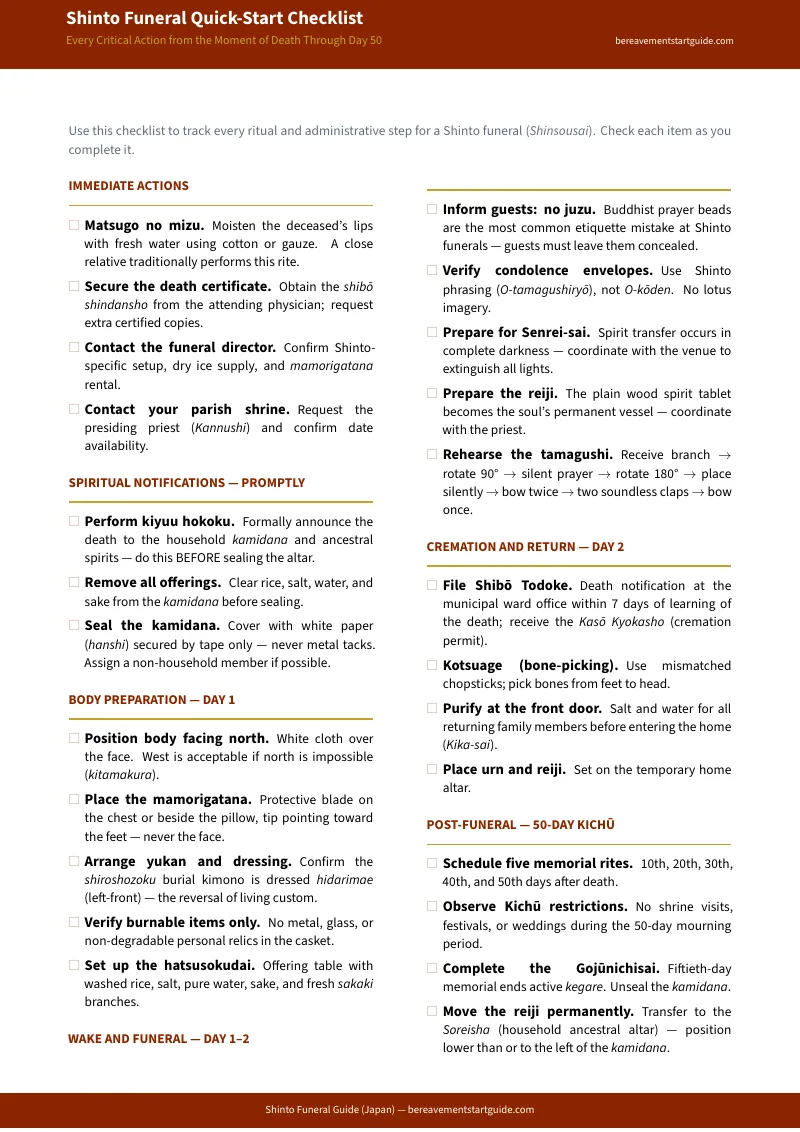
- 25-item planning checklist — a sequenced task list covering the first hours through the 50th-day enshrinement, designed to be printed and divided among family members so each person has clear responsibility for their role.
Who This Is For
- Families choosing Shinto over the default Buddhist service — whether for spiritual reasons, family tradition, or to avoid the opaque pricing structure of Buddhist temple funerals
- Secularized adult children suddenly appointed chief mourner — with no ritual background and traditionalist relatives expecting every detail to be correct
- Bicultural and interfaith families — where one spouse is non-Japanese and the family needs to reconcile Shinto purity concepts with overseas relatives' expectations
- Japanese diaspora members coordinating from abroad — managing ward-office paperwork, shrine arrangements, and crematorium scheduling under severe time and travel constraints
- Funeral planners and celebrants — who need a consolidated English-language reference for Shinto mortuary procedures to guide bicultural clients with confidence
Why Free Resources Fall Short
Shrine association booklets cover liturgical definitions and theological explanations in archaic Japanese — they offer zero guidance on commercial logistics, hospital body transport, or how to audit a funeral director's estimate. Funeral home websites keep details intentionally generic to force families into booking consultations. Government and consular portals list statutory deadlines and permit requirements without any guidance on Shinto family etiquette, home purification, or the psychological weight of kegare. Forum threads and YouTube videos are fragmented, unverified, and routinely confuse Shinto ceremonies with Buddhist practices.
The guide synthesizes what these sources scatter across dozens of documents, languages, and levels of reliability into a single operational reference — organized in the order you will actually need it.
Satisfaction Guarantee
Full refund, no time limit. If the guide does not help you plan the service with confidence, email [email protected] and we will refund you in full.
Get Started
Download the free checklist for a sequenced overview of every step. When you are ready for the complete planning system — the full liturgical walkthrough, cost benchmarks, vendor questions, municipal paperwork tracker, and printable reference sheets — get the full guide for .