The family is waiting. The Gurdwara needs a decision. And nobody wrote down how Antam Sanskar actually works.
Someone has died. Within hours, you need to coordinate the body washing, arrange the Five Ks, choose between a wood pyre and an electric crematorium, schedule an Akhand Paath or Sehaj Paath, manage elders who want rituals the Rehat Maryada prohibits, and figure out how to register the death at the Sewa Kendra before the 21-day window closes. If you are an NRI flying in from abroad, add a repatriation document checklist to that list.
You are doing all of this while grieving. And the information you need is scattered across the Sikh Rehat Maryada (written in dense theological language), Western funeral home websites (written for the UK, not Punjab), Reddit threads (unverified and contradictory), and Punjab government portals (broken links and legal jargon).
The Sikh Funeral — Punjab Planning System puts the complete Antam Sanskar framework into one structured, printable document — every ritual step, every prayer in sequence, every cremation cost comparison, every registration workflow, every repatriation requirement. Written for the family member standing in the middle of it, not the scholar studying it from a distance.
What You Get
- Hour-by-hour planning timeline — from securing the medical certificate and notifying the Gurdwara in the first hours, through body preparation, cremation, the Bhog ceremony, and death registration. The full sequence laid out so nothing falls through.
- Body preparation instructions with the Five Ks protocol — step-by-step washing and dressing guidance, plus a printable instruction sheet for hospital and mortuary staff. For Amritdhari Sikhs, the Panj Kakars must remain on the body — staff remove them routinely unless explicitly told not to. This sheet prevents that.
- Complete prayer and scripture sequence — Sukhmani Sahib at the deathbed, Ardas at each transition, the Akhand Paath vs. Sehaj Paath decision with scheduling implications, Kirtan Sohila at the cremation grounds, and Anand Sahib at the Bhog. Each prayer placed in its correct moment with enough context for a less observant family member to follow.
- Cremation method comparison with real costs — traditional wood pyre (240–350 kg dry wood plus ghee, ₹15,000–₹35,000 total, 3–4 hours) vs. electric or CNG crematorium (60–120 minutes, immediate ash collection where offered, lower cost). A factual side-by-side so the family can decide without pressure from wood merchants.
- Kiratpur Sahib ash immersion walkthrough — transportation, arrival and registration at Gurdwara Patalpuri Sahib, the ceremony itself (scriptural reading, Antim Ardas, release into the Sutlej), and etiquette. The Rehat Maryada rejects astrological date restrictions — you go when the family is ready.
- Rasam Pagri succession ceremony — the turban or white lohe ceremony that transfers family leadership to the eldest son after the Bhog. Protocol, family dynamics, and what happens when the eldest son lives abroad.
- Generational conflict resolution — village elders may insist on siapa (ritual wailing), Kapal Kriya (skull cracking), or Shradh (ancestral offerings). All three are rejected by the SGPC-approved Rehat Maryada. The guide provides a neutral, authoritative reference grounded in scripture — not one relative's opinion.
- Punjab death registration workflow — the standard 21-day process (hospital vs. home, urban vs. rural reporting paths) and the delayed registration procedure (affidavits, Non-Availability Certificate, Executive Magistrate order, Sewa Kendra processing). Step by step, with the documents and fees at each stage.
- NRI repatriation document checklist — death certificate, embalming certificate, consular NOC, IATA-compliant zinc-lined casket, e-CARE portal clearance, and consignee letter. The complete sequence for bringing remains from the UK, USA, or Canada to Punjab, with specific contacts and procedures.
- Attendee etiquette guide — dress code, head covering rules, seating, condolence customs, and a printable one-page overview for non-Sikh relatives and colleagues attending their first Sikh funeral.
- Langar and hospitality coordination — Karah Parshad, communal meal logistics, Gurdwara kitchen coordination, and guest management for large extended families.
- Legal Heir Certificate process — claiming bank deposits, settling insurance, and transferring land after the funeral. Tehsildar/SDM application steps, required documents, and typical timelines (15–30 working days).
Who This Is For
- The eldest child organising a parent's funeral — you attended funerals as a child but never ran one. This gives you the complete sequence.
- The NRI managing arrangements from the UK, Canada, or the US — you need the repatriation checklist, the local coordination framework, or both.
- The urbanised family returning to a village for the funeral — your knowledge of Sikh funeral customs has gaps, and the elders will notice.
- The interfaith spouse or non-Sikh relative — you married into a Sikh family and need to know what to wear, how to behave, and what the prayers mean.
- The funeral planner or celebrant coordinating a Punjab-based service — you need verified local practices and costs, not a generic overview.
Why Not Free Online Resources?
The Sikh Rehat Maryada is authoritative but gives you theology without logistics. Western funeral home websites are clear but written for the UK or Canada, not Punjab. Reddit gives you real experiences but no verification. Punjab government portals give you forms but not instructions. Repatriation companies give you checklists but only as marketing for expensive full-service packages.
None of them give you the complete system — rituals, logistics, costs, paperwork — assembled for someone who has hours to prepare, not weeks.
What Families Say
We knew the prayers but not the order. We knew the cremation grounds but not the costs. We knew we needed to register the death but not the specific documents. This guide had all of it in one place — we printed it and carried it to every meeting.
Satisfaction Guarantee
If the guide does not give you the clarity you need to plan Antam Sanskar with confidence, email us within 30 days for a full refund. No questions, no conditions.
Get the Complete Guide
The Sikh Funeral — Punjab Planning System costs — less than a single bundle of firewood at today's Punjab prices. It covers every ritual step, every prayer in sequence, every cost comparison, every registration deadline, and every repatriation document in one printable reference.
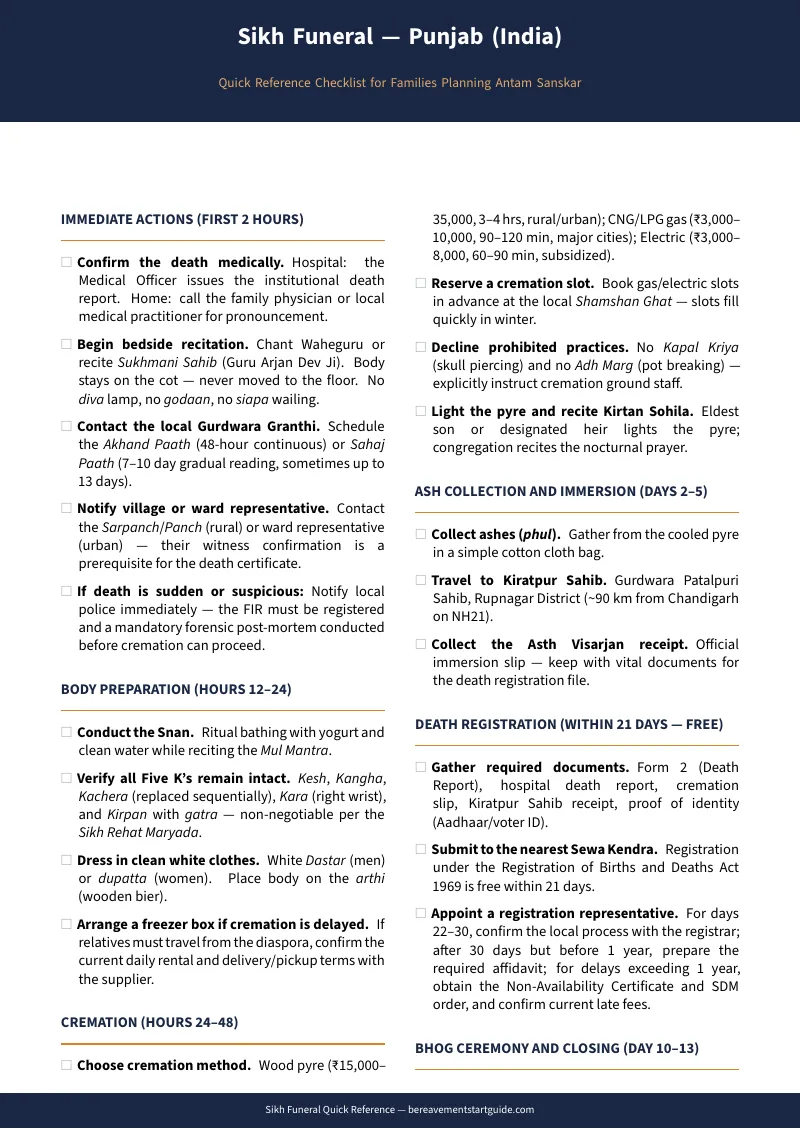
Not ready for the full guide? Download the free Sikh Funeral Quick Reference Checklist — a one-page overview of the essential steps, prayer sequence, and immediate decisions for the first 72 hours.
You did not plan to be the one making these decisions. But the Gurdwara is waiting, the cremation grounds need a booking, and the 21-day registration clock is ticking. This guide gives you the complete plan — so you can honour your loved one's Antam Sanskar with clarity and dignity.