The Elders Know the Rituals — but Nobody Wrote Them Down for You
Your family just lost someone, and the clock is already running. Home Affairs needs the DHA-1663A within 72 hours. The senior uncles are waiting for the ukwazisa notification — and they expect you to know who calls whom, in what order. A goat or an ox must be sourced for the umkhapho slaughter, and the intsonyama cut has to come from the right foreleg, roasted without salt, served to kin in strict seniority order before anyone else eats. Get any of this wrong and the elders will talk about it at the next funeral — yours.
The funeral director has a checklist for caskets and flowers. The church has an order of service. Neither one covers the ancestral protocols that actually hold the ceremony together. And the information that does exist — scattered across Reddit threads, academic PDFs locked behind paywalls, and oral instructions that vary by clan — is the last thing a grieving family can piece together at midnight before a Saturday burial.
The Ancestral Bridge System
The South African Funeral — Zulu & Xhosa guide is a complete operational bridge between the administrative requirements of a modern South African funeral and the ancestral obligations that no corporate funeral insurer's checklist will ever cover. It is organized chronologically — from the first phone call through the one-year umbuyiso ceremony — so you find what you need exactly when you need it.
Unlike free guides from funeral parlours (which stop at paperwork) or generic cultural overviews (which explain the theology but never tell you where to buy livestock in Johannesburg), this guide gives you both layers in a single reference: the legal steps and the traditional steps, in the order they actually happen, with practical workarounds for every urban constraint a modern executor faces.
What's Inside
- DHA-1663A and legal registration walkthrough — the forms, the deadlines, and the SAPS case-number requirement for deaths at home, laid out step by step so nothing gets missed in the first 24 hours when everything feels impossible
- Ukwazisa notification protocol — who to call first, in what order, and how to handle the diplomacy of informing senior uncles, the chief, and the church before word spreads through the community on its own
- Ritual slaughter guide with urban workarounds — the full isiko lokuhlaba and umkhapho protocol including ancestral invocation, intsonyama cutting instructions, the no-salt rule, seniority-order consumption, and how to source certified livestock when you live in a townhouse complex far from the family kraal
- Body preparation and mortuary briefing page — how to instruct a modern funeral home to respect traditional washing, dressing, and the overnight home sleepover, with a printable page you hand directly to the funeral director
- Night vigil programme template — a structured umlindelo timing plan that coordinates Christian hymns, choral tributes, and traditional clan addresses into a Friday-night programme that runs smoothly through to Saturday morning
- Umnyama cleansing and purification procedures — how to set up the umsuzwane hand-washing station, perform the inyongo (animal gall) application, and conduct the ukucheba hair-shaving ceremony, including apartment-friendly adaptations for families without access to a rural homestead
- Mourning period reference with employer-negotiation strategies — the gendered ukuzila obligations mapped out clearly (widow: one year of inzilo; widower: three to six months; children: elder-determined), alongside talking points for negotiating with HR when traditional mourning clashes with corporate leave policies
- Elder conversation scripts — pre-written, respectful interview templates for asking senior uncles about clan-specific variations, praise names for the ancestral invocation, and which customs your particular family observes, so you can walk into those conversations prepared instead of guessing
- Exceptional circumstances chapter — protocols for twins, violent or unnatural deaths (including the full ukulanda umoya spirit-retrieval procedure with the umphafa branch), infant deaths, and funerals for traditional leaders
- Diaspora adaptations — how to organise a culturally faithful funeral from the UK, Australia, or the Gulf, including livestock sourcing at certified farms abroad, virtual mourning spaces for relatives who cannot attend, and symbolic alternatives when the umphafa branch is unavailable
- Umbuyiso one-year ceremony planner — a three-month countdown for bringing the ancestor's spirit home, including tombstone unveiling logistics, traditional beer brewing timeline, and the second slaughter protocol
- Burial-society coordination log — a tracking worksheet for managing multiple stokvel and burial-society contributions, payouts, and labour commitments, so nothing falls through the cracks when four different societies are each providing different forms of support
- Six fillable planning worksheets — a clan authority decision record, a DHA-1663A preparation checklist, a funeral budget planner, a vendor question checklist for funeral directors, a night vigil programme planner, and a post-burial cleansing log
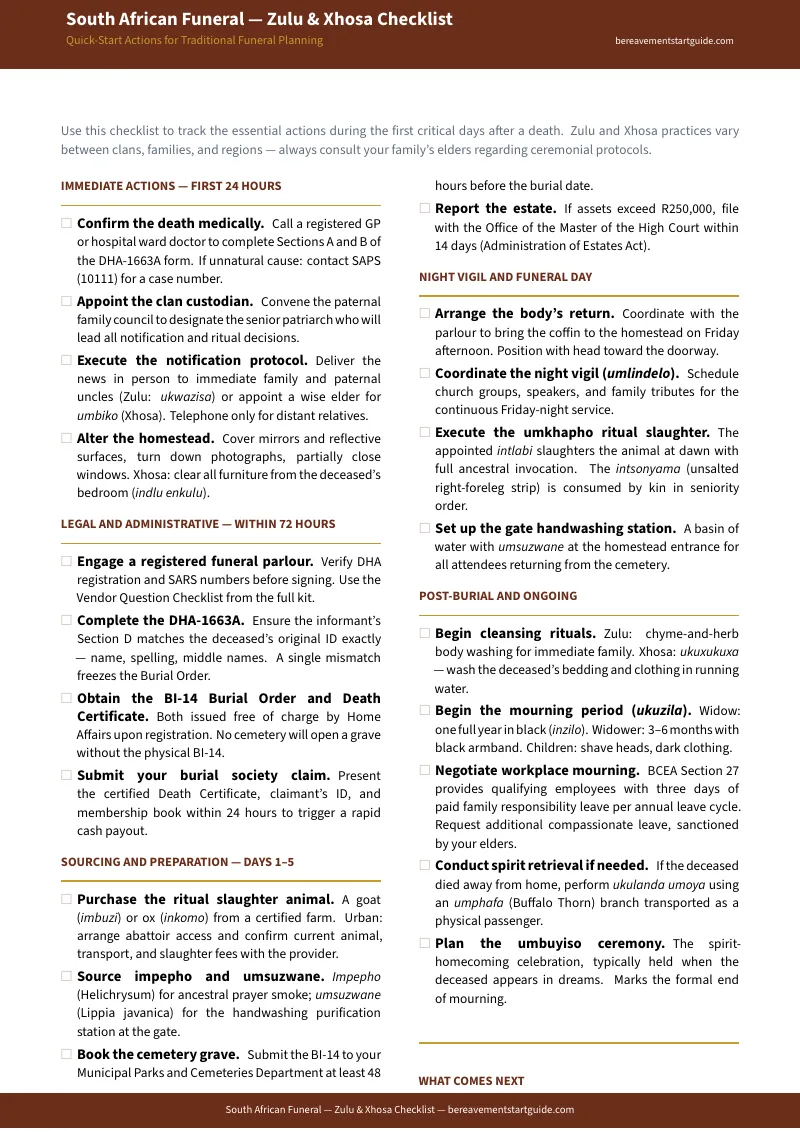
- Printable two-page checklist — every step condensed into a portable reference you carry through the entire planning process
Who This Guide Is For
- Urbanised adult children who grew up in the city observing traditions they never had to execute — and now need to coordinate a funeral that satisfies both Home Affairs and the family elders without embarrassing either side
- Cross-cultural spouses and in-laws who married into a Zulu or Xhosa family and want to honour their partner's traditions without accidentally violating a taboo that carries spiritual weight the family takes seriously
- Diaspora families funding and planning a funeral from overseas — dealing with repatriation logistics, remote coordination with local undertakers, and the guilt of not being physically present for rituals that demand presence
- Funeral directors and celebrants serving South African communities who need a reliable, tradition-specific reference instead of a generic administrative template that stops at the casket selection
- Families navigating the Christian-traditional intersection — trying to keep the pastor and the senior uncle both satisfied when the church service and the ancestral slaughter need to happen on the same morning
Why the Free Resources Are Not Enough
Corporate funeral insurers like AVBOB, Doves, and Clientele publish polished free checklists — designed to sell funeral policies, not to explain how to perform ukuthetha (speaking the body home) or where the intsonyama cut comes from. Community forums give anecdotal advice that contradicts itself across threads. Academic dissertations explain the cosmology of umnyama in rigorous detail but are written for researchers, not for someone who needs an answer at 2am before the Saturday morning slaughter.
Traditional leaders hold the authoritative knowledge — but their instructions are oral, family-specific, and impossible to verify in advance from an apartment in Sandton or a flat in Birmingham. You cannot call the chief's office at midnight to confirm whether your clan uses a goat or an ox.
This guide consolidates what those sources scatter across languages, formats, and oral traditions into a single vetted reference — organized by timeline, tagged by Zulu and Xhosa variation, and built for people making decisions under time pressure and grief.
Respectful, Practical, and Never Prescriptive
This guide does not tell you which customs to follow — it tells you what each custom means, how both Zulu and Xhosa traditions approach it, and exactly how to arrange it in a modern urban setting. Your family and your elders decide what belongs in the ceremony. The guide makes sure nothing falls through the cracks because the person who was supposed to arrange it did not know it needed arranging.
Every factual claim is cross-referenced against published ethnographic research, practitioner consultations, and South African legal requirements. Where customs vary by clan or region, the guide says so and gives you the question to ask — it never flattens two distinct cultural traditions into a single set of rules.
Full refund, no time limit. If the guide does not serve your family's needs, email hello@bereavementstartguide.com and we will refund you in full.
Start Planning With Confidence
Download the free checklist for a quick-reference overview of every step, or get the full guide for the complete blueprint — including the ritual slaughter protocols, mourning-period strategies, diaspora adaptations, and the six fillable planning worksheets that the checklist does not cover.
Your family's traditions were carried across generations by people who never needed a written guide. You do — and there is no shame in that. The guide exists so you can honour those traditions with the same confidence your grandparents had, even when the world around you has changed.