When Someone Dies, the Matrilineal Family Takes Over — and Most People Are Not Prepared for What That Means
A death in an Akan or Ashanti family activates a customary authority structure that overrides everything the nuclear family expects. Under Ghanaian matrilineal law — confirmed by the landmark ruling in Neequaye v. Okoe — custody of the deceased's body does not belong to the spouse or children. It belongs to the abusuapanyin, the head of the maternal extended family. The nuclear family is still expected to purchase the coffin, provide the burial shroud, supply the ritual bathing items, and make substantial financial contributions. They carry most of the cost. They hold almost none of the authority.
This collision between obligation and authority is where families fracture. A son who assumes he is planning his father's funeral discovers he cannot schedule the burial date without the maternal family's approval. A widow who has never met her husband's abusuapanyin learns she must provide specific ritual items — sponge, soap, towel, blanket, pillow, and the hand-woven Danta cloth — or risk being excluded from the funeral entirely. A diaspora daughter coordinating across three time zones cannot get the body released from the mortuary because the abusuapanyin has not yet convened the maternal council.
Free resources do not help with this. Funeral home websites sell packages — embalming, casket, hearse — without explaining who holds the authority to approve them. Government clinical guides address paperwork. Forum threads mix lived experience with dangerous generalizations. Church liturgy templates cover the service but ignore the customary obligations that run parallel to it. None of them address the structural reality that determines whether a funeral proceeds smoothly or collapses into litigation, public shame, and permanent family division.
The Akan Funeral Authority Navigator
This is not a generic bereavement checklist with a West African section added. It is a structured cultural navigation system built for the specific collision between Akan customary authority and modern family structures — the collision that creates almost every preventable crisis during an Akan or Ashanti funeral.
The guide maps the full authority chain from the abusuapanyin through the ɔbaapanin (the senior female elder who holds spiritual veto power) to the paternal ntoro lineage, and explains exactly where the nuclear family fits within that chain. It covers every stage from the first hour after death — when premature disclosure of the death to anyone outside the household is a serious customary breach — through the forty-day succession ceremony and the Monday accounting session that balances every cedi of expenditure against the nsawa donations collected.
Seven standalone planning tools — printed, filled in by hand, carried into real conversations — bridge the gap between what the guide teaches and what you need to do next.
What You Get
- Matrilineal authority map — who controls the body, who schedules the burial, who holds spiritual veto power, and how the nuclear family can participate without overstepping customary boundaries that trigger exclusion from the funeral
- First-24-hours notification protocol — the mandatory private notification chain that must reach the abusuapanyin before any public disclosure, social media post, or obituary draft, with the specific consequences of violating it
- Ritual bathing reference — who washes the body (maternal kinswomen on the right, paternal on the left), the protective cloth-strip binding against abubummabaa, and the ceremonial drink the paternal family must provide to the washers
- Nsawa donation tracking system — how the public announcement, receipt issuance, and reciprocal obligation system works, with a tracking framework to prevent the accounting discrepancies that cause family accusations of financial mismanagement
- One-week observation and burial weekend planning — the full timeline from the nnawotwe da through the Saturday burial, wake-keeping, thanksgiving, and Sunday services, with vendor coordination checklists for catering, PA systems, and venue logistics
- Traditional council by-law reference — regional funeral regulations that restrict wake-keepings, ban public laying-in-state, or prohibit custom family fabrics, with the penalties (including burial denial) for non-compliance
- Widowhood rites (Kunadie) guide — the stone-throwing ritual, the breaking of the cooking pot, the mourning period restrictions, and the transition rites the widow must complete before resuming normal social life
- Diaspora repatriation roadmap — Consular Report of Death Abroad (CRODA), local death certificate requirements under Act 301, mortuary release procedures, and international body transport documentation
- Elder Question Script — culturally respectful questions for approaching the abusuapanyin and maternal elders to clarify family-specific customs without appearing disrespectful or ignorant
- Vendor Question Checklist — prompts for funeral directors, mortuaries, and venues covering extended storage, embalming capabilities, cultural body preparation accommodation, and large-gathering logistics
Who It's For
- Diaspora relatives — first- and second-generation Ghanaian immigrants in the US, UK, Canada, or Europe managing a funeral from abroad with limited traditional knowledge and compressed timelines
- Non-Akan and interfaith spouses encountering matrilineal funeral obligations, ritual item requirements, and in-law expectations for the first time
- Urban Ghanaian adult children navigating the gap between nuclear family values and matrilineal authority when appointed as the primary financial coordinator
- Professional event planners and celebrants contracted for cultural accuracy in an Akan or Ashanti funeral
- Christian clergy coordinating with traditional authorities to integrate church liturgy and ancestral customary protocols
Why Free Resources Fall Short
Corporate funeral homes like Transitions (Enterprise Group) offer full-service packages — body pickup, embalming, casket delivery, hearses — but their documentation is transactional. They do not explain who holds the authority to approve body release, how to negotiate with the abusuapanyin about burial timing, or what happens if the maternal family and nuclear family cannot agree on a date.
Design platforms like FuneralPress produce beautiful brochures, invitations, and digital guestbooks. They provide no guidance on the customary obligations that must be fulfilled before any of those aesthetic elements matter — the ritual bathing, the kinship notification chain, the nsawa reciprocity system, the traditional council by-laws that can deny burial rights entirely.
Mainline churches provide liturgical templates and orders of service. They restrict their documentation to Christian theology, leaving families confused about how to reconcile church rules with the ancestral libation prayers, the pre-burial spiritual rites, and the widowhood customs that the traditional family fully expects to be observed.
This guide fills the structural gap between transactional funeral services and community-specific oral tradition — consolidating the administrative, legal, customary, and logistical information that no single free resource covers, in a format you can act on during the worst week of your life.
Full Refund, No Time Limit
If the guide does not give you what you need, email hello@bereavementstartguide.com for a full refund. No time limit, no questions, no forms to fill out.
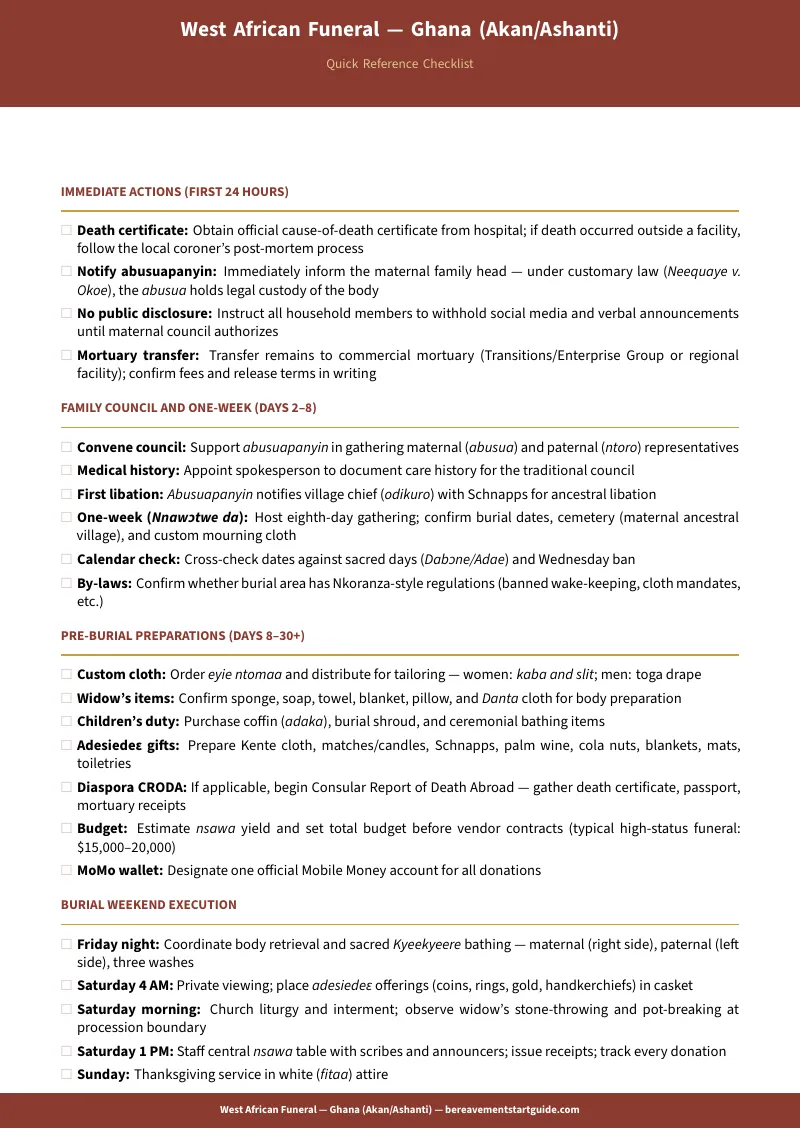
The free checklist gives you the 27 critical actions in sequence. The full guide gives you the how — with the matrilineal authority map, the ritual protocols, the financial tracking tools, and the elder consultation scripts you can carry into every conversation.