Your family is grieving. The elders are waiting. The clock is already running.
Within hours of an elder's passing, the notification hierarchy activates. The Olori Ebi must be informed before the public hears a word. The Umunna demands a formal summons. The maternal kin require a presentation of kola, dry gin, and livestock before they will even permit the burial to be discussed. Make a single misstep in this sequence — announce the death publicly before the proper authority releases it, notify the wrong lineage tier first, or present the wrong gifts — and the elders can halt the entire ceremony. Indefinitely.
Meanwhile, the financial demands begin immediately. A mid-range ceremony in Nigeria costs between ₦2 million and ₦5 million. A high-status elder's burial in Igboland or Yorubaland regularly exceeds ₦10 million. The reception alone — catering for hundreds of guests, a live Fuji or Highlife band, currency spraying, souvenir distribution — can consume half the budget. Every married daughter must present livestock. Every son-in-law must contribute. The "Committee of Friends" WhatsApp group launches, and with it the pressure to match the contributions of siblings you have not spoken to in years.
For diaspora families, the repatriation paperwork alone — Nigerian consulate clearance, Federal Ministry of Health waivers, hermetically sealed casket requirements, and port health service fees — costs between $10,000 and $18,000 before the first mourning drum sounds.
Free resources online cover fragments. A church website gives you a service of songs template but says nothing about the Umuada's authority to veto your plans. A funeral home handles logistics but cannot navigate the politics between your father's paternal kindred and your mother's lineage. Reddit threads offer raw anecdotes, but nothing structured, nothing verified, and nothing you can hand to an elder at the ancestral compound and say, "This is the plan."
The Kinship Authority Blueprint
This guide bridges every gap those fragments leave open. It is a Kinship Authority Blueprint — a single, structured document that maps the complete authority chain for both Yoruba and Igbo funerals, gives you the exact scripts and protocols for each decision point, and protects your family's standing and budget at every stage.
It does not replace your elders. It equips you to work with them — armed with the right questions, the correct presentation items, and a clear understanding of where customary law, religious liturgy, and modern logistics intersect.
What's Inside
- Notification hierarchy for both traditions — the exact sequence from private elder notification to public Itufo (Yoruba) and Ikpo Oku (Igbo), with side-by-side comparison tables and scripts for each notification tier. Never trigger a social breach by informing the wrong person first.
- Body preparation protocols — gendered cleansing rituals, camwood application, shrouding, and grave goods for both Yoruba and Igbo customs. Includes practical notes on working with modern mortuaries that may not understand traditional requirements.
- Complete Aso Ebi coordination system — color selection guidelines, fabric sourcing timelines, distribution logistics, and the social rules governing who wears what and how non-family guests participate.
- Reception planning framework — catering menus (Jollof rice, pounded yam, amala, small chops), band booking, currency spraying etiquette, livestock slaughter protocols, and souvenir distribution — with vendor negotiation scripts designed to prevent the inflated markups that target grieving families.
- Two full budget examples with line-by-line breakdowns — a mid-range ceremony and a high-status elder's burial, showing where costs actually accumulate and where families most commonly overspend. The worked examples include catering per-head calculations, mortuary storage fees, transportation, and livestock obligations.
- Widowhood rites and modern reforms — a frank, respectful treatment of traditional mourning obligations alongside the legislative protections (state and federal) that now exist. Know what is customary, what is legally required, and where families have grounds to negotiate.
- Repatriation document matrix — the seven documents required to ship remains internationally, covering hospital, health department, mortuary, Nigerian consulate, and Federal Ministry of Health requirements, with step-by-step instructions for the US, UK, and Canadian corridors.
- Ikwa Ozu (second burial) planning guide — timing, financial requirements, the role of Ogbo age-grades, and how to manage the scheduling pressure between family readiness and Catholic diocese mandates that increasingly require burial within one month.
- Guest etiquette section — what to wear, how currency spraying works, photography boundaries, condolence contribution expectations, and behavioral norms for interfaith spouses, colleagues, and first-time attendees.
Who It's For
- Diaspora families planning a parent's funeral from the US, UK, Canada, or Europe — especially those managing repatriation and remote committee coordination
- Interfaith or cross-cultural spouses entering the planning process for the first time alongside traditional in-laws
- Urban Nigerian professionals (Lagos, Abuja, Port Harcourt) tasked with digital coordination, vendor management, and budget oversight
- Professional celebrants and event planners managing high-net-worth Nigerian ceremonies who need culturally accurate reference material
Why Free Tools Fall Short
Churches provide liturgy templates — but they reject traditional rites like Ikwa Ozu and libations, and they offer no strategy for negotiating between your pastor and the Umuada. Town unions maintain rigid customary demands but provide no guidance on modern budgeting or overseas logistics. Commercial funeral homes manage the hearse and the mortuary but have no insight into the family politics that actually determine whether a funeral proceeds or stalls.
Online forums are worse: contradictory anecdotes from strangers, hostile arguments about which village's customs are "correct," and zero verification of any claim. No structure. No scripts. Nothing you can act on under acute time pressure.
The Kinship Authority Blueprint consolidates what these fragments each cover in isolation and fills the gaps between them — so you are not stitching together a plan from five different sources while the Umunna elders are waiting for your answer.
Your Peace of Mind, Guaranteed
If the guide does not help you navigate your family's funeral planning with greater confidence and clarity, email hello@bereavementstartguide.com for a full refund, no time limit. No forms, no questions, no waiting period.
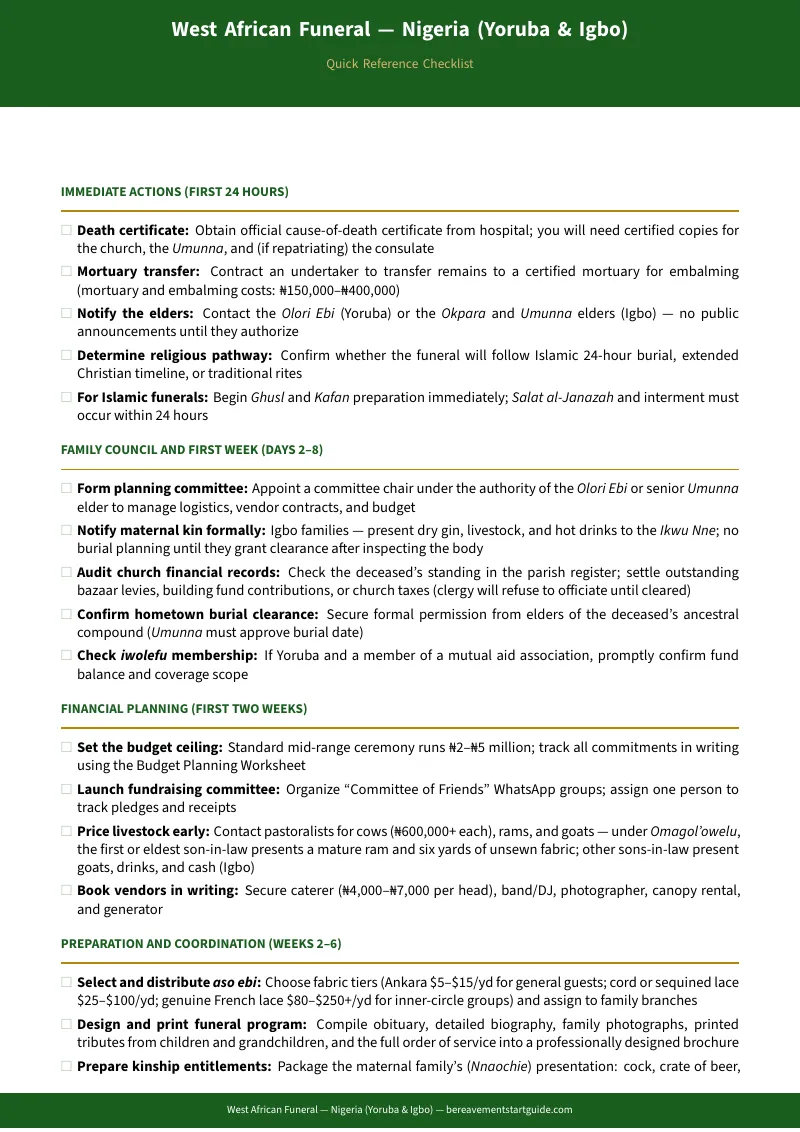
The free checklist gives you the sequence. The full guide gives you the authority, the scripts, and the budget protection to execute it.
Already grabbed the free checklist? Upgrade to the complete Kinship Authority Blueprint — everything in the checklist, plus 13 chapters of step-by-step protocols, negotiation scripts, and budget tools.