Your family assumes they can speak for you. English law says they cannot.
Under the Mental Capacity Act 2005, "next of kin" holds no legal authority over healthcare decisions. When someone loses the ability to decide — after a stroke, during surgery, in the late stages of dementia — doctors make treatment choices based on their own clinical assessment of the patient's "best interests." The family's views are consultable. They are not controlling.
In acute care settings, clinicians default to invasive, life-prolonging interventions. Ventilators. Tube feeding. Cardiopulmonary resuscitation. Even when the family tells the medical team their loved one wouldn't have wanted this, the ward is under no legal obligation to listen — unless a valid, legally binding document says otherwise.
Free information exists. GOV.UK publishes the forms. Compassion in Dying offers a digital ADRT builder. But these resources share a fundamental limitation: they help you complete a document without ensuring that document will actually hold up in a hospital ward. Vague language like "if I have a terminal illness" or "no quality of life" gives clinicians grounds to argue the ADRT is not "applicable" to the specific clinical situation — and proceed with treatment you would have refused.
The Clinical Precision Protocol — healthcare planning language that closes the loopholes doctors use
The Advance Decision to Refuse Treatment (ADRT) Guide is built around what we call the Clinical Precision Protocol — a systematic approach to drafting legally binding healthcare documents using specific medical terminology, named treatments, defined clinical trigger conditions, and the exact statutory language required under Sections 24–26 of the Mental Capacity Act 2005.
Generic guides tell you to "specify your wishes." This guide shows you exactly how — with treatment refusal language that names the intervention (clinically assisted nutrition and hydration via nasogastric or PEG tube), the clinical context (progressive cognitive decline meeting the criteria for moderate-to-severe dementia), and the statutory clause ("even if my life is at risk as a result") that makes the refusal legally binding on every doctor who encounters it.
What's inside
- Clinically precise ADRT drafting templates — specific refusal language for CPR, mechanical ventilation (invasive intubation and non-invasive CPAP), tube feeding, antibiotics for life-threatening infections, and dialysis — each tied to named clinical conditions, not vague quality-of-life statements that doctors can interpret away
- Worked drafting example — a complete ADRT clause for progressive dementia that shows exactly how vague language gets overridden in practice and how precise language holds, built from the statutory requirements under the Mental Capacity Act 2005
- LPA registration walkthrough — the chronological signing sequence (donor first, certificate provider second, attorneys last), witness eligibility rules, the £92 per-document OPG registration fee, and the specific errors that cause 15% of DIY applications to be rejected and restart an 8–16 week waiting process
- 2026 fee remission guidance — the February 2026 changes that removed automatic exemptions for Universal Credit claimants, the £12,000 gross income threshold for 50% remission, the Form LPA120 evidence requirements (12 months of consecutive UC statements), and why retrospective applications are now banned
- ReSPECT and DNACPR coordination — the critical difference between clinical advisory forms (non-binding) and statutory instruments (binding), and how to align all your documents so the ward team encounters a consistent set of instructions rather than conflicting paperwork
- Document precedence rules — when an ADRT overrides an LPA and when an LPA overrides an ADRT, based on the chronological execution dates under the Mental Capacity Act 2005 — because getting the sequence wrong can render a carefully drafted ADRT legally impotent
- Ward advocacy framework — what to say when clinical staff challenge your documents, the statutory references that back your position, and the escalation pathway from ward nurse to consultant to PALS to the Court of Protection
- Estate administration integration — death registration under the Medical Examiner system (mandatory since September 2024), the five-day registration deadline, IHT reporting, probate application pathways, and the 2027 pension taxation changes that will bring defined-contribution pots into the inheritance tax net
- Bereavement benefits navigation — Bereavement Support Payment eligibility and amounts, Funeral Expenses Payment rules, Universal Credit bereavement transition, and a worked fee calculation example showing exactly how the numbers work
- Court of Protection avoidance — the cost (£2,000+), the timeline (up to a year), and the supervision regime of a deputyship application — the outcome you face if no planning documents exist when capacity is lost
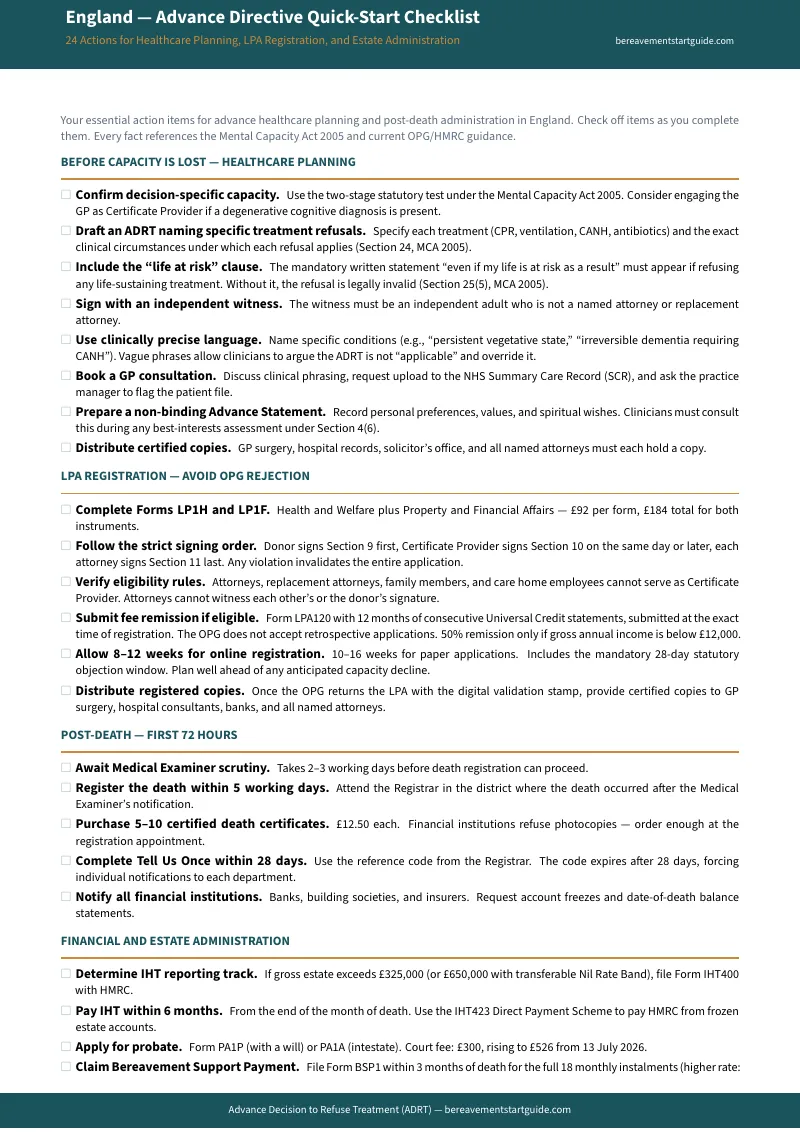
Plus a 24-item printable checklist covering every step from drafting your ADRT through registering both LPAs, notifying your GP, and distributing copies to your attorneys and hospital bag — and 7 standalone printable worksheets including an ADRT drafting template, LPA signing sequence tracker, GP consultation preparation sheet, first 72 hours action checklist, estate inventory worksheet, benefits eligibility checker, and document storage log.
Who this is for
- Adult children of ageing parents — operating in a 30–90 day window before a dementia or neurological diagnosis removes their parent's capacity to sign legal documents, who need the LPA registration completed correctly the first time
- Self-planners who want control — retired adults who have witnessed a relative receive unwanted life-prolonging treatment and want legally binding instructions that no clinical team can override
- Caregivers facing hospital pushback — families dealing with ward staff who are defaulting to invasive treatments against documented wishes and need the statutory language and escalation framework to challenge those decisions
- Low-income families — navigating the 2026 OPG fee changes and needing to understand exactly what evidence is required for the £12,000 income threshold under the new Form LPA120 rules
- Couples planning together — who need to coordinate ADRTs and LPAs for both partners with the correct chronological sequencing, understanding that £184 covers both Health and Welfare LPAs for one person, and £368 covers both people
Why not the free alternatives?
The free resources are not wrong — they are incomplete in ways that matter most when the document is tested.
Compassion in Dying's ADRT builder produces a valid document. It does not produce a document that is optimised against the specific clinical loopholes that ward teams use to override treatment refusals. GOV.UK's LPA forms are correct but give no guidance on the signing sequence errors, certificate provider restrictions, or witness eligibility rules that cause the 15% DIY rejection rate — a rejection that costs £92 in re-registration fees and restarts an 8–16 week processing queue.
Age UK and Alzheimer's Society publish detailed factsheets but deliberately stop short of actionable instructions, directing families to solicitors charging £150–£600 per document. Law firm blogs rank well on Google precisely because they withhold the operational steps that would let you do this yourself.
This guide connects the clinical drafting, the OPG registration, the ReSPECT coordination, and the estate administration into a single coordinated plan — because each of these systems creates traps that the others don't warn you about.
The cost of not knowing
- A Court of Protection deputyship application costs £2,000 or more and takes up to a year — the direct consequence of not registering an LPA before capacity is lost
- A rejected LPA application costs £92 in re-registration fees and restarts an 8–16 week OPG processing queue — while the capacity window continues to shrink
- A vaguely worded ADRT gives clinicians grounds to override your treatment refusal under "best interests" — and proceed with the exact interventions you wanted to refuse
- Solicitor-drafted ADRTs and LPAs cost £150–£600 per document — and many use the same generic language that creates override opportunities
The guide costs a fraction of a single rejected LPA re-registration fee.
— less than the OPG fee you lose on one rejected application
Every rejected LPA application costs £92 in wasted registration fees alone — before counting the weeks of delay. The Clinical Precision Protocol gives you the drafting language, signing sequence, and evidence checklists to get every document right the first time, and ensures those documents actually hold up when a medical team reaches for them.
Frequently Asked Questions
What if the rules change after I buy?
We update the guide when the rules change. Email us any time, even years later, and we'll send you the current edition free.