Stop Guessing When a Probate Dispute Starts — Know Every Move on Both Sides Before the Clock Runs Out
A family member dies, and something does not add up. Maybe a late-in-life will changed everything without explanation. Maybe you entered a caveat on GOV.UK to pause the grant — and then a sealed Form 4 Warning to Caveator landed on your doormat with a strict 14-calendar-day clock. Or maybe you are the executor named in the will, trying to sell a house and settle the estate, only to get a letter from Leeds District Probate Registry telling you the entire application has been frozen.
Suddenly you are staring at unfamiliar terms — contrary interest, entry of appearance, standing search, Larke v Nugus, CPR Part 57 — while family tension rises and every unanswered question feels like a trap. File the wrong form, miscount weekends and bank holidays on a Warning, or lodge a caveat when you actually needed a standing search for an Inheritance Act 1975 claim, and you can lose your pause or expose yourself to adverse costs.
Introducing the Two-Sided Caveat & Warning Process System
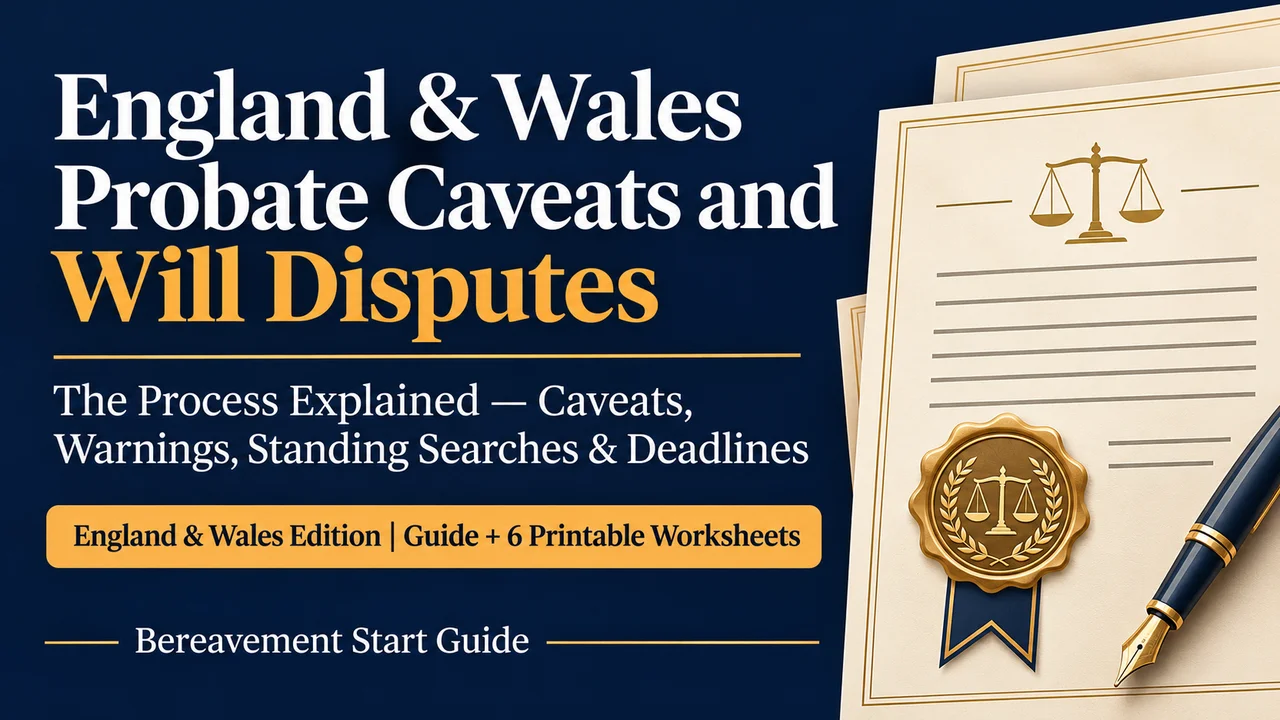
England and Wales Probate Caveats and Will Disputes — The Process Explained is built around one clear idea: you cannot make a calm decision if you only understand your own side of the table. Most articles speak only to challengers or only to executors — and many still quote pre-July 2026 fees or the outdated 8-day warning window.
This independent 52-page guide and six-worksheet kit maps the complete England and Wales procedure from both sides, verified against current HMCTS rules (including SI 2026/642 fees in force from 13 July 2026 and the 14-calendar-day Form 4 Warning period under SI 2025/1004). You see what happens before a grant, what happens after a grant, which official form fits your situation, and how to organise your evidence before you ever pay for billable legal time.
Independent educational explainer: not affiliated with HM Courts and Tribunals Service (HMCTS), the Probate Registry, HMRC, or the UK Government, and not legal, tax, or financial advice. Official forms and basic guidance are available directly on GOV.UK.
What's Inside the Complete Kit
- The 12-Chapter Process Guide (
guide.pdf, 52 pages) — Because piecing together scattered blog posts leaves dangerous gaps. Walks through the registry-vs-court boundary, who can enter a caveat, what a caveat stops (and what may pass outside probate, such as property held as joint tenants and most discretionary lump-sum pension death benefits), verified HMCTS fees (£4.00 for PA8A, PA8B, and PA1S; £526.00 for grants over £5,000), Help with Fees (Form EX160), Form 4 Warnings and Form 5 Appearances, standing searches, grounds for challenging a will, Inheritance Act 1975 claims and the 6-month limit from grant, executor neutrality, CPR Part 57 court rules, mediation, costs exposure under CPR 44.2, and current law vs. proposed Law Commission reforms. - Two-Sided Caveat and Warning Process Map (
process-map.pdf) — Because entering a caveat without knowing how an executor can respond leads to panic when a Warning arrives. Maps every procedural fork for both caveators and executors from Form PA8A through Form 4, Form 5, summons, and Form N2. - Deadline and Warning Trigger Log (
deadline-log.pdf) — Because miscounting calendar days (weekends and bank holidays included) or missing the final-month PA8B extension window can wipe out your protection overnight. Tracks your 16-digit caveat reference, renewal window, 14-day Warning clock, PA1S watch dates, and 6-month Inheritance Act limit in one place. - Caveat vs. Standing Search Decision Sheet (
caveat-vs-standing-search.pdf) — Because lodging a caveat for a pure Inheritance Act 1975 financial-provision claim is the wrong tool and can invite costs trouble. Helps you check whether your situation calls for Form PA8A, Form PA1S, or immediate legal advice before you submit anything. - HMCTS Registry Form and Fee Tracker (
registry-form-tracker.pdf) — Because disputes often span months and involve multiple forms across Leeds DPR, Newcastle DPR (EX160), and the courts. Keeps every form, fee, receipt, and confirmation date together. - Evidence and Solicitor Consultation Preparation Worksheet (
solicitor-prep-worksheet.pdf) — Because walking into a contentious probate solicitor's office with a box of unsorted emails burns through billable hours fast. Organises your chronology, will history, witness details, and Larke v Nugus background before you instruct a lawyer. - Executor Caveat Response Planner (
executor-response-planner.pdf) — Because lay executors who serve a Form 4 Warning too early can leave the estate facing a permanent caveat that needs further legal action to resolve. Walks executors through verifying the caveat, keeping fiduciary neutrality, neutral disclosure, Section 27 notices, and weighing a Warning against mediation. - Two-Page Action Checklist (
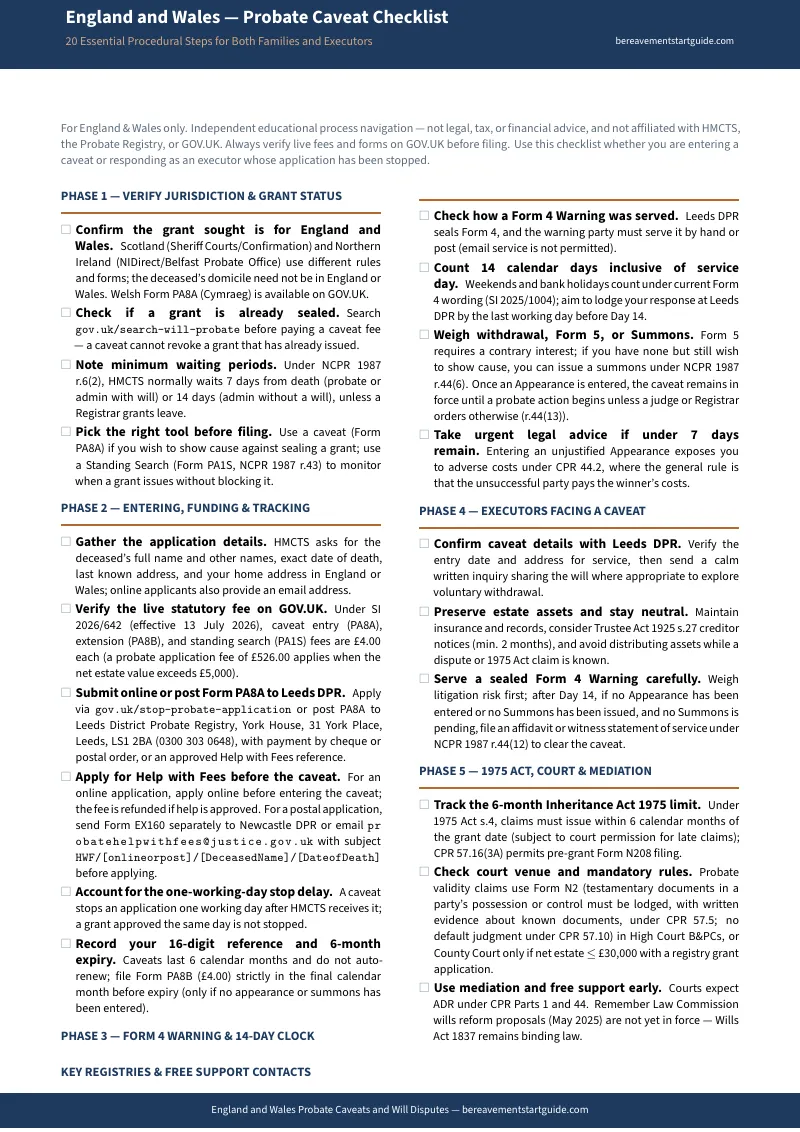
checklist.pdf) — A five-phase quick-reference sheet you can keep at the front of your estate folder.
Who This Guide Is For
- Relatives questioning a will's validity who want to understand what Form PA8A does — and what happens if a Warning is served — before they click submit.
- Family members and dependants considering an Inheritance Act 1975 claim who need to know how Form PA1S standing searches and the 6-month post-grant clock work.
- Lay executors and administrators whose probate application has been stopped by a caveat and who need a calm, neutral roadmap for their next step.
- Adult children and family helpers gathering dates, forms, and questions on behalf of an older relative before speaking to an SRA-regulated solicitor.
Jurisdiction note: This guide covers England and Wales only (including bilingual Welsh Form PA8A Cymraeg where relevant). It does not cover Scotland or Northern Ireland, which have separate courts, registries, and succession laws.
Why Not Just Rely on Free Pages or Generic Templates?
- GOV.UK tells you how to submit a form — not what happens next. Official pages explain how to file Form PA8A or PA1S for £4.00, and you should always file through GOV.UK. They do not map the strategic consequences of serving a Form 4 Warning, explain why entering a Form 5 Appearance removes your ability to withdraw unilaterally, or give you a structured way to prepare for a solicitor meeting.
- Law firm blog posts are written for one side and often lag behind rule changes. Many free articles still cite the pre-July 2026 £3 fee or the old 8-day warning period, and most stop just short of the practical detail because their goal is to book a paid consultation.
- Generic online DIY packs mix up UK jurisdictions. Cheap templates frequently blend England and Wales rules with Scottish Confirmation or Northern Ireland forms, creating costly mistakes in a process where the wrong form or wrong registry wastes critical days.
Full Refund, No Time Limit
We want this guide to give you genuine clarity during a difficult time. Every purchase is backed by a full refund, no time limit. If the guide does not help you understand the process and prepare your next step, email hello@bereavementstartguide.com and we will refund you in full.
Get Started Today
Not sure yet? Download the free two-page England and Wales — Probate Caveat Checklist right now to check your jurisdiction, search for a grant record, and review urgent deadlines. New probate records can take about 14 days after issue to appear online, so a missing result does not prove that no grant has been sealed. Ready for the complete two-sided guide and all six printable worksheets? Get instant PDF access as a single one-time purchase — a fraction of a single hour of specialist legal time, with no subscription and no account required.
Frequently Asked Questions
What if the rules change after I buy?
We update the guide when the rules change. Email us any time, even years later, and we'll send you the current edition free.