Know Whether You Need Probate in England — Without Paying a £526 Court Fee You Might Not Owe
When someone dies leaving a modest or mostly joint estate in England or Wales, the first question is also the most frustrating: do you actually need a Grant of Probate?
There is no single statutory small-estate limit in England and Wales. One high-street bank may release £40,000 on a death certificate and small-estate declaration while another institution asks for a court grant on a far smaller sole balance. Online search results regularly mix up Scottish Confirmation rules with English law, and government pages assume you have already decided to apply for a grant.
With the HMCTS probate application fee rising to £526 on 13 July 2026 for estates over £5,000 — and regulated solicitors charging hundreds to thousands of pounds for grant-only or full administration — guessing wrong costs either unnecessary court and legal fees or months of stalled accounts and personal liability.
The Asset-by-Asset Grant Audit System
England Small Estates — When You Don't Need Probate replaces scattered search results with the Asset-by-Asset Grant Audit System: a clear, ordered process navigation guide built specifically for England and Wales. Instead of guessing from total estate value, you test every property, bank account, savings product, pension, policy, vehicle, and tenancy against the exact ownership rules and institutional release policies that decide whether a court grant is required.
Independent process navigation for England and Wales — not legal, tax, or financial advice, and not affiliated with HMCTS, the Probate Registry, HMRC, HM Land Registry, DVLA, or the UK Government.
What's Inside the Complete Kit
- 12-Chapter Process Navigation Guide (56 pages) — walks through every non-grant pathway in order, because knowing that NS&I may ask for a grant at £5,000 or more while Santander requires one when all sole-name accounts total more than £50,000 does not tell you how balance aggregation, accrued interest, or direct funeral invoice payments work when you call a bereavement team.
- The Administration of Estates (Small Payments) Act 1965 Explained — clears up the most common misconception in UK estate searches, showing which statutory bodies fall under the £5,000 Act and why commercial high-street banks set their own discretionary release rules instead.
- Tell Us Once vs. Death Notification Service Workflow — stops you from assuming Tell Us Once notifies commercial banks, and shows the exact documents to gather (including ordering 3 to 5 official Death Certificates) before making your first call.
- HM Land Registry Form DJP & Ownership Audit — explains how to read Section B of the title register, when Form DJP removes a deceased joint proprietor at £0 fee, how a Form A restriction affects the handling of beneficial interests when a property is sold, and why sole-name land always requires a grant regardless of value.
- Pensions, Life Assurance, Shares & NS&I Without a Grant — covers discretionary-trust Expression of Wish payouts, policies written in trust, share registrar small-estate forms, and NS&I's £5,000 guideline (and why you should wait for NS&I's written confirmation before paying a court fee).
- DVLA Vehicle Transfers & Social Housing Succession — gives the exact V5C and Form V62 (£25) steps to DVLA Sensitive Casework Team (Swansea SA99 1ZZ), non-transferable road tax and SORN rules, personalised plates (Form V317, £80), and England's post-1 April 2012 council tenancy succession trap under Housing Act 1985 s.86A.
- Inheritance Tax Without a Grant (Including April 2027 Rules) — explains why IHT applies independently of probate, how excepted estates work after the abolition of Form IHT205, when Form IHT400 is still required without a grant, and how Finance Act 2026 brings most unused pensions into IHT from 6 April 2027.
- Indemnities, Debt Priority & Personal Liability Protection — explains what you are signing on a bank small-estate declaration, why funeral bills, taxes, and debts must be paid before beneficiaries under Administration of Estates Act 1925 s.34, and when to stop immediately if an estate may be insolvent.
- 4 Worked Estate Scenarios & July 2026 HMCTS Fee Schedule — see the rules applied end-to-end across four realistic estates, plus the six triggers that force a grant and how to order extra copies at £2 with the application instead of £16 later.
- 5 Printable Standalone Worksheets + Free 20-Item Quick-Start Checklist — includes the Asset-by-Asset Grant Decision Worksheet, Bank and Institution Release Tracker, DVLA and HM Land Registry Dispatch Checklist, Estate Debt and Distribution Ledger, and Agency and Bereavement Communication Log so you keep a clean paper trail for co-executors and family members.
Who This Guide Is For
- Surviving spouses and civil partners confirming whether a jointly owned home, joint bank accounts, pensions, and modest sole savings can be settled without paying for a court grant.
- Adult children and named executors juggling a parent's modest estate across multiple banks, NS&I, a car, and a rented home who want every form, address, and step in one place.
- Next of kin acting without a will who want plain-language clarity on intestacy rules (including the £322,000 statutory legacy), bank indemnities, debt priority, and when a formal grant is unavoidable.
Who it is not for: If the estate consists of a single bank account under £5,000 with no car, property, or debts, the free bank bereavement form and GOV.UK pages are all you need. If there is a contested will, family dispute, complex trust, foreign property, or suspected insolvency, instruct a regulated probate solicitor or seek free legal advice.
Why Not Rely Only on Free Pages or Pay a Solicitor?
Official portals like GOV.UK, HM Land Registry, and DVLA host every official form for free — and this guide links directly to them. The problem is fragmentation: HMCTS explains how to apply for a grant, not how to audit whether you can lawfully settle without one; charity summaries state that bank limits vary without giving you an operational workflow across property, vehicles, tenancies, tax, and indemnities; and commercial probate blogs funnel small-estate questions into full-fee legal retainers built for larger estates.
This guide bridges that gap in one structured afternoon, with verified 2026 rules and printable tracking sheets.
No-Risk Guarantee
Every purchase is backed by a full refund, no time limit. If this guide does not save you hours of confusion or give you a clear answer for your estate, email hello@bereavementstartguide.com and we will refund your purchase in full.
Start Your Estate Audit Today
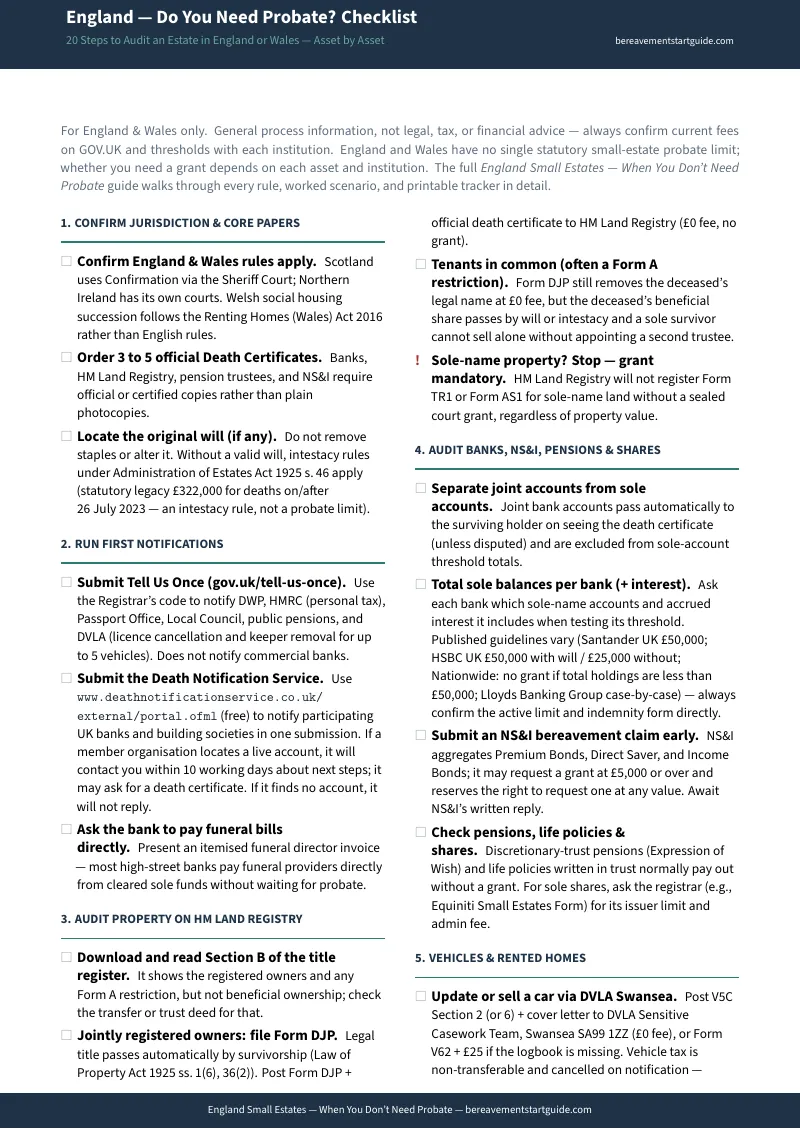
Not sure yet? Download the free 2-page England — Do You Need Probate? Checklist to run an immediate 20-step triage. Ready for the complete 56-page guide, four worked scenarios, and all five printable worksheets? Get instant PDF access now and settle the estate with a clear, documented plan.
Frequently Asked Questions
What if the rules change after I buy?
We update the guide when the rules change. Email us any time, even years later, and we'll send you the current edition free.