Your Wishes, Written in Language Scottish Clinicians Actually Follow
Scotland has no Advance Decision to Refuse Treatment statute. No statutory form. No government registry. The Mental Capacity Act that governs England and Wales stops at the border.
What Scotland does have is a common-law framework that makes a clearly drafted advance directive highly persuasive and effectively binding — if the document is written correctly. If it is not, nothing compels a hospital team to follow it. Vague language like "no extraordinary measures" gives clinicians and family members room to override you, and there is no ombudsman to appeal to at three in the morning.
This is the Scots Law Directive System — a complete planning toolkit built specifically for Scotland's separate legal and clinical infrastructure. It covers the common-law drafting rules that make your treatment refusals stick, the OPG registration process for Welfare and Continuing Powers of Attorney, and the NHS Key Information Summary upload that makes your preferences visible to every paramedic, out-of-hours doctor, and NHS 24 clinician in Scotland.
What's Inside
- Common-law drafting templates with clinical precision — Treatment refusal clauses for CPR, mechanical ventilation, artificial nutrition and hydration, and specific progressive conditions. Each clause includes the explicit life-risk acknowledgement that Scottish courts expect, because a refusal that does not address the possibility of death can be treated as ambiguous.
- The NHS KIS Upload Kit — Your advance directive has no clinical effect in an emergency unless your GP has uploaded it to the Key Information Summary database. Most families do not know this. The kit includes a GP practice request letter, a checklist of the specific KIS fields that need to be completed, and instructions for confirming the upload was processed correctly.
- OPG backlog navigation — Welfare Power of Attorney registration in Scotland currently takes up to 12 months. The guide explains how to use your advance directive as interim protection while the WPA sits in the Falkirk queue, and how to apply for expedited processing when a medical or social work crisis forces the timeline.
- Advance Directive Drafting Worksheet — A structured printable form that walks you through each clinical scenario, each treatment, and each refusal — including the sanctity-of-life clause — before you write the formal document.
- Document Storage Tracker — A record sheet mapping every copy of every document to its physical and digital location: your GP practice, your named attorney, your bedside drawer, your solicitor's file.
- GP Practice Request Letter — A ready-to-send letter asking your surgery to upload your advance directive to the KIS, complete with the clinical codes that the practice receptionist will need to pass to the GP.
- Attorney Selection Scorecard — A structured evaluation tool for choosing your welfare attorney, covering willingness, geographic proximity, emotional resilience, and potential conflicts of interest.
- Estate Inventory Worksheet — A form for compiling the Sheriff Court Confirmation Inventory (Form C1): heritable property, bank accounts with accrued interest, investments valued at date of death, vehicles, personal effects, and liabilities.
- ReSPECT and DNACPR alignment guidance — Your advance directive informs the ReSPECT form and any DNACPR order, but it does not replace them. The guide explains how to ensure all three documents align, and how to raise these conversations with your GP or hospital consultant.
- Organ donation documentation — Scotland's opt-out law presumes authorisation unless you have explicitly opted out. The guide includes a donation declaration section that integrates with your advance directive and the NHS Organ Donor Register, so your position is clear and family disputes are prevented.
- Sheriff Court estate roadmap — Death registration within the 8-day Scottish deadline, the Confirmation process, Bond of Caution requirements for intestate estates, the executor-dative petition, and the Funeral Support Payment application.
Who This Is For
- Adults in Scotland who want to document treatment refusals that clinicians must respect — without paying a solicitor £500–£1,000 for standard estate planning documents
- Caregivers whose parent has been admitted to an NHS Scotland hospital and needs immediate welfare and financial decision-making authority
- Families navigating the OPG's registration backlog who need interim protection while a Welfare Power of Attorney processes
- Anyone who has drafted a directive but has not confirmed that their GP uploaded it to the KIS database — the most common gap in Scottish advance care planning
Why Free Templates Fall Short in Scotland
Compassion in Dying's free Advance Decision pack is designed for English law — the Mental Capacity Act 2005 statutory requirements, not Scotland's common-law rules. NHS Inform's anticipatory care planning pages explain the KIS concept but provide no letter templates, no clinical wording, and no guidance on what to do when the OPG queue means your Welfare POA will not be registered for a year. Age Scotland's leaflets cover the Adults with Incapacity Act clearly but stop at the explanation stage — they do not give you the structured tools to actually draft, sign, upload, and verify.
This toolkit bridges that gap. It starts where the free resources stop: at the point where you need to write specific clinical refusals, get them into the right database, and coordinate them with your Power of Attorney documents — all within Scotland's separate legal system.
Satisfaction Guarantee
If the toolkit does not give you what you need, email hello@bereavementstartguide.com and we will make it right.
Get Started
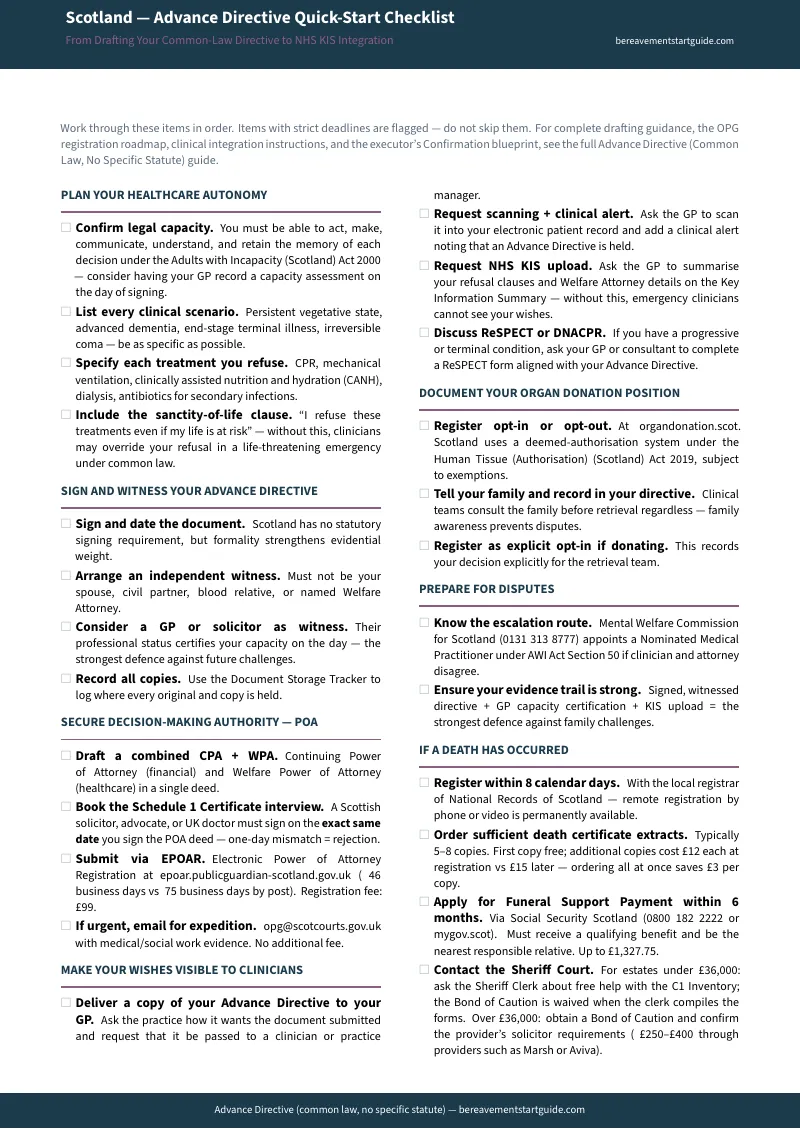
Download the free checklist for an overview of every critical action and deadline. When you are ready for the full drafting templates, KIS upload kit, and estate roadmap, get the complete toolkit — for less than a single hour of a solicitor's time.
Frequently Asked Questions
What if the rules change after I buy?
We update the guide when the rules change. Email us any time, even years later, and we'll send you the current edition free.