The Bank Says "Letters of Administration." Scotland Has No Such Thing.
Someone has died in Scotland without a will. The bank has frozen every account. The letter says you need "Letters of Administration" or "Probate" — terms borrowed from an English system that does not apply north of the border. In Scotland, you need Confirmation. Because there is no will, nobody is named executor. For an estate over £36,000, you petition the sheriff court to appoint you as executor-dative before applying for Confirmation.
The Scottish Courts and Tribunals Service publishes guidance notes and form templates, but for estates over £36,000, their website states explicitly that court staff cannot help you with the application. HMRC publishes Form C1 and 25 pages of notes explaining tax valuation rules — not how to draft the court petition. Citizens Advice Scotland explains what prior rights are, then tells you to find a solicitor. The solicitor quotes thousands of pounds in fees, plus the court lodging fee, plus the bond of caution premium, for a process you are legally entitled to handle yourself in an uncontested family estate.
The Scotland Executor-Dative Guide is the Intestacy Navigation System that fills this gap: a complete, step-by-step process map from "someone has died without a will" to "Confirmation is granted," written for Scotland and only Scotland, in the order things actually happen.
What's Inside
- Who can petition and in what order — the statutory priority of entitlement, how joint appointments work, and what happens when the surviving spouse's prior rights exhaust the estate before anyone else has a claim
- The sheriff court petition — what the petition contains, which sheriffdom you file in, the £23 lodging fee, the intimation period, and the hearing, so you draft the application correctly the first time instead of having it returned
- The bond of caution decoded — what it is, why the court requires it, how to approach underwriters without going through a solicitor, and the specific situations where the bond is not required at all — because most online guides mention caution without explaining the exemptions
- Prior rights with worked arithmetic — dwelling house (up to £473,000), furniture and plenishings (up to £29,000), and financial provision (£50,000 or £89,000), applied in the statutory cascade order with three complete worked examples, so you can see exactly how much reaches the next tier
- Legal rights explained — jus relicti, jus relictae and legitim: the fractions, the moveable-estate-only rule, and worked calculations with and without a surviving spouse, because getting this arithmetic wrong creates personal liability for the executor
- The free estate and the succession order — what remains after prior and legal rights, the rigid section 2 hierarchy from children through parents, siblings and collaterals, and when the Crown takes the estate as ultimus haeres
- The C1 inventory — date-of-death asset valuation, the heritable/moveable distinction, how secured debts affect net C1 values and gross Confirmation value, why Form C5 is abolished for most post-2022 deaths, and the most common rejection triggers so you avoid the 24–30% return rate
- The cohabitant's deadline — the six-month section 29 limit for deaths before 14 December 2026 and twelve-month limit for deaths on or after that date, what the court considers, and the consequences of missing the deadline
- The small-estate route — the £36,000 threshold, sheriff clerk help with the inventory, the bond exemption when the clerk assists, and the fees for copies and certificates that remain payable
- Court fees — the full fee schedule from the dative petition through certificates of confirmation, with the inventory examination tiers (£0 / £351 / £705)
- When you genuinely need a solicitor — contested entitlement, insolvent estates, cohabitant claims, cross-border assets, and the specific situations where professional help is worth the cost
- Scottish legal terms glossary — plain-English definitions for every term the sheriff court uses that the rest of the UK does not
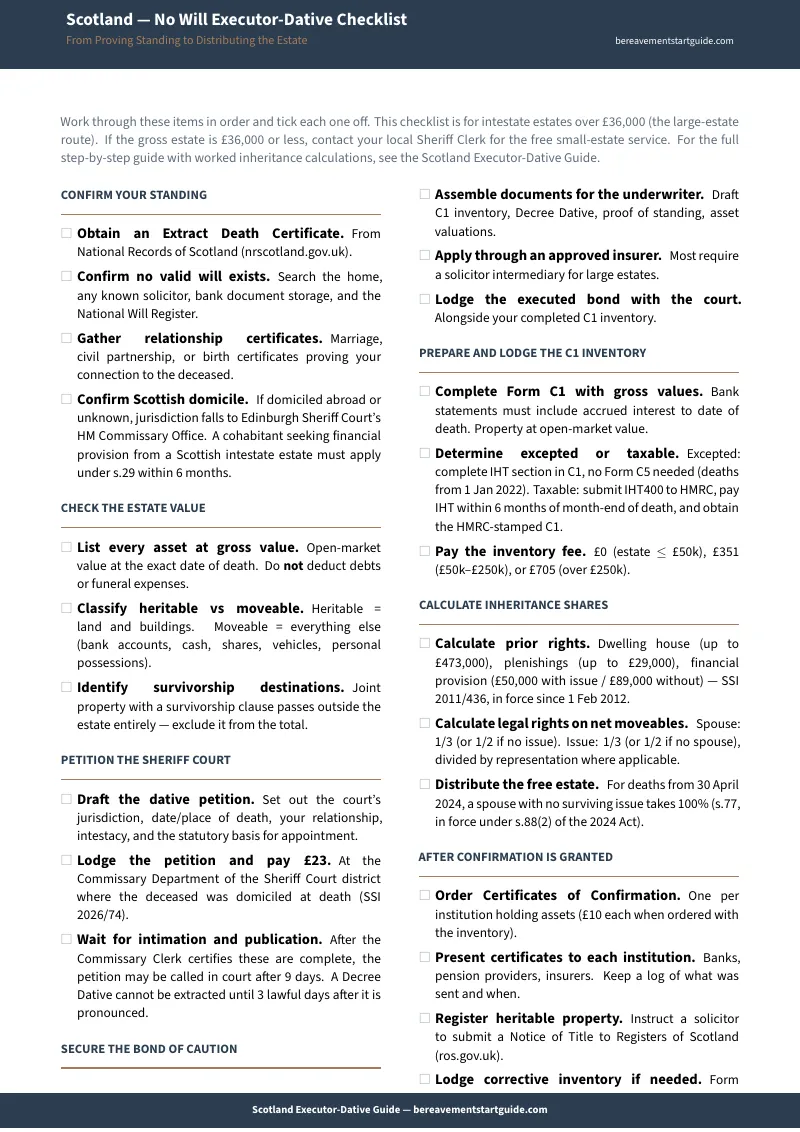
Plus a printable 24-step checklist covering every document, form, fee and deadline from the first petition through to the grant of Confirmation.
Plus six standalone printable worksheets: an estate asset inventory aligned with the C1 format, a prior rights calculator, a legal rights and free estate calculator, a bond of caution preparation checklist, a petition preparation checklist and a post-confirmation action tracker — print them, fill them in and bring them to the sheriff court or the solicitor's office.
Who This Guide Is For
- Surviving spouses and civil partners who have been told they need "Letters of Administration" and want to understand what prior rights give them before spending anything on a solicitor
- Adult children coordinating siblings, splitting costs, and working out whether the surviving parent's prior rights leave anything for the next generation
- Families where the estate is over £36,000, the SCTS cannot help, and the solicitor's quote makes no sense for a straightforward, uncontested estate
- Unmarried cohabitants facing the six-month section 29 limit for deaths before 14 December 2026 and twelve-month limit for deaths on or after that date, with no automatic standing as executor
- Relatives at any step in the priority order who have been asked to administer an estate because nobody closer in the statutory hierarchy is willing or able
Why Not Use the Free Government Guidance?
The SCTS publishes the official guidance notes and the blank Form C1. For estates of £36,000 or less, the sheriff clerk can help prepare the inventory. If the clerk prepares it, no bond of caution is required, and there is no statutory fee for issuing confirmation; fees for certificates and copies remain payable. That is a genuine, useful service, and if your estate qualifies, you should use it — you do not need this guide.
For estates over £36,000, the picture changes. The SCTS website says court staff cannot assist you. HMRC's C3 guidance notes help you complete the C1 inventory and explain tax valuation rules, but they do not explain how to draft the dative petition. Citizens Advice Scotland describes the statutory rights framework in general terms, then refers you to a solicitor. Online forum threads mix English and Scottish terminology, cite abolished forms, and repeat rules from jurisdictions that do not apply north of the border.
The result is a family trying to piece together a sheriff court petition from fragments of English probate guidance, an HMRC tax manual, and a Reddit thread from 2019 that still references Form C5.
This guide replaces that patchwork with a single, end-to-end process written exclusively for the Scottish executor-dative route, with every statutory figure dated to its current source.
Satisfaction Guarantee
If the guide does not help you navigate the executor-dative process, email hello@bereavementstartguide.com for a full refund, no time limit. No questions, no hoops.
Get Started
Download the free checklist to see the 24 steps laid out in order — who can petition, what the sheriff court needs, how prior and legal rights are worked out, and every form and fee along the way.
When you are ready for the full worked examples, the C1 walkthrough, the bond of caution strategy and the chapter-by-chapter process, get the complete Scotland Executor-Dative Guide for — less than a single hour of a solicitor's time.
Frequently Asked Questions
What if the rules change after I buy?
We update the guide when the rules change. Email us any time, even years later, and we'll send you the current edition free.