The bank said no. The solicitor quoted £1,500. The court website says "phone for an appointment."
You are standing between three systems that do not talk to each other — the bank that froze the account, the court that issues the legal authority, and the government guidance that assumes you already know how Scottish confirmation works. Meanwhile, the funeral invoice is sitting on the kitchen table and every institution wants a different piece of paper.
The sheriff clerk at your local court will help you prepare the paperwork for a small estate — that much is true. But the clerk's help has hard boundaries. They cannot tell you whether you need confirmation in the first place. They cannot help you beforehand. And they stop the moment the certificate lands in your hands, leaving you to collect every asset, pay every debt and account to every beneficiary on your own.
The Small Estate Confirmation Toolkit
This guide bridges the gap between what the court gives you and what you actually need to get through the process from start to finish. It is built entirely around the Scottish small-estate procedure — the £36,000 threshold, the sheriff clerk's service, the Form C1 inventory, the bond of caution rules and everything that happens after the certificate arrives.
It is not generic UK probate guidance repackaged with a tartan cover. Every form reference, fee figure, court procedure and worked example is specific to Scotland's confirmation system and dated to its source.
What's Inside
- Do-I-need-confirmation decision framework — a structured walkthrough of bank release thresholds, joint-account rules, survivorship destinations in property titles, nominated pensions and NS&I holdings, so you know exactly which assets need court authority and which do not
- Gross-estate calculation worksheet — the £36,000 ceiling is calculated on gross confirmable value, not net. Debts, funeral costs and liabilities cannot be subtracted to squeeze below the line. The worksheet shows what counts, what does not and how to handle joint assets
- Sheriff clerk appointment preparation checklist — the full list of documents to bring (original will, death certificate, photo ID, proof of address, date-of-death balance certificates from every bank and building society), to help you prepare the information the sheriff clerk needs to complete the inventory
- Form C1 inventory drafting guide — how to list each type of asset (bank accounts, vehicles, pension refunds, accrued interest, unit trusts) with the correct date-of-death valuations and formatting the court expects
- Bond of caution explained — when it is required, when no bond is needed for a small intestate estate if the sheriff clerk's office prepares the inventory, and what to do if you use another route
- Post-confirmation asset collection ledger — tracking template for sending certified copies of confirmation to each institution, recording the funds received and matching them against the inventory
- Beneficiary distribution and discharge record — the paper trail that protects you as executor: who received what, when and with what acknowledgement
Who This Is For
You are a surviving spouse, an adult child or a sibling in Scotland. The person who died left a modest estate — perhaps a bank account, some savings, a vehicle, maybe a flat. Someone at the bank or a solicitor's office has told you the estate counts as "small." You want to handle confirmation yourself rather than paying legal fees that would swallow a large share of the estate.
This guide is for simple, non-contentious estates. If the will is disputed, if beneficiaries disagree about shares, if there are significant business assets or cross-border complications, you need a solicitor — and the guide tells you exactly when to stop and get one.
Why Not Just Use the Free Court Guidance?
You should use it — and the guide points you to official form sources, court office directories and free advisory services. The court's own guidance explains what confirmation is. What it does not do is walk you through the practical execution: how to organise your paperwork before the appointment so you are not sent home, how to draft the inventory entries the clerk will need, how to handle assets the court forms do not mention, and how to manage everything that happens after the clerk's job ends.
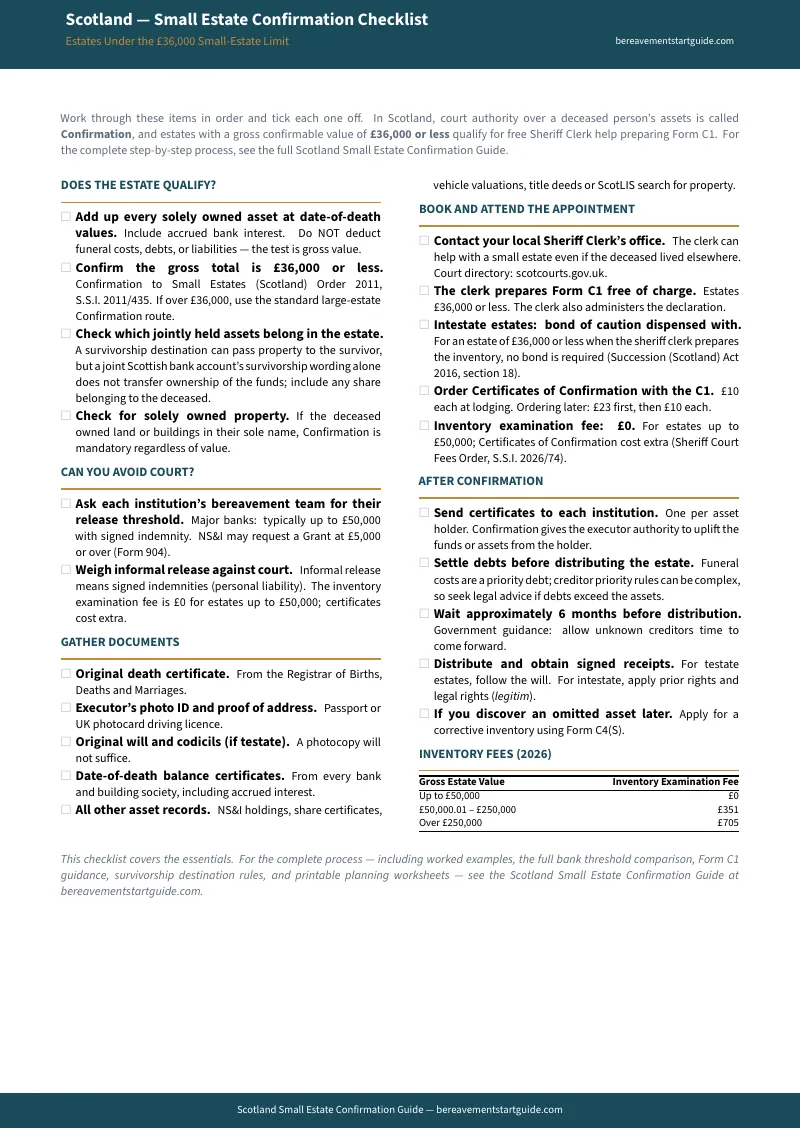
The free checklist you can download above covers the essentials — whether the estate qualifies, what to bring to court and the SCTS website address. The full toolkit goes further: a fourteen-chapter guide with worked examples, six printable worksheets (estate valuation, decision framework, C1 inventory preparation, bank threshold tracker, asset collection ledger and beneficiary distribution record) and the complete post-confirmation workflow from certificate to final distribution.
What It Costs
The guide costs — a one-time download, no subscription. That is a fraction of the £1,500–£2,500 that solicitors typically quote for straightforward confirmation work. If you decide partway through that you need professional help after all, nothing is lost: the preparation work you have done with the guide makes the solicitor's job faster and cheaper.
Satisfaction Guarantee
If the guide does not help you, email hello@bereavementstartguide.com for a full refund, no time limit. We read every message.
Frequently Asked Questions
Is this an official government guide?
No. This is an independent educational publication. It has no affiliation with the Scottish Courts and Tribunals Service, HMRC or the Scottish Government. The guide lists official form sources, court directories and government resources so you can verify the process against primary sources.
What if the estate is worth more than £36,000?
The small-estate procedure only applies to estates of £36,000 or less in gross confirmable value. If the estate exceeds that threshold — or if newly discovered assets push it above — the guide explains the hand-off and points you to the Scotland Probate Process Guide, which covers the standard confirmation procedure for larger estates.
What if there is no will?
The guide covers both testate (with a will) and intestate (without a will) small estates. For an intestate estate of £36,000 or less, no bond of caution is required when the sheriff clerk's office helps prepare the inventory. If the intestate estate is above £36,000, you would need the Scotland Executor-Dative Guide instead.
Can I handle this without a solicitor?
For a straightforward small estate — a few bank accounts, a vehicle, perhaps a pension refund — most people can handle the process themselves with the sheriff clerk's help and this guide. The guide is clear about when professional help is needed: disputed wills, contested claims, business assets, cross-border estates or anything involving the Court of Session.
How is the free checklist different from the full guide?
The free checklist is a one-page decision tool: it tells you whether the estate qualifies as small, lists the documents for your court appointment and gives you the SCTS website address. The full toolkit includes a fourteen-chapter guide with worked examples, plus six printable worksheets — estate valuation, decision framework, C1 inventory preparation, bank threshold tracker, asset collection ledger and beneficiary distribution record. The checklist tells you what to do; the guide and worksheets show you how.
Frequently Asked Questions
What if the rules change after I buy?
We update the guide when the rules change. Email us any time, even years later, and we'll send you the current edition free.