You Downloaded the Form. Now What?
The California Attorney General's office publishes the statutory Advance Health Care Directive form for free. Millions of Californians have downloaded it. Most of them are still sitting on an unsigned PDF — because the form is the easy part.
The hard part is execution: figuring out who can legally witness your signature (the rules disqualify more people than you'd expect), formatting the PDF so Kaiser's scanning center doesn't reject it after a 7-day review, discovering that your parent's nursing home directive is legally void without a registered ombudsman present, and navigating a state registry that has no online portal and requires a physical check mailed to Sacramento.
The California Advance Directive & Living Will Kit is an Execution Bridge System — it takes you from downloaded form to legally valid, hospital-uploaded, state-registered directive in a single afternoon. No attorney consultation. No subscription. No second attempt because you got the witnessing wrong.
— Less Than 15 Minutes with an Attorney
Elder law attorneys charge $150–$400 for a standalone advance directive. That's without the hospital upload walkthrough, the ombudsman scheduling instructions, or the Secretary of State filing checklist. And the consultation takes weeks to schedule.
The kit covers everything the attorney would — and several things most attorneys don't mention — for a one-time fee that's a fraction of a single billable quarter-hour.
What the Kit Covers
- The Complete AHCD Framework — California's two-part structure (healthcare agent appointment + treatment preferences) explained in plain English, with the exact Probate Code sections so you know the legal basis for every step
- Agent Selection and Briefing Protocol — who is legally barred from serving as your agent (Probate Code § 4659), the difference between immediate and springing authority, and a structured conversation guide covering core values, specific interventions, and comfort care boundaries
- Treatment Preference Documentation — graduated options for CPR, mechanical ventilation, artificial nutrition, pain management, and organ donation that go beyond the form's checkbox format. How to document a 14-day ventilator trial when the form only offers "yes" or "no"
- Dementia Planning Addendum — the dedicated section standard advance directives miss entirely. Stage-specific preferences for early, middle, and late cognitive decline: medication compliance, feeding assistance, hospitalization thresholds, and the transition point to comfort-only care
- Witness Eligibility Checklist — the complete disqualification rules that trip up most families. Pre-formatted notary blocks as the simpler alternative ($15 maximum under California law)
- Nursing Home Ombudsman Walkthrough — the Probate Code § 4675 requirement that makes any directive signed in a skilled nursing facility legally void without a registered ombudsman witness. Scheduling process, required addendum form, private capacity verification
- Kaiser Permanente Upload Guide — the kp.org portal workflow: Medical Records → Life Care Planning, single PDF under 4MB, full name and MRN on every page. The exact formatting that prevents the rejection-and-resubmit cycle
- Sutter Health Upload Guide — My Health Online portal submission with the specific requirements that differ from Kaiser's process
- Secretary of State Registry Filing — Form SFL-461 checklist, required identifiers (SSN or CA DMV ID), $10 check, and the Sacramento mailing address. No online portal exists — this is the only way to register
- POLST and DNR Coordination — how the legal planning document (AHCD) works alongside the clinical medical orders (POLST on bright pink paper, DNR) that paramedics actually follow during an emergency. When you need both and how to ensure they don't contradict each other
- Community Property Step-Up Basis — for married couples, how California's full double step-up (IRC § 1014(b)(6)) works and why your AHCD should coordinate with your trust and financial DPOA
- LGBTQ+ and Unmarried Partner Protections — your partner has zero default medical decision-making authority without an AHCD. The specific legal mechanism that puts them ahead of biological family in the surrogate hierarchy
- Review, Update, and Revocation System — the 5 Ds framework (Death, Divorce, Diagnosis, Decline, Decade), how a new directive supersedes an old one, and when you need a formal revocation versus a simple update
Who This Is For
- Adults helping aging parents who need a legally valid directive completed before a health crisis makes it urgent — and need to know how to start that conversation
- People facing scheduled surgery who need an executed AHCD uploaded to their hospital portal before the pre-op appointment
- Unmarried and LGBTQ+ partners who need to override California's default surrogate hierarchy before a medical emergency reveals that their partner has no legal standing
- Family caregivers navigating nursing home admissions who need to understand the ombudsman witnessing requirement before they schedule a signing
- Anyone who downloaded the free form and got stuck on the witnessing rules, the hospital upload process, or the state registry filing
- Families coordinating a complete estate plan who need the AHCD to work alongside existing trusts and financial powers of attorney
Why Not Just Use the Free Form?
The statutory form from oag.ca.gov is technically complete. But it ships with zero operational guidance. No witness eligibility rules. No hospital upload instructions. No ombudsman scheduling process. No state registry filing checklist. No explanation of how the AHCD interacts with POLST or DNR orders.
National platforms like LegalZoom, Five Wishes, and Trust & Will charge more and deliver less — generic multi-state templates that don't cover California's nursing home ombudsman mandate, the Kaiser upload workflow, or the Secretary of State's mail-only registry. They give you a form. The kit gives you the execution system that makes the form work.
The Guarantee
If your physician, hospital network, nursing facility, or notary public rejects the instructions in this kit for any compliance reason, email us for an immediate, no-questions-asked refund.
Start Today
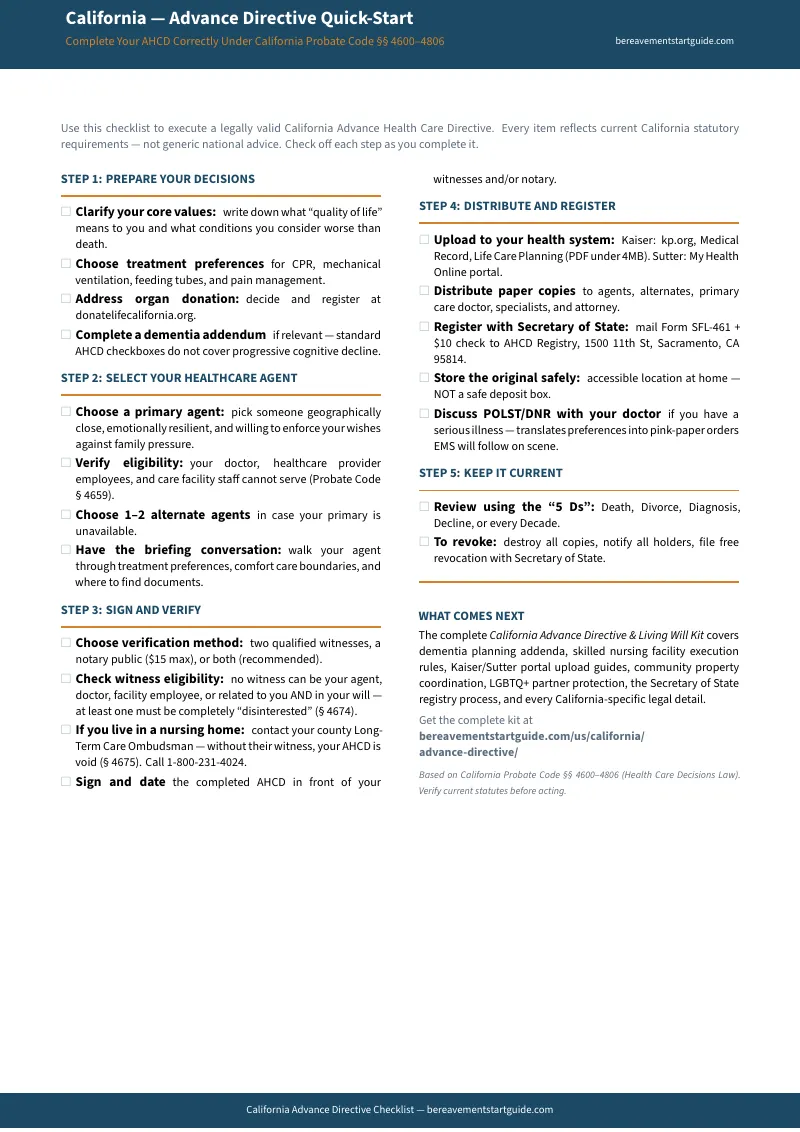
Download the free California Advance Directive Quick-Start Checklist to see every step at a glance. When you're ready for the full execution system — the 13-chapter guide plus 10 standalone printable tools (witness eligibility checklist, treatment preferences worksheet, dementia planning addendum, agent briefing guide, Kaiser and Sutter upload guides, ombudsman scheduling checklist, Secretary of State filing checklist, POLST coordination reference, and review reminder card) — the complete kit is available for .
Disclaimer: Bereavement Start Guide is a publisher of self-help educational templates and resource guides. The materials in this kit are designed to comply with California Probate Code but do not constitute legal or medical advice. For complex estate planning, contested family dynamics, or specific medical instructions, consult a licensed California attorney or healthcare provider.
Frequently Asked Questions
What if the rules change after I buy?
We update the guide when the rules change. Email us any time, even years later, and we'll send you the current edition free.