Your Parent Is in the Hospital. The Doctor Asks Who Has Authority to Make Medical Decisions. You Say "I'm the Daughter." Colorado Law Says That Is Not How It Works — And Now Every Family Member Has to Agree Before Anyone Can Act.
This is how most Colorado families discover the Proxy Decision-Maker Act. Not during a planned conversation at the kitchen table. During a crisis — in an ICU hallway, after a stroke, during a rapid cognitive decline — when someone asks the attending physician "can I authorize this treatment?" and the answer is: not without unanimous agreement from every interested person in the family.
Colorado is not like other states. There is no default next-of-kin hierarchy for adult medical decisions. Under C.R.S. § 15-18.5-103, if a patient becomes incapacitated without a Medical Durable Power of Attorney, the hospital must contact all interested persons — spouse, parents, adult children, siblings, even close friends — and every one of them must agree on who makes decisions. If one person objects, the family's only path is a guardianship petition in county probate court. That process can take weeks, cost thousands, and result in a professional guardian who charges by the hour to make decisions for someone they have never met.
The Colorado Advance Directive & Living Will Kit is a Witness-Trap Bypass System — built around Colorado's unique notary-only execution option (C.R.S. § 15-18-106) that eliminates the disinterested witness requirement entirely, plus structured walkthroughs for every document in Colorado's advance care planning framework: MDPOA, Living Will, CPR Directive, MOST coordination, organ donation, and disposition of remains.
What's Inside the Witness-Trap Bypass System
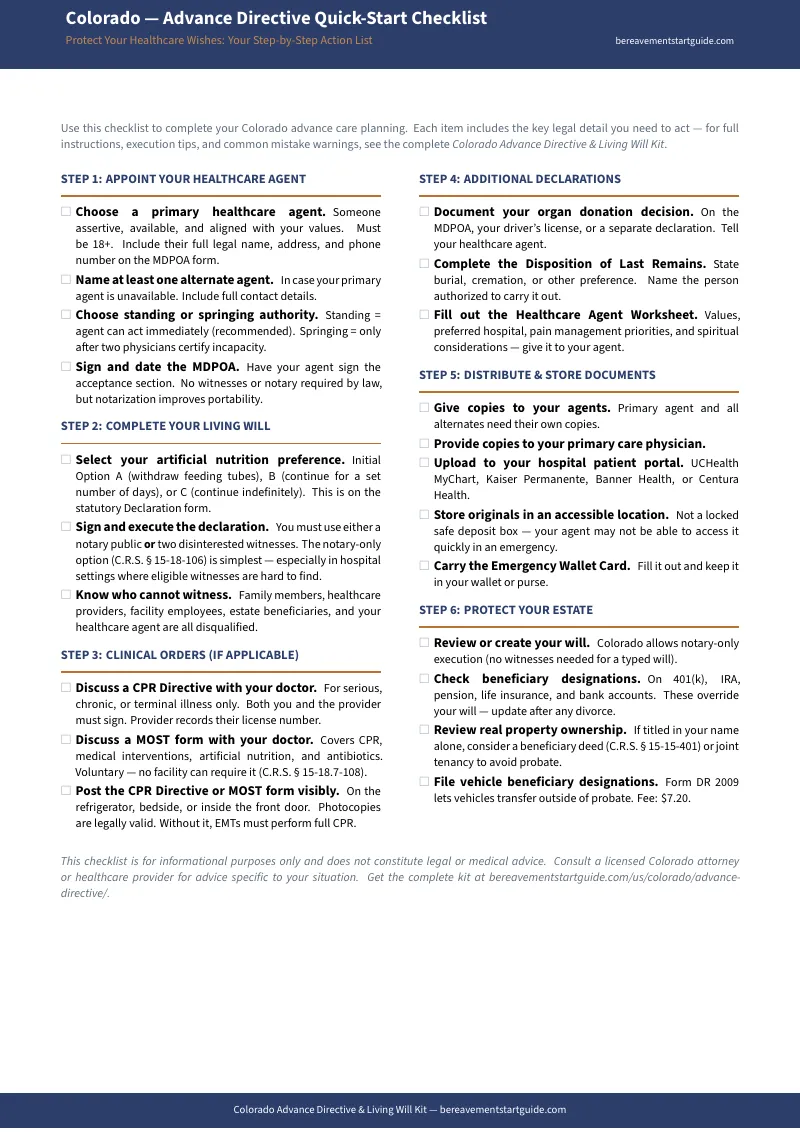
A comprehensive 10-chapter guide, a 20-item Quick-Start Checklist, and standalone printable tools — covering every step from understanding Colorado's advance directive framework through distributing and storing your completed documents, built specifically for Colorado statutory requirements that make advance care planning here different from any other state:
Medical Durable Power of Attorney: Ending the Consensus Problem
The MDPOA is the single most important document in Colorado's advance care planning system. Without it, the Proxy Decision-Maker Act forces every family member to agree — or forces the family into court. The guide walks you through selecting a primary agent and alternates, choosing between standing authority (takes effect immediately) and springing authority (requires certification by two physicians), and defining the scope of your agent's decision-making power. It covers HIPAA authorization, the statutory limitations on proxy authority (no assisted suicide, no decisions outside the scope of the directive), and how to brief your agent so they are prepared for the clinical conversations that happen at 2 a.m. in an emergency department.
The Notary-Only Path: How Colorado Lets You Skip the Witness Trap
Most states require two disinterested witnesses for a valid living will. Colorado does too — unless you use a notary. Under C.R.S. § 15-18-106(1)(b), a Declaration as to Medical Treatment signed before a notary public is legally valid without any witnesses at all. This matters because the disinterested witness requirements disqualify family members, your named agent, healthcare employees, and anyone entitled to inherit from your estate. In a hospital or hospice setting, finding two eligible strangers willing to witness a legal document is often impossible. The kit includes notary-only execution templates that bypass this problem entirely.
Living Will: Making Terminal Care Choices Explicit
Colorado's living will takes effect only after two physicians certify in writing that you are terminally ill or in a persistent vegetative state. The guide explains what each treatment category means in practice — mechanical ventilation, artificial nutrition and hydration, dialysis, antibiotics, blood transfusion — and how to document your preferences so they leave no room for interpretation or family dispute. It covers the distinction between "withhold" and "withdraw," the comfort-care-only option, and how to add specific instructions for situations the standard form does not address.
CPR Directive and MOST Form: The Pre-Hospital Gap
A living will does not stop CPR. Colorado EMTs are legally required to perform full resuscitation unless a physician-signed CPR Directive (the orange "double-heart" form) or MOST form is physically present. Families who rely solely on a living will are often devastated to learn that first responders performed aggressive interventions they believed were refused — because the living will is a legal declaration, not a medical order. The guide explains which patients need a CPR Directive versus a MOST form, how to request them from your physician, and where to place them in your home for emergency access.
Organ Donation and Disposition of Remains
Colorado's Uniform Anatomical Gift Act allows you to make a legally binding organ and tissue donation declaration within your advance directive. The guide covers the registration process, coordination with Donor Alliance (Colorado's organ procurement organization), and how to document your anatomical gift wishes so they do not conflict with your treatment preferences. It also walks through the Disposition of Last Remains declaration — burial, cremation, aquamation, green burial, or body donation — and the legal authority chain that governs who controls your remains when there is no written instruction.
Execution Checklists and Standalone Tools
In addition to the full guide and quick-start checklist, the kit includes standalone PDFs you can print, hand to your proxy, or post on the refrigerator:
- Witness Screening Checklist — screen both witnesses against every disqualification category before signing day, or confirm you qualify for the notary-only path
- Healthcare Agent Briefing Packet — hand this directly to your named proxy so they understand their legal authority, HIPAA rights, and the boundaries Colorado law places on their decisions
- Treatment Decision Worksheet — record your choices for life-sustaining treatment, artificial nutrition, CPR, organ donation, and remains disposition before filling out the official forms
- Family Conversation Starters — scripts for initiating the advance care planning conversation with parents, spouses, or adult children without the discussion turning into silence or a fight
- Storage & Distribution Tracker — track where every copy of your signed directive goes (agents, physicians, hospital portals, wallet card)
- Colorado Key Contacts — quick-reference card with phone numbers for CDPHE, Colorado Legal Services, UCHealth patient services, and notary locators
- 7 Mistakes That Invalidate Your Colorado Directive — review this before signing to avoid the most common execution failures under Colorado law
Who This Kit Is For
- The adult child managing a parent's declining health — who needs clear legal authority to communicate with doctors, access medical records, and make treatment decisions without waiting for a unanimous family consensus or a probate court guardian
- The parent of a college student — who discovered that once their child turned 18, HIPAA prevents hospitals from sharing medical information or allowing a parent to make emergency decisions without a signed MDPOA
- The recently diagnosed patient — facing a serious or terminal illness and needing to document medical wishes while they still have legal capacity to sign, before the clinical situation narrows the window
- The caregiver of someone with early-stage dementia — who understands that legal capacity is not permanent and needs to execute planning documents while the person can still legally sign
- The spouse in a blended family — who needs explicit documentation to prevent disputes between a current partner and children from a previous marriage over treatment decisions and remains disposition
- The retiree arranging their affairs — who wants their children spared the emotional burden of guessing their treatment preferences or fighting over whether to continue life support during a family crisis
Why Free Colorado Forms Leave Families Exposed
The Colorado Judicial Branch and CDPHE distribute the statutory advance directive forms at no cost. The Colorado Hospital Association publishes a free booklet. UCHealth and Kaiser Permanente offer their own form packets. The legal skeleton is there. Here is what is missing:
- No notary-path guidance. Free forms include the notary signature block but do not explain that using a notary eliminates the witness requirement entirely — families spend days trying to locate disinterested witnesses when a single notary appointment would solve the problem in minutes.
- No proxy consensus warning. Free forms let you name a healthcare agent but do not explain what happens if you skip this step: the Proxy Decision-Maker Act's unanimous consensus requirement, the risk of guardianship court, and the professional guardian fees that can drain an estate.
- No CPR Directive coordination. Standard hospital PDFs do not explain that a living will alone will not prevent unwanted resuscitation — EMTs must follow a physician-signed CPR Directive or MOST form. Families learn this distinction during the emergency it was supposed to prevent.
- No agent preparation. Free forms designate a decision-maker but do not explain their legal duties, HIPAA access process, authority limitations, or what clinical conversations look like in practice. Agents walk into ICU meetings unprepared for the decisions they are asked to make.
- No conversation framework. The blank forms arrive without any guidance for the hardest part: how to bring up end-of-life planning with your family when everyone would rather avoid the topic.
Generic online platforms like Trust & Will, LawDepot, and WillMaker generate documents but do not provide Colorado-specific execution guidance. They produce forms — they do not help you survive the signing table, prepare your agent for their role, or ensure the right documents reach the right people before the emergency happens.
Your Purchase Is Protected
If the kit does not help you complete a legally sound Colorado advance directive, email hello@bereavementstartguide.com for a full refund. No time limit, no questions, no hassle.
Start Planning Today
Download the free Colorado Advance Directive Quick-Start Checklist to see what goes into proper execution under Colorado law. When you are ready for the complete system — the full 10-chapter guide, standalone printable tools (witness screening, agent briefing, treatment worksheet, conversation starters, storage tracker, contacts card, and mistakes reference), plus the checklist — the full kit is . A fraction of the cost of one hour with a Colorado elder-law attorney.
Frequently Asked Questions
What if the rules change after I buy?
We update the guide when the rules change. Email us any time, even years later, and we'll send you the current edition free.