Your Medical Wishes Are One Witness Error Away from Being Ignored
Connecticut gives you a clean, statutory advance directive form — free from the Department of Public Health. Two witnesses, a signature, and you are done. Except you are not.
Your healthcare representative cannot witness the document. If you sign inside a DMHAS or DDS facility, one witness must be unaffiliated with the facility and one must be a physician, APRN, or clinical psychologist — a rule buried deep in the statute that no one explains until after the signing is invalid. Your financial Power of Attorney needs two witnesses and a notary — unlike your medical directive — and one missing signature means your bank rejects it during the exact crisis when you need account access.
The Connecticut Department of Public Health form tells you what to fill in. It does not tell you how to avoid the execution errors that invalidate thousands of directives annually, how to coordinate with MOLST so paramedics actually follow your instructions during an emergency, or how to handle the pregnancy restriction that silently suspends your living will without warning.
The Connecticut Clinical Compliance System
The Connecticut Advance Directive & Living Will Kit is a complete execution system: the step-by-step operational guide that takes you from blank statutory form to legally valid, clinically coordinated, institutionally accepted directive. Every chapter addresses a specific failure point — witness eligibility, financial POA execution, MOLST coordination, special facility rules, the probate fee trap, pregnancy clause language — so you complete the process correctly the first time, without paying an elder law attorney's hourly rate for what is fundamentally a self-directed document.
What's Inside
Connecticut's Combined Advance Directive (C.G.S. § 19a-575a)
The kit covers all four sections of Connecticut's statutory document in a single pass: healthcare representative appointment, living will instructions, conservator nomination, and anatomical gift designation. One document, one signing session, full legal coverage — with the exact execution steps that prevent invalidation.
Witness Eligibility Checklist + Optional Affidavit
Two witnesses are required. Your healthcare representative is disqualified. DMHAS/DDS residents face additional requirements. The kit includes the standalone Witness Eligibility Checklist (witness-eligibility-checklist.pdf) — a printable verification form covering advance directive, financial POA, and facility-specific witness rules — plus the optional Witness Affidavit (C.G.S. § 19a-578) that creates prima facie evidence of validity.
MOLST Coordination Framework
Your living will activates only when you are terminally ill or permanently unconscious. But a cardiac event, a stroke, or a fall happens without warning — and EMTs follow MOLST orders, not advance directives. The kit explains when you need a MOLST, how to initiate the conversation with your physician, and how to ensure your clinical orders match your legal instructions so there is no gap between what you documented and what paramedics are authorized to follow.
Financial POA Execution Checklist — Side by Side
A healthcare directive needs two witnesses. A financial POA needs two witnesses AND notarization. Families routinely get one right and the other wrong — then discover the error when a bank refuses their agent's authority during a medical crisis. The kit includes the standalone Financial POA Execution Checklist (financial-poa-checklist.pdf) — a printable before/during/after signing guide with a bank rejection prevention table.
Special Facility Witnessing Rules
Signing inside a DMHAS or DDS facility requires at least one unaffiliated witness and at least one physician, APRN, or licensed clinical psychologist. Miss either requirement and the directive is void — even if you otherwise followed every rule. The kit includes the complete verification checklist for facility residents.
Pregnancy Restriction + Optional Clause Language
Connecticut law suspends living will instructions — withdrawal of life support specifically — if the declarant is pregnant, unless the fetus is not viable or the directive contains explicit custom language. Without that clause, your instructions simply stop applying during pregnancy with no notice or override. The kit includes the pregnancy provision language that keeps your directive enforceable.
Probate Fee Context and Estate Coordination
Connecticut calculates mandatory probate fees on the gross estate — including assets held in living trusts, joint accounts, and life insurance. A $1.5 million estate pays $8,115 in statutory fees even if every asset bypasses court. The kit explains how your advance directive fits into the broader estate framework — Form CT-706 NT, the six-month filing deadline, the standalone state gift tax — so your healthcare representative, financial POA agent, and executor are not working at cross purposes.
Anatomical Gift + Disposition of Remains
Connecticut's directive includes organ donation under the Uniform Anatomical Gift Act. The kit also covers the separate Designation of Agent for Disposition of Remains — who controls cremation versus burial decisions, and how to prevent sibling conflict when no one agreed in advance.
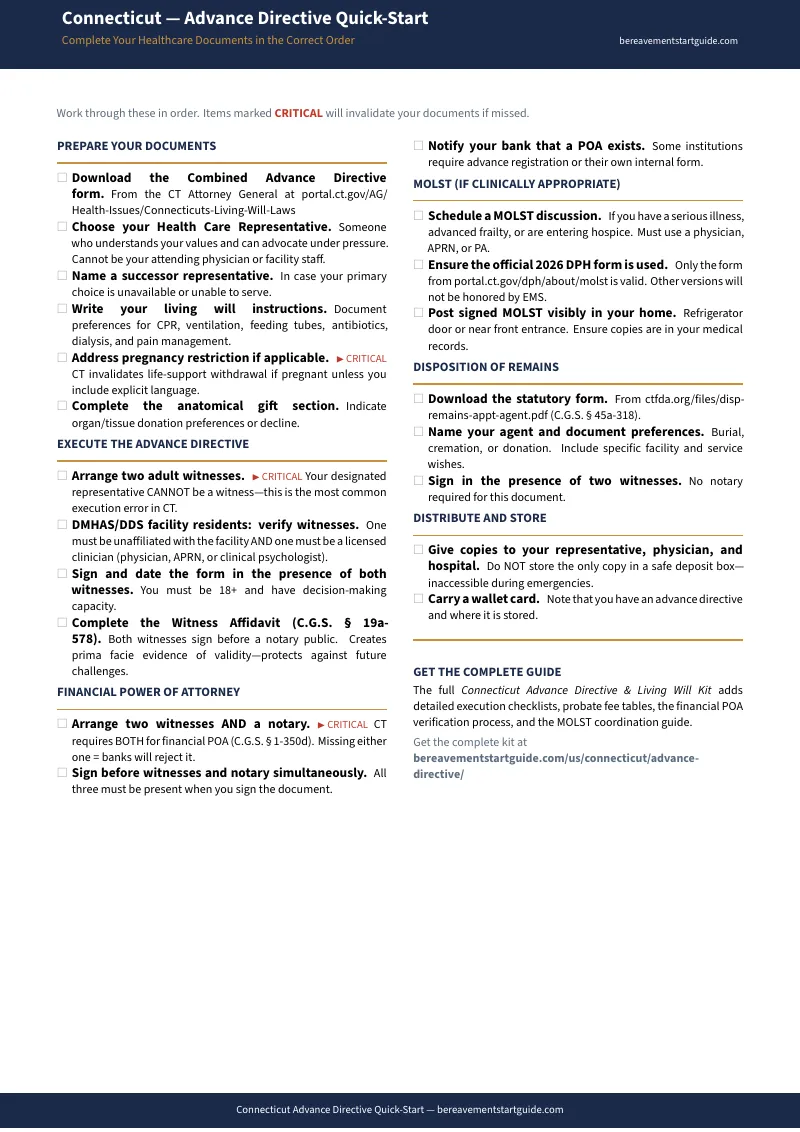
20-Item Quick-Start Checklist + 8 Standalone Printables
A one-page printable reference covering the entire process — plus 8 standalone PDFs you can print individually: Witness Eligibility Checklist, Financial POA Execution Checklist, Document Distribution Checklist, MOLST Conversation Guide, Forms Quick-Reference Card, Agency Contacts Card, Special Situations Quick Reference, and Probate Fee Worksheet. Every critical tool at your fingertips, ready for the signing appointment, physician visit, or bank meeting.
Who This Is For
- Adults documenting their healthcare wishes — before a diagnosis makes it urgent, before a surgery makes it necessary, before the statutory default puts the wrong person in charge
- Adult children helping aging parents — starting the conversation, walking through the signing, ensuring the documents actually work when the crisis arrives
- Unmarried partners — who have zero default medical authority under Connecticut's statutory hierarchy and need an advance directive to override the biological family default
- Families correcting a rejected POA — who discovered the bank requires both witnesses AND notarization and need to execute the financial document correctly this time
- DMHAS/DDS facility residents and their families — who need the special witness requirements explained before the signing, not after it is invalidated
- People coordinating with an existing estate plan — who already have a trust and financial POA and need the healthcare directive to fit the broader framework
Why Not the Free Form Alone?
The DPH statutory form is free. It covers the legal content. What it does not cover:
- Witness eligibility verification — one ineligible witness voids the entire document, and the rules differ between healthcare directives, financial POAs, and facility settings
- MOLST coordination — the form covers planning, but paramedics follow clinical orders. Without MOLST, your directive is not actionable during an emergency
- Financial POA execution — different signing requirements that families routinely conflate, leading to bank rejections during the exact crisis when account access matters
- The pregnancy restriction — nowhere on the standard form does it explain that your living will instructions are suspended during pregnancy without explicit language preserving them
- Probate fee implications — the form does not mention Connecticut's gross-estate calculation, the six-month CT-706 NT deadline, or the interest penalties for late filing
National template platforms (Rocket Lawyer, LegalZoom, eForms) insert Connecticut's name into generic forms. They do not address the DMHAS/DDS facility rules, the optional Witness Affidavit, the standalone state gift tax, or the dual-execution requirements for financial versus healthcare documents. You pay a monthly subscription for a multi-state template, not a Connecticut-specific operational guide.
Our Connecticut Clinical Acceptance Guarantee
If any Connecticut healthcare provider, hospital network, or probate court declines to honor a document prepared using this kit due to formatting or structural non-compliance, email support for a full refund of the purchase price. No questions, no timeline, no hoops.
— Less Than One Hour with an Attorney
A Hartford elder law attorney charges $300–$500 per hour for advance directive work. The full engagement takes weeks to schedule. The kit gives you the same Connecticut-specific execution system — witness rules, affidavit templates, MOLST coordination, financial POA requirements, facility rules, pregnancy clause, probate context — for a one-time purchase with no subscription and no hourly clock.
Not ready for the full kit? Start with the free Connecticut Advance Directive Quick-Start Checklist — the 20-item printable reference covering witness eligibility, distribution targets, and every critical step. The full kit is there when you need the detailed instructions behind each step.
Frequently Asked Questions
What if the rules change after I buy?
We update the guide when the rules change. Email us any time, even years later, and we'll send you the current edition free.