Your POA Is Worthless Until Someone Tries to Use It
You downloaded the free form from CTLawHelp. You signed it at the kitchen table with your neighbor watching. Then six months later, your daughter walked into the bank with your mortgage bill and the signed document — and the branch manager told her no.
Not "come back with more paperwork." Just no.
This is what happens to most Connecticut powers of attorney. They look complete on paper but collapse the moment a bank teller, town clerk, or hospital admissions coordinator puts them under scrutiny. One witness instead of two. A notary acknowledgment but no witness signatures. Generic language that doesn't authorize the one transfer your family actually needs — the self-dealing provision that lets a healthy spouse protect the family home from Medicaid spend-down.
The Connecticut Power of Attorney Kit exists because a document that can't survive its first real-world test is not a plan — it's a false sense of security.
The Bank Acceptance System
Most POA guides hand you forms and wish you luck. This kit was built around a different question: what actually happens when your agent walks into a Connecticut bank branch with your power of attorney and a stack of unpaid bills?
The answer, for most families, is rejection. Branch staff are trained to be suspicious — they fear elder abuse claims and personal liability. Even a perfectly valid POA can get refused if the agent doesn't know how to push back.
Under the Connecticut Uniform Power of Attorney Act, financial institutions are legally prohibited from rejecting a valid document because it's "too old" or not on their proprietary form. The kit includes the tools to enforce that protection:
- Sworn Certification Template — the formal declaration under C.G.S.A. Chapter 15c that compels a financial institution to accept your POA or face statutory liability for court costs and attorney's fees
- Formal Demand Letter — escalation language that moves the conversation from branch manager to legal department within 48 hours
- Signing Protocol — the exact two-witness and notary execution steps that eliminate the "defective document" excuse banks use to stall
When your agent presents the sworn certification, the bank's calculation changes. They're no longer weighing whether to help you — they're weighing whether refusing creates legal exposure for them.
What's Inside the Kit
The complete guide plus 8 standalone printable tools — 10 PDFs total:
- Complete 15-Chapter Guide — covers both financial and healthcare powers of attorney under Connecticut law, with plain-English explanations of agent selection, power customization, the two-witness execution requirement, real estate transactions through town clerks, motor vehicle transfers, and conservatorship avoidance
- Bank Acceptance Toolkit — sworn certification template, formal demand letter, bank visit documentation log, and step-by-step protocol for when a branch refuses to cooperate
- Signing Protocol — witness eligibility table, Connecticut's two-witness plus notary requirement, signing ceremony steps, and what-to-bring checklist for signing day
- Powers Selection Worksheet — general statutory powers, "hot powers" requiring explicit authorization, self-dealing decision, and agent appointment summary
- Gift Tax and Self-Dealing Worksheet — Connecticut's standalone gift tax thresholds, Medicaid gift tax trap, gift tracking log, DRS filing requirements, and self-dealing authorization checklist
- Real Property Transaction Checklist — town clerk recording procedures (not county — Connecticut has no county government), recording fees, closing-day steps, and property information form
- Revocation Forms — pre-drafted revocation document, notification letter template, and certified mail tracking checklist for all parties
- Agent Duties Reference Card — fiduciary obligations, personal liability risks, record-keeping requirements, and transaction log for the person you appoint as agent
- Review Schedule — triggering events table, annual maintenance checklist, review log, and key contacts form
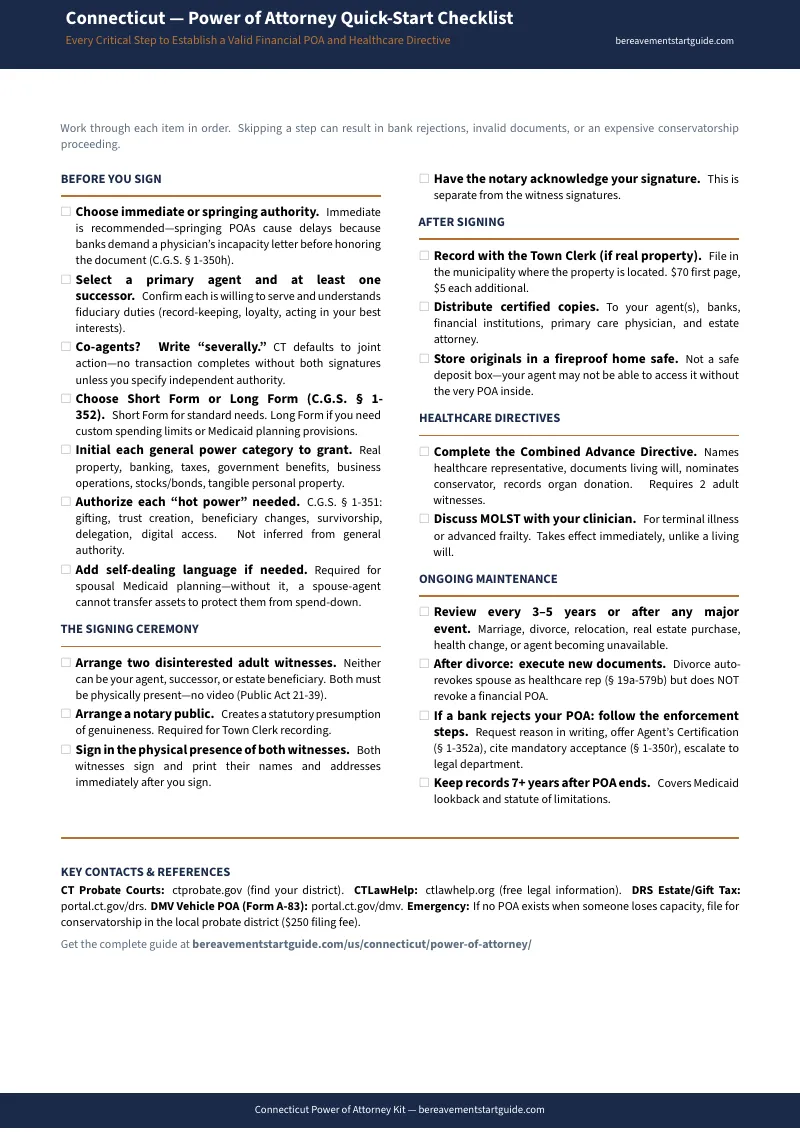
- Quick-Start Checklist (free version available) — one-page essential steps to get your POA executed correctly
Who This Kit Is For
- Adult children managing aging parents — you've noticed the missed bills, the confusion with medications, the mail piling up. You need legal authority to step in before a conservatorship hearing becomes your only option — and that window closes the moment your parent can no longer understand what they're signing.
- Connecticut homeowners — your property is likely your family's largest asset. If a health crisis hits mid-closing or your spouse can't attend a signing, you need a recordable POA that the town clerk won't reject.
- Couples on fixed income — you want mutual financial and medical protection without spending $1,500+ on estate attorney consultations. This kit covers both financial and healthcare POA in a single purchase.
- Families preparing for Medicaid — generic free forms don't include the self-dealing and broad gifting authority your elder law strategy requires. Without those specific provisions, your asset protection plan falls apart when the agent tries to execute it.
- Anyone facing surgery or extended travel — anesthesia means temporary incapacity. You want healthcare directives in place and a trusted person authorized to pay bills and manage accounts while you're unavailable.
Why Not Use the Free CTLawHelp Form?
Connecticut provides free statutory forms through CTLawHelp and the Probate Courts. They're legally valid. They're also scattered across multiple agency portals with zero guidance on how to sign them correctly, use them when challenged, or avoid the mistakes that void them.
Here's what the free forms don't tell you:
- That Connecticut requires two witnesses in addition to notarization — most states need only a notary, so out-of-state guides and national platforms skip this requirement entirely
- That Connecticut is the only state with its own standalone gift tax — any transfers your agent makes could trigger a DRS filing obligation that no generic form mentions
- That bank branches routinely reject valid POAs they consider "stale" even though Connecticut law prohibits rejection on that basis
- That a "springing" power with a physician-determination trigger can delay your agent's access by days or weeks during a medical emergency
- That real estate filings go to the town clerk, not a county recorder — and national forms that reference county procedures will steer you to an office that doesn't exist
- That generic gifting language doesn't authorize self-dealing, which means a healthy spouse can't protect the family home from Medicaid spend-down without going to court
The free form gives you the legal shell. The kit gives you the knowledge to make it actually work.
100% Money-Back Guarantee
If the kit doesn't meet your needs — or if a financial institution rejects your properly executed documents — email us at any time for a full refund. No forms to fill out, no justification required.
Get Protected Today
For , you get both a Durable Financial POA and Healthcare POA — plus the signing protocol and bank acceptance tools that make them enforceable. That's less than what most notaries charge for a single acknowledgment session.
Download the free Quick-Start Checklist to see our approach, or get the complete Connecticut Power of Attorney Kit and have your documents ready to sign tonight.
Frequently Asked Questions
What if the rules change after I buy?
We update the guide when the rules change. Email us any time, even years later, and we'll send you the current edition free.