You Downloaded the Form. Now What?
Florida publishes free statutory advance directive forms through the Agency for Health Care Administration. They're easy to find. They're also blank PDFs with zero instructions — no guidance on who can legally witness your signature, no explanation of the yellow-paper DNRO requirement that paramedics actually follow, and no warning that your 2008 power of attorney will get rejected at the bank because a 2011 law changed the rules.
The gap between having a form and having a legally valid, medically enforceable plan is where families get hurt. A living will that skips the witness rules is legally useless when your daughter presents it at the ICU. A white photocopy of a DNR gets ignored by every paramedic in the state. A power of attorney without the specific superpower initials gets turned away by every bank compliance department.
The Florida Advance Directive & Living Will Kit is a Crisis Prevention System — it takes you from blank statutory form to fully executed, properly witnessed, medically coordinated directive in a single afternoon. No attorney retainer. No subscription. No second attempt because the witness eligibility was wrong.
— Less Than 15 Minutes with an Elder Law Attorney
Florida elder law attorneys charge $1,500–$4,500 for a comprehensive advance directive package. Even a standalone healthcare surrogate consultation runs $150–$300. That's before the follow-up appointment when they discover your existing power of attorney needs a complete rewrite.
The kit covers everything an attorney would — and several Florida-specific traps that most general practitioners don't flag — for a one-time fee that's less than the notary charge on a single legal document.
What the Kit Covers
- Healthcare Surrogate Designation — the complete Chapter 765 execution protocol, including the 2015 amendment that lets you choose immediate authority (your agent can act right away) versus springing authority (only after a doctor declares incapacity). Most older forms don't address this distinction, causing delays when hospitals won't share medical records with your designated agent
- Living Will Execution Guide — Florida Statutes § 765.302 requirements in plain English. When it activates (terminal condition, end-stage condition, or persistent vegetative state), what you can direct (CPR, ventilation, artificial nutrition, hydration, pain management), and the exact witness rules that trip up families doing it themselves
- Witness Eligibility Checklist — the two rules that invalidate most DIY forms. Your designated surrogate cannot be a witness. At least one witness must not be your spouse or blood relative. Get these wrong and the document is legally void when your family needs it most
- Yellow-Paper DNRO Walkthrough — Florida Administrative Code Rule 64J-2.018 requires pre-hospital Do Not Resuscitate Orders on actual yellow paper. White photocopies are legally invalid. The kit explains how to get DH Form 1896 properly signed by your physician, APRN, or PA and placed where EMTs will find it
- POLST Coordination Guide — how Florida's Physician Orders for Life-Sustaining Treatment translate your general end-of-life preferences into the specific medical orders that hospitals and paramedics follow. When you need a POLST alongside your living will and how to ensure they don't contradict each other
- 2011 Power of Attorney Act Superpowers — the specific initials your Durable Power of Attorney needs for gifting, trust amendments, beneficiary changes, and retirement account management. Banks routinely reject older documents missing these initials, and once a principal loses capacity, it's too late to sign a new one
- Pre-Need Guardian Declaration — Section 744.3045 lets you nominate who would serve as your guardian if a court proceeding becomes necessary. Filing this declaration with the clerk creates a rebuttable presumption in your nominee's favor — without it, a judge picks for you
- The Homestead Inheritance Trap — Florida's constitution prevents you from devising your homestead to anyone other than your spouse or minor children. A will that tries to leave the house to a stepchild or partner is constitutionally invalid. The kit explains the life estate default, the tenancy-in-common election, and what to coordinate with your estate attorney
- 2026 Probate Reform Reference — the July 1, 2026 changes that doubled the summary administration threshold and expanded personal representative authority for safe deposit box access. How these reforms affect the documents you're signing today
- Complete Signing Day Protocol — the exact sequence: gather documents, confirm witness eligibility, sign in the proper order, notarize where recommended, distribute copies to physician, hospital, surrogate, and county clerk. One afternoon, no ambiguity
- County Filing Fee Reference — recording and filing costs across all 67 Florida counties, so you know exactly what to budget before you walk into the clerk's office
- Family Conversation Framework — a structured approach to discussing end-of-life preferences with your surrogate, spouse, and adult children. Covers values clarification, specific intervention scenarios, and the questions most families avoid until it's a crisis
Who This Is For
- Adult children managing aging parents — especially when early cognitive decline means the legal window to execute valid documents is closing. Every month of delay is a month closer to court-supervised guardianship instead of a simple surrogate designation
- Snowbirds and new Florida residents — whose out-of-state documents may technically be valid but routinely get rejected by Florida banks and hospitals. The 2011 Power of Attorney Act's superpower requirements alone disqualify most documents drafted in other states
- People scheduled for major surgery — who need a complete, executed set of directives before the pre-op intake appointment reveals the gaps in their current planning
- Married couples in blended families — who need to understand that Florida's homestead restriction overrides their will provisions. Planning around this requires coordination between the advance directive, the will, and potentially a trust
- Families transitioning a parent to assisted living or memory care — where the intake process requires complete, current healthcare directives that survive facility-to-hospital transfers
- Anyone who downloaded the free statutory forms and got stuck — because the blank PDFs from FloridaHealthFinder and AHCA offer no execution guidance, no witness eligibility instructions, and no explanation of how the living will connects to the DNRO and POLST that medical staff actually follow
Why Not Just Use the Free Forms?
The statutory forms from FloridaHealthFinder are technically valid. But they ship without execution instructions, witness eligibility rules, or any explanation of how a living will connects to the medical orders that first responders follow. They don't mention the yellow-paper DNRO requirement. They don't warn you about the 2011 Power of Attorney Act changes that make older documents unenforceable. They don't address the homestead inheritance restriction that can invalidate your will.
National platforms like Rocket Lawyer, Five Wishes, and LegalZoom charge more and cover less — generic multi-state templates that miss Florida's specific witness rules, the yellow DNRO mandate, and the superpower initialing requirements under Chapter 709. Five Wishes is legally valid as a living will in Florida, but it doesn't cover your DPOA, your DNRO, your POLST coordination, or the homestead trap. They give you a form. The kit gives you the execution system that makes the form legally binding.
The Guarantee
If any Florida hospital, physician, bank, or county clerk rejects instructions from this kit for a compliance reason, email us for an immediate, no-questions-asked refund.
Start Today
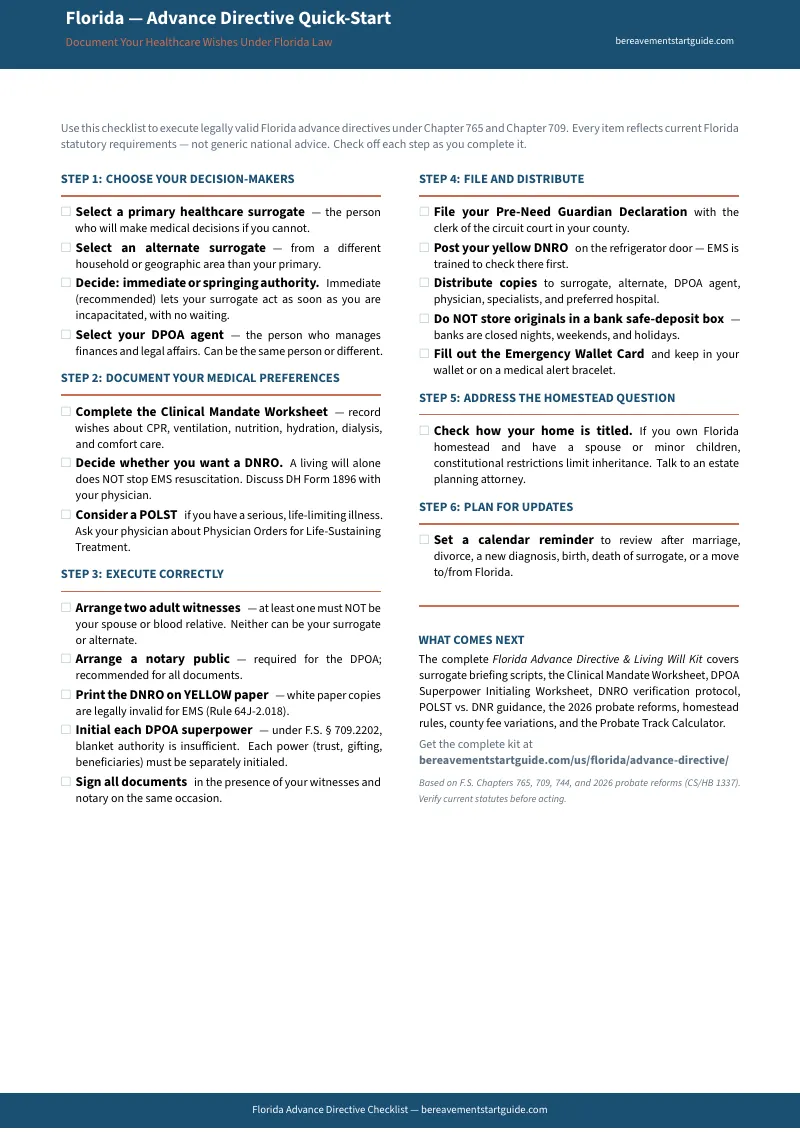
Download the free Florida Advance Directive Quick-Start Checklist to see every step at a glance — witness rules, signing sequence, and storage locations in a one-page reference. When you're ready for the complete execution system — the 15-chapter guide plus 9 standalone printable worksheets including the witness eligibility checklist, DPOA superpower worksheet, DNRO verification protocol, signing day protocol, clinical mandate worksheet, probate track calculator, county filing fees, family conversation guide, and emergency wallet cards — the full kit is available for .
Disclaimer: Bereavement Start Guide is a publisher of self-help educational templates and resource guides. The materials in this kit are designed to comply with Florida Statutes Chapters 765 and 709 but do not constitute legal, medical, or financial advice. For complex trust structures, contested family dynamics, or specific clinical instructions, consult a licensed Florida attorney or healthcare provider.
Frequently Asked Questions
What if the rules change after I buy?
We update the guide when the rules change. Email us any time, even years later, and we'll send you the current edition free.