Your Family Has 72 Hours Before the Hospital Asks Who Decides
When a medical crisis hits — a stroke on Maui, a fall at home in Kailua-Kona, a sudden diagnosis at Queen's — the hospital needs one thing from your family: a name. Who decides whether to continue treatment? Who authorizes surgery? Who says yes or no to life support?
Without a valid advance directive, Hawaii law forces your family into a consensus process. Under HRS § 327E-5, every interested person — your spouse, adult children, parents, siblings, grandchildren — must agree on who decides. If even one person disagrees, treatment decisions stall. The only way forward is a guardianship petition in Circuit Court: filing fees, attorney costs, weeks of waiting, and your family's private medical disagreements entered into the public record.
An executed Advance Health-Care Directive prevents all of this. Your designated agent steps in immediately. No consensus required. No court petition. No delay.
The Execution Verification System
The problem with free forms from the Department of Health or sites like eForms isn't the form itself — the statutory language is the same. The problem is what happens after you fill it out. Hawaii's execution rules under HRS § 327E-3 are unusually strict, and a single technical defect can void the entire document.
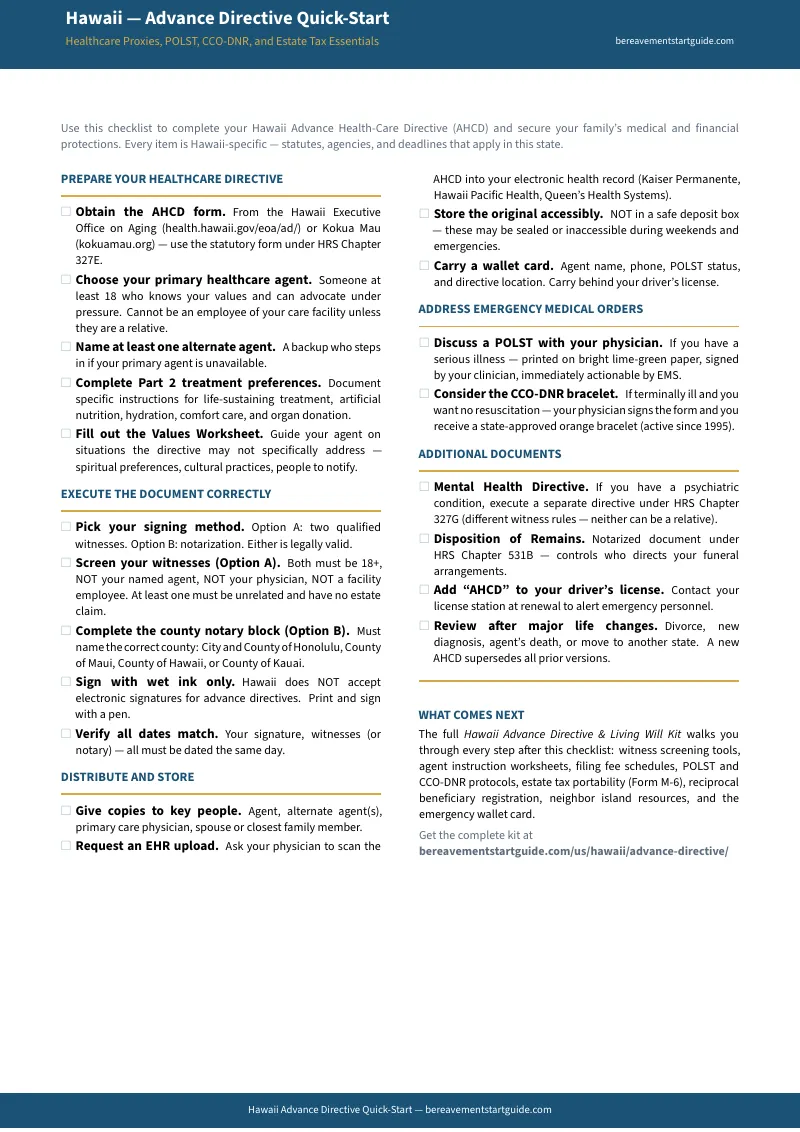
This kit is built around an Execution Verification System — a structured process that catches the five most common mistakes before they invalidate your directive:
- Witness screening checklist — because your daughter who is also your named agent, the nurse at your hospital, or your care home employee cannot legally witness your signature. The checklist walks you through every disqualification rule so you know before signing day, not after a hospital rejection.
- County-specific notary blocks — pre-formatted for Honolulu, Maui, Hawaii, and Kauai. A blank or incorrect county designation causes rejection by medical records departments and financial institutions. Free forms leave this field unmarked.
- Wet-ink verification — Hawaii does not accept electronic signatures for advance directives. The kit flags this early so you don't discover it at the hospital admissions desk.
- Same-day signature audit — all signatures (yours, witnesses or notary) must be dated the same day. A date mismatch invalidates the document. The audit step catches this before you distribute copies.
- Hospital integration steps — exact instructions for getting your directive scanned into electronic health records at Kaiser Permanente, Hawaii Pacific Health, and Queen's Health System. A document in your desk drawer doesn't help the ICU team at 2 a.m.
What's Inside the Kit
Your download includes 11 PDFs — a 14-chapter guide plus 9 standalone printable tools:
- 14-chapter guide — covers every document you might need: the AHCD (Parts 1 and 2), POLST form, CCO-DNR bracelet, Advance Mental Health Care Directive, and organ donation preferences. Written for Hawaii specifically, not adapted from a 50-state template.
- Witness screening checklist — walks through every HRS § 327E-3 disqualification rule so you verify eligibility before signing day. Print it and bring it to the signing.
- Personal values worksheet — goes beyond the statutory form's checkboxes. Covers quality-of-life preferences, religious and cultural considerations, pain management philosophy, and treatment preferences that the standard form doesn't address. Your agent uses this when faced with decisions the directive didn't anticipate.
- Healthcare agent briefing packet — your agent needs to know their legal duties, the boundaries of their authority, and how HIPAA access works in Hawaii hospitals. Print this and hand it to your agent during the briefing conversation.
- POLST & CCO-DNR coordination reference — explains exactly how these physician-signed medical orders interact with your advance directive, who needs one, and how to have the conversation with your doctor. Bring it to the physician appointment.
- County-specific notary blocks — pre-formatted acknowledgment blocks for Honolulu, Maui, Hawaii, and Kauai. Fill-in-ready, not blank.
- Step-by-step action plan — three paths based on your situation: healthy adults doing proactive planning, families facing an immediate crisis, and married couples or reciprocal beneficiaries.
- Post-signing distribution checklist — tracks who gets a copy of your completed AHCD, with space for dates and hospital EHR upload status.
- Hawaii forms directory — every form you may need (AHCD, POLST, CCO-DNR, estate tax, probate, vital records) with where to get each one.
- Emergency wallet card — a printable card with your agent's contact information and a note that you have an AHCD on file. Fits in your wallet next to your driver's license. First responders check for these.
Who This Kit Is For
- Adult children caring for aging parents (kūpuna) — you're already managing medications, appointments, and daily care. This kit gives you the legal documents to match the responsibility you're already carrying.
- Healthy adults who want this handled — you don't need to be sick or elderly. The best time to execute an advance directive is while you're clear-headed and can choose your own agent without pressure.
- Anyone entering a care facility — assisted living facilities and nursing homes in Hawaii typically require a completed advance directive as an intake condition. The kit produces a document that meets their requirements.
- Neighbor island residents — if you're on Maui, Kauai, or the Big Island, access to elder law attorneys and notaries is limited. The kit is designed for self-completion at home.
- Families navigating a new diagnosis — a terminal or degenerative diagnosis (cancer, ALS, dementia) creates a legal window that closes as capacity declines. The kit helps you act while you still can.
Why Not Free Forms?
The Hawaii Department of Health and Kōkua Mau offer free statutory forms. They are legally accurate. But they deliver blank PDFs with no guidance on:
- Who can and cannot witness your signature (and the consequences of getting it wrong)
- Which county to mark in the notary block
- How to coordinate your AHCD with a POLST or CCO-DNR
- How to get your directive into hospital electronic health records
- What the Our Care, Our Choice Act does and does not cover
- How to handle advance care planning on neighbor islands with limited professional resources
University of Hawaii's Elder Law Program publishes exhaustive, multi-hundred-page handbooks. Thorough — but overwhelming to read during a medical crisis when you need to act in days, not months.
Elder law attorneys in Honolulu charge $275+ per hour. A basic advance directive package from a boutique firm runs $2,500–$5,000. If your estate is under the $5.49 million threshold and you don't need complex trust structures, that cost buys expertise you can replicate yourself with the right guide.
Satisfaction Guarantee
If the kit doesn't give you everything you need to execute a legally valid Hawaii advance directive, email us for a full refund. No forms to fill out, no waiting period.
Get Started Now
Download the free checklist to see the complete execution process at a glance. Ready for the full kit? The complete Hawaii Advance Directive & Living Will Kit is — less than a single notary house call, and a fraction of what an attorney charges for the same documents.
Frequently Asked Questions
What if the rules change after I buy?
We update the guide when the rules change. Email us any time, even years later, and we'll send you the current edition free.