Your Hawaii Home Can Trigger Both a State Estate Tax and a Full Probate Proceeding
Most Hawaii families don't think of themselves as wealthy. But with a single-family home on Oahu routinely appraised above $1 million, combined with retirement accounts and life insurance, even middle-class households can approach Hawaii's state estate tax threshold — frozen at $5.49 million, well below the federal line.
Without the right documents in place, your family faces the full weight of Hawaii's probate system: 7 to 15 months of court proceedings, $8,000+ in legal and administrative fees, and every detail of your estate entered into public records. Meanwhile, a deed recorded in the wrong property system — Land Court instead of Regular, or vice versa — can delay a property transfer by four to five years.
Generic mainland estate planning templates don't account for any of this. Hawaii's dual recording system, its state-level estate tax, its reciprocal beneficiary laws, and the Our Care, Our Choice Act all require documents drafted to Hawaii-specific standards.
The Hawaii Estate Protection System
The Hawaii Basic Estate Planning Kit is a step-by-step, plain-English walkthrough of every document and decision that protects your family from Hawaii's probate courts, its state estate tax, and the administrative friction that trips up even well-intentioned planners.
This is not a stack of blank forms. It is a structured system that shows you which documents to complete, in what order, and exactly how they coordinate — so a power of attorney your bank actually accepts, a deed the Bureau of Conveyances doesn't reject, and a will the probate court can fast-track are all part of one unified plan.
What You Get — 9 Printable PDFs
- Complete Estate Planning Guide — 9 chapters covering Hawaii wills, trusts under the 2022 Uniform Trust Code, Transfer on Death Deeds, durable powers of attorney, advance healthcare directives, the OCOCA medical aid in dying act, estate tax planning, intestacy rules, and special situations. Every form number, fee, and deadline is Hawaii-specific.
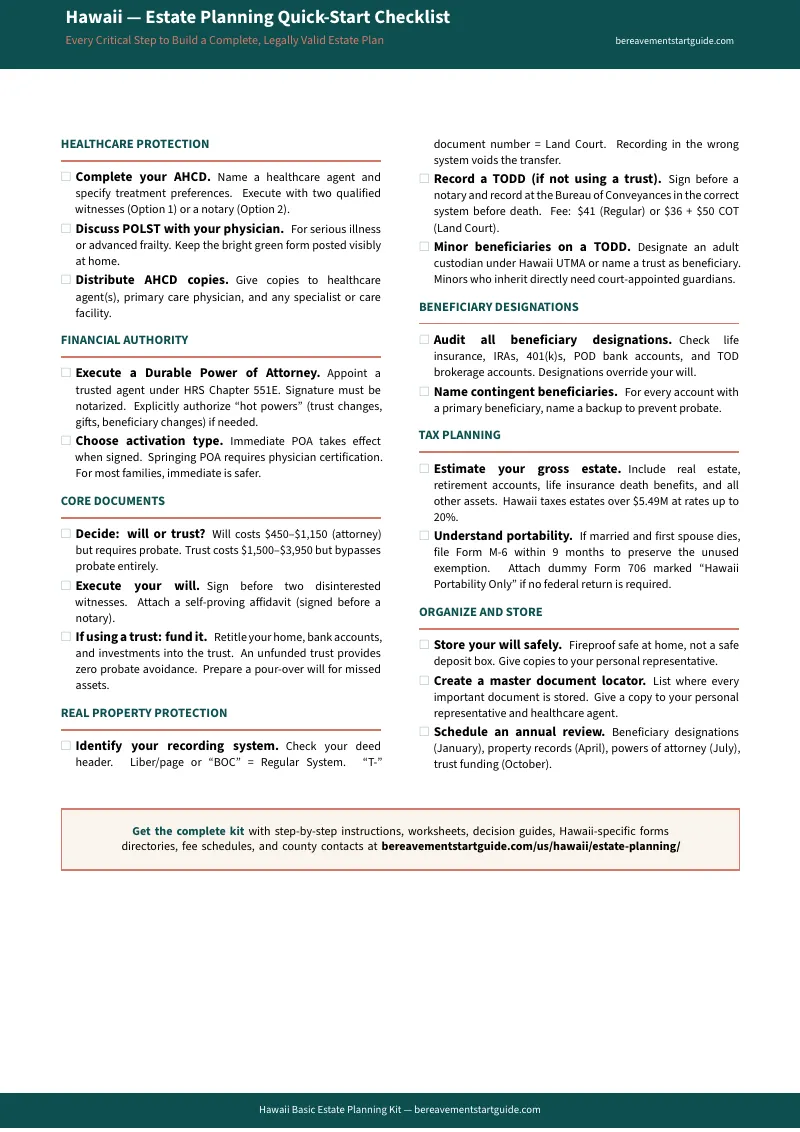
- Quick-Start Checklist — every document and deadline in priority order, with the Hawaii-specific thresholds that determine which steps apply to your situation.
- Document Inventory and Filing Checklist — track every estate document, where originals are stored, who has copies, and which county or state office each filing goes to.
- Asset Inventory and Probate Status Worksheet — catalog every asset with its current title, estimated value, and probate status. Identifies which assets pass outside probate through beneficiary designations or joint tenancy, and which require additional action.
- Beneficiary Designation Audit — review every account with a named beneficiary, check that designations match your current wishes, and flag accounts where no beneficiary is on file. Covers bank accounts, retirement accounts, life insurance, and investment portfolios.
- Probate Pathway Decision Guide — a structured walkthrough that determines whether your estate qualifies for simplified probate, small estate procedures ($100,000 threshold), or full probate, and what you can do now to shift assets out of the probate path.
- Estate Tax Estimation Worksheet — calculate your combined estate value against the $5.49 million Hawaii exemption. Includes the spousal portability election (Form M-6), the graduated rate schedule, and planning strategies for estates near the threshold.
- Annual Review Calendar — yearly protocol covering asset changes, beneficiary updates, life events, legal threshold shifts, and document re-execution requirements. Print and complete once per year.
- Family Conversation Guide — structured approach to discussing estate plans with family members, including specific conversation starters for each topic and a format for documenting decisions reached.
Who This Is Built For
- Homeowners who want to keep their property out of Hawaii's public probate process — whether your home is worth $800,000 or $3,000,000
- Parents who need to name guardians for minor children and set up custodian designations under Hawaii's UTMA
- Married couples and reciprocal beneficiaries who need to plan around the state estate tax and understand how their property titling affects both probate and tax exposure
- Adult children helping aging parents get documents signed while they still have legal capacity — because once capacity is gone, you are looking at guardianship court
- Blended families who need to protect children from prior relationships while also providing for a surviving spouse or partner
- Anyone with Land Court property who needs clear guidance on how the dual recording system affects deed transfers, trust funding, and TODDs
Why Not Just Download Free State Forms?
Hawaii does not offer a statutory will form the way some mainland states do. The Judiciary provides probate court forms, the Bureau of Conveyances provides deed templates, and the Department of Health provides advance directive forms — but each is a standalone PDF with minimal instructions, no coordination guidance, and explicit disclaimers that they are not a "do-it-yourself" legal guide.
A power of attorney printed from a generic website gets rejected by local banks because it doesn't match Hawaii's statutory language. A deed recorded in the Regular System when your property is in the Land Court gets rejected and delays the transfer by years. A will signed with only one witness instead of two is invalid.
The free forms give you individual pieces. The kit shows you how they fit together — and where the filing mistakes that cost thousands actually happen.
Why Not LegalZoom or a National Platform?
National platforms generate documents using templates built for broad mainland applicability. They don't account for Hawaii's Land Court vs. Regular System distinction, the specific notarization language local banks enforce for powers of attorney, or the OCOCA medical aid in dying requirements.
Those platforms also charge $149 to $499+ for initial document creation, then bill annually — $49 to $299 per year — just to maintain editing access to files you already paid to create. Cancel and you lose access.
The Hawaii Basic Estate Planning Kit is a one-time purchase with no subscriptions, no annual renewal, and no paywall between you and your own estate plan.
— Less Than One Hour of Attorney Time
Hawaii estate planning attorneys charge $275 to $400 per hour. A basic revocable living trust package runs $1,500 to $3,950. Even a simple will review starts at several hundred dollars.
This kit doesn't replace an attorney for complex situations — and it tells you exactly when you need one. But for the majority of Hawaii families who need clear, Hawaii-compliant documents and a structured plan, the kit provides immediate protection at a fraction of professional fees.
And if you do decide to hire an attorney, the asset inventory, beneficiary audit, and decision worksheets you've completed become your intake package — saving hours of billable time.
Money-Back Guarantee, No Time Limit
Download the kit, review every chapter and worksheet. If the plain-English instructions don't clarify the exact steps needed to protect your ohana — or if you decide to hire a local attorney for a custom trust instead — email us at any time for an immediate, full refund. No questions asked.
Important notice: Bereavement Start Guide is a publisher of educational resources and planning templates. This kit assists individuals in organizing their estate affairs and completing standard statutory forms. It does not provide personalized legal, financial, or tax advice, does not act as a law firm, and does not establish an attorney-client relationship. For complex assets, multi-state property, or custom trust structures, consultation with a licensed Hawaii attorney is strongly recommended.
Frequently Asked Questions
What if the rules change after I buy?
We update the guide when the rules change. Email us any time, even years later, and we'll send you the current edition free.