Your directive is legally binding. But only if it survives the witnessing rules, the clinical translation, and the 2 a.m. emergency when no one can find it.
Victoria has the strongest advance directive law in Australia. Under the Medical Treatment Planning and Decisions Act 2016, an instructional directive in a valid Advance Care Directive is not advisory — it is legally binding on treating clinicians. A doctor must follow your documented treatment refusal the same way they would follow a direct instruction from you in real time.
That statutory protection is extraordinary. And it is wasted if the directive is poorly drafted, improperly witnessed, or sitting in a filing cabinet when the ambulance arrives.
The Victoria Advance Directive & Living Will Kit is a Clinical-Ready Directive System — a step-by-step manual that takes you from blank form to a properly executed, clinically translatable, digitally accessible advance care plan that Victorian health practitioners are legally obligated to follow.
The problem is not the law. It is the gap between the law and the hospital floor.
The Victorian Government publishes free statutory forms. They are legally compliant. They are also blank pages with no guidance on what to write, no clinical phrasing examples, and no instructions for the witnessing appointment that trips up more families than any other step.
Here is what the free forms do not tell you:
- Your GP may refuse to witness your directive. The 2016 Act requires one witness to be a registered medical practitioner, and both witnesses must be physically present in the same room — no video calls, no remote witnessing. GPs routinely decline, citing liability concerns, unfamiliarity with the Act, or time constraints. Those who agree may charge $100 to $300 for a non-Medicare-rebatable administrative appointment. Without a consultation script and pre-prepared documentation, the appointment often stalls or gets deferred indefinitely.
- "No heroic measures" is not a clinical instruction. Emergency departments do not work from your stapled papers. They work from internal clinical orders — Goals of Patient Care summaries, Acute Resuscitation Plans. If your directive uses vague language, treating teams cannot translate it into the orders that govern bedside care. A directive that says "I refuse cardiopulmonary resuscitation and mechanical ventilation in the setting of irreversible multi-organ failure" gets followed. A directive that says "no extraordinary treatment" does not.
- Your Enduring Power of Attorney does not cover medical decisions. In Victoria, an EPOA under the Powers of Attorney Act 2014 covers financial and personal matters — not medical treatment. The term "Medical Power of Attorney" is legally obsolete since 12 March 2018. To give someone authority over healthcare decisions, you must execute a separate Medical Treatment Decision Maker appointment under the 2016 Act. Families who discover this during a hospital admission lose critical hours — or weeks, if a VCAT guardianship application becomes necessary.
What the Clinical-Ready Directive System gives you
- Clinician-approved instructional directive templates — pre-drafted treatment-specific phrasing for CPR, mechanical ventilation, artificial nutrition, dialysis, blood transfusions, antibiotics in end-stage illness, and organ donation. Written in the clinical language that hospital staff translate directly into Goals of Patient Care orders — not vague wishes that treating teams debate.
- The GP witnessing protocol — a step-by-step guide to booking, preparing for, and managing the witnessing appointment. Includes the consultation script that frames the appointment as a clinical conversation rather than a legal chore, the documentation checklist your GP needs before signing, and the fee expectations so you are not ambushed at reception.
- MTDM appointment with interview script — the correct statutory form for appointing your Medical Treatment Decision Maker, plus the interview questions that confirm your appointee understands your wishes, knows the boundaries of their authority, and is prepared to enforce your directive against family pressure.
- Values directive framework — a structured approach to articulating quality-of-life preferences, pain management priorities, religious or cultural considerations, and the circumstances under which you would or would not want life-sustaining treatment continued. Goes beyond "I value dignity" to language precise enough to guide clinical decisions.
- My Health Record upload walkthrough — the step-by-step process for uploading your completed directive so emergency departments can access your wishes electronically, instead of relying on a family member to locate physical papers during a cardiac arrest at 3 a.m.
- Family conversation scripts — practical frameworks for discussing your wishes with partners, adult children, and extended family. Covers the conversations most families avoid: treatment refusals, organ donation, palliative care preferences, and the difference between what a family member wants and what the directive says.
- EPOA coordination guide — how to draft your ACD and MTDM appointment alongside your Enduring Power of Attorney so all three documents work as a single, consistent plan. Covers the common mistake of assuming one document handles everything, and the institutional confusion that follows when financial and medical authorities are misaligned.
- The estate transition map — your MTDM appointment and EPOA terminate at death. This section maps the handoff to the Will-based estate administration: death certificate, probate filing, and the administrative steps that prevent a gap between living authority and estate management.
Printable worksheets included with the kit:
- treatment-decision-worksheet.pdf — consent, refusal, and values wording to copy onto the statutory form
- gp-consultation-worksheet.pdf — conditions, medications, questions, and what to ask the doctor to do in the room
- mtdm-interview-worksheet.pdf — eligibility ticks and interview answers before you appoint
- family-conversation-planner.pdf — who you told, what you covered, and what they said
- signing-witnessing-checklist.pdf — ACD, MTDM, and EPOA witnessing rules to tick in the room
- document-distribution-log.pdf — who received a copy, when, and where the original is stored
- my-health-record-upload-checklist.pdf — the myGov upload steps, ticked as you go
- estate-handoff-planner.pdf — death certificate, probate threshold, and deadline tracker
Who this is for
Adult children acting before a parent loses capacity. Early-stage dementia, progressive cognitive decline, or a parent who keeps saying "we'll get around to it." The signing window closes when capacity is lost — and once it does, the only path forward is a VCAT guardianship application. The kit gets a valid directive executed while there is still time.
Partners protecting each other. De facto and same-sex partners sit at the top of Victoria's statutory decision-maker hierarchy — but proving a "close and continuing relationship" to an unfamiliar ICU team at 2 a.m. is uncertain at best. A formal MTDM appointment removes that uncertainty entirely.
People facing a diagnosis. Terminal illness, progressive neurological disease, chronic organ failure. The treatment decisions ahead are specific — ventilation, feeding tubes, dialysis, palliative sedation — and a generic directive does not cover them with the precision clinicians need to act. The kit's treatment-specific templates document exactly what you want and do not want.
Proactive planners who tried the free forms. You opened the statutory PDF, saw a blank instructional directive section, and stopped. The kit is the missing manual — it shows you what to write, how to phrase it, and how to get it witnessed and distributed so it actually works when it matters.
Why not free resources?
The government forms are legally correct and practically incomplete. The Office of the Public Advocate publishes an authoritative guide that runs past 40 pages of legal analysis — written for lawyers and health administrators, not for a person sitting at their kitchen table trying to protect their family. Health.vic offers the statutory PDFs with no clinical phrasing guidance and no witnessing instructions. Advance Care Planning Australia provides a national overview that dilutes Victoria's specific rules — the MTDM terminology, the GP witnessing requirement, the strict prohibition on remote witnessing — leaving users confused about which requirements actually apply.
A Melbourne solicitor provides tailored drafting — starting at $200 to $250 plus GST for an MTDM appointment alone. The right choice for complex estates. Not available at 9 p.m. on a Tuesday when your parent has just been admitted to the Royal Melbourne.
The kit fills the gap between the free blank form and the $1,000-plus legal planning package. One manual. One afternoon. One properly executed plan.
Satisfaction guarantee
If the kit does not give you everything you need to draft, execute, and distribute a valid Victorian advance care directive, email hello@bereavementstartguide.com and we will make it right.
Get the complete Victorian advance care planning system
Twelve chapters and eight printable worksheets. Clinician-approved templates. GP witnessing protocol. MTDM appointment. EPOA coordination. Estate transition. All for — a fraction of what one solicitor consultation costs, and available right now instead of next month.
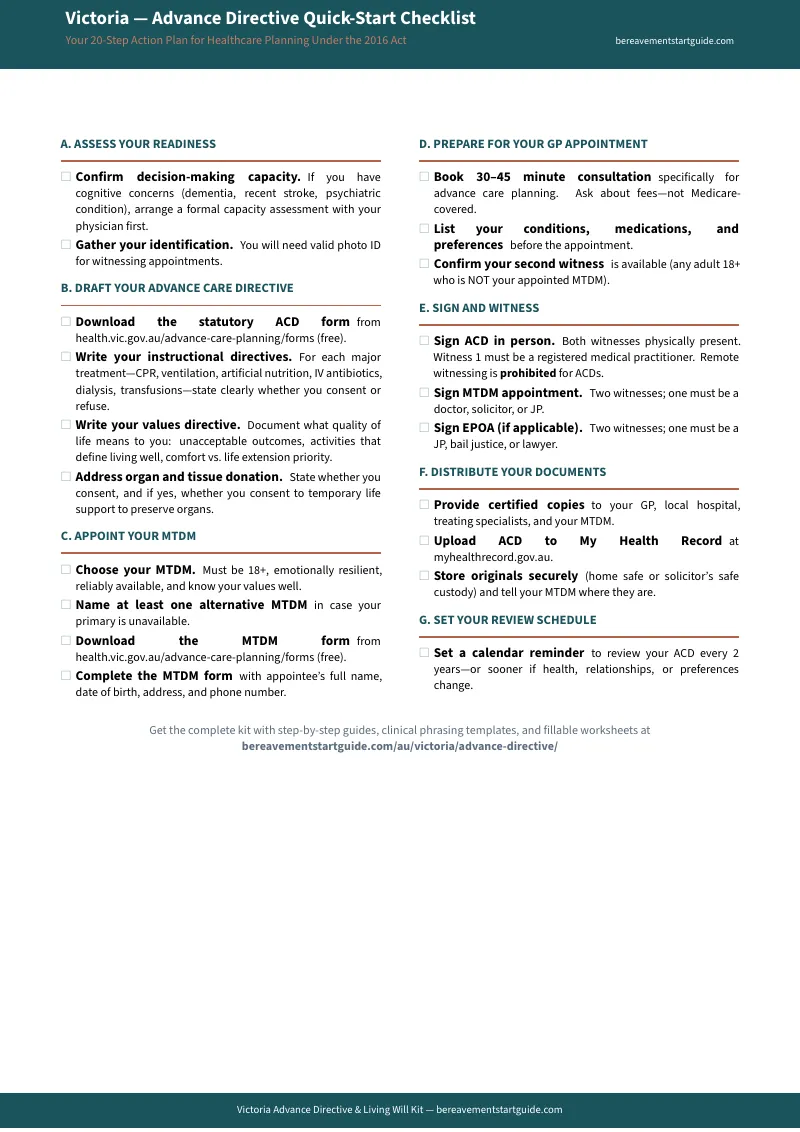
Download the free Victoria Advance Directive Quick-Start Checklist to see the 21-step framework. When you are ready for the full system — the clinical phrasing templates, the witnessing protocol, the family conversation scripts, and the estate transition map — the complete kit is one click away.