Your parent is in a hospital bed. The doctor is asking who makes the care decisions. Nobody can answer — because the document your family downloaded does not appoint anyone.
This is what happens in New Brunswick when families rely on a generic living will or an American-style "advance directive" template. Since July 1, 2020, the Enduring Powers of Attorney Act created a dual-document system that most online resources still do not explain correctly. A Health Care Directive records your medical instructions — what treatments you want, what you refuse. But it cannot give anyone the legal authority to speak for you. Only an Enduring Power of Attorney for Personal Care does that.
Download the wrong template and your family has a piece of paper with instructions — and no one authorized to enforce them.
Meanwhile, two other legal changes have raised the stakes dramatically. On January 1, 2024, the Supported Decision-Making and Representation Act replaced the Infirm Persons Act with a three-tiered court system — Decision-Making Assistants, Supporters, and Representatives — that families are forced into when no EPA exists and the capacity window has closed. And on June 12, 2026, the province tripled its probate tax rate on estates over $100,000, from 0.5% to 1.5%.
The New Brunswick Care Transition System
The New Brunswick Advance Directive & Living Will Kit is not a form. It is a complete care transition system — 15 chapters and 3 appendices that cover the legal documents, the clinical strategy, the nursing home navigation, and the probate protection that New Brunswick families actually need under current law.
The difference between this kit and the free government resources: PLEIS-NB explains what the law says. This kit walks you through doing the work — in the right order, with the specific instructions that prevent the witnessing errors, capacity traps, and nursing home billing surprises that cost New Brunswick families thousands of dollars and months of delay.
What's Inside
- The dual-document system, fully explained — a Health Care Directive for your medical instructions and an EPA for Personal Care to appoint your decision-maker, with the exact relationship between them and what happens when you have only one
- The capacity assessment framework — a plain-language guide to determining whether a parent or spouse can still legally sign an EPA before the window closes and the SDMRA court pathway becomes the only option
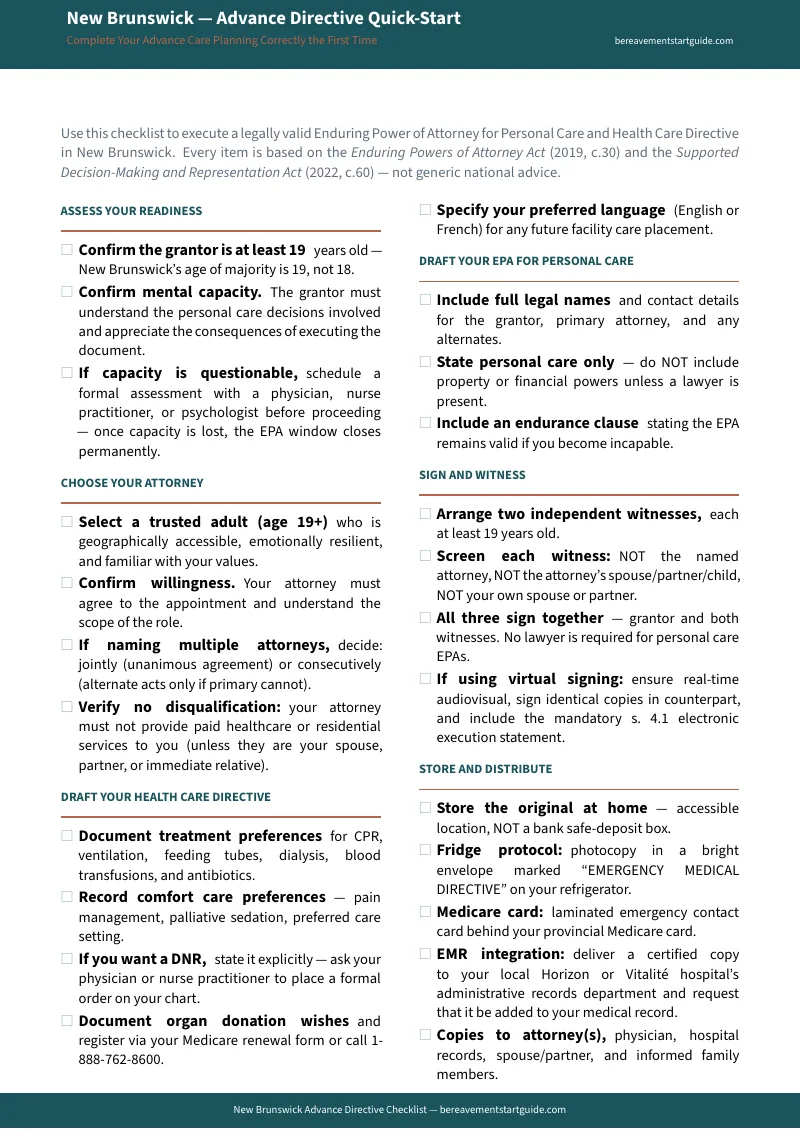
- Witnessing rules that prevent rejection — two independent witnesses, both at least 19 years old, with specific exclusions for the named attorney, their spouse, common-law partner, and children. The signing-day checklist catches the errors that invalidate most self-drafted documents
- Hospital and nursing home navigation — the chapter no government resource covers. ALC designation and the immediate $57.15 daily billing. The 100-kilometre interim placement rule under Regulation 85-187. The two-refusal policy that removes your parent from the active waitlist for 12 weeks. How to coordinate with social workers before a bed offer arrives
- SDMRA tier-by-tier breakdown — Decision-Making Assistants, Supporters, and Representatives, what each tier means, how the court process works, and how a properly executed EPA keeps your family out of it entirely
- Estate transition and probate protection — how advance care planning decisions today (direct beneficiary designations, joint tenancy, named RRSP and TFSA beneficiaries) reduce what passes through probate under the new 1.5% rate
- Bilingual execution guidance — navigating Horizon and Vitalité health zones, ensuring documents are recognized across New Brunswick's Francophone and Anglophone systems
- Doctor and hospital conversation scripts — what to say at the family talk, the primary care appointment, the hospital admission, and the nursing home assessment meeting
- 8 standalone printable worksheets — signing-day checklist with witness screening, conversation scripts to bring to the doctor, distribution log, probate fee worksheet, SDMRA tier comparison, document comparison chart, key contacts reference card, and a forms-and-fees quick reference
Who This Kit Is For
- Caregivers managing a parent's decline — you need legal authority to make placement decisions before ALC billing starts and bed offers arrive
- Proactive planners over 60 — you want your medical wishes and your decision-maker documented correctly under current New Brunswick law, not a pre-2020 template
- Couples planning together — each of you needs separate documents, and neither can witness the other's. The kit prevents the single most common execution error
- Recently diagnosed individuals — a progressive diagnosis makes the capacity window urgent. The kit covers both documents while you can still legally sign
- Cross-border families — property or family across the Quebec–New Brunswick border, or a parent relocating from another province with documents that may not transfer
Why This Kit Instead of Free Resources
PLEIS-NB publishes excellent bilingual booklets explaining the EPA Act and the SDMRA. They do not provide completed templates, custom clinical instructions, or any guidance on nursing home placement, ALC billing, or probate planning. They explain the law. They do not walk you through doing it.
Vitalité's Form RA-256E is a standard institutional template — clinical, sparse, and missing the witnessing traps, the SDMRA interaction, and any estate context. It is one page of a multi-document process.
Online platforms generate documents at subscription prices from $189 to $329 and up. They stop at the document — no nursing home navigation, no ALC billing strategy, no probate protection, no conversation scripts.
New Brunswick law firms charge $300 to $500 per hour. Essential for complex estates and contested situations. Unreachable at 10 p.m. on a Tuesday when Social Development calls about a bed offer and you have 48 hours to respond.
The kit costs — once, no subscription. Fifteen chapters covering the legal documents, the clinical strategy, the nursing home roadmap, and the probate protection. Plus the Quick-Start Checklist to begin tonight.
Satisfaction Guarantee, No Time Limit
If the kit does not give you a clear, actionable path to completing your New Brunswick advance care plan, contact us at any time for a full refund. No hoops, no questions.
Start Your Plan Tonight
The capacity window does not reopen. A nursing home bed offer does not wait. Every week without the correct documents is another week your family has no legal authority to make the decisions that matter most.
Not ready for the full kit? Download the free New Brunswick Advance Directive Quick-Start Checklist — 20 items covering the dual-document system, the witnessing rules, and the capacity assessment. It is enough to get the critical moves right.