
You're Grieving Someone Who Is Still Here. The Paperwork Won't Wait.
Right now, you are watching someone you love die. You are managing medications, coordinating with hospice, fielding calls from relatives who want updates but never offer to take a shift — and somewhere in the back of your mind, you know there are legal documents that need to be signed before it's too late. Power of attorney expires the instant they die. Insurance policies have contestability windows. HIPAA blocks medical records the moment death occurs if you haven't collected authorizations first.
And you are supposed to handle all of this on four hours of broken sleep, while your body is running on cortisol and your brain can barely hold a grocery list.
The Pre-Death Triage System
This is not a grief journal. It is not a book of comforting platitudes about letting go. It is a Pre-Death Triage System — a structured, crisis-grade toolkit that covers the legal, financial, medical, and family decisions that must happen before death, when they are still possible, and carries you through the first weeks after, when they are not.
Every chapter is built for a caregiver whose cognitive bandwidth is depleted. Single-page checklists. Copy-paste scripts. Fill-in templates. Five-minute action blocks you can do between medication rounds or during the quiet hours of a night vigil.
What's Inside
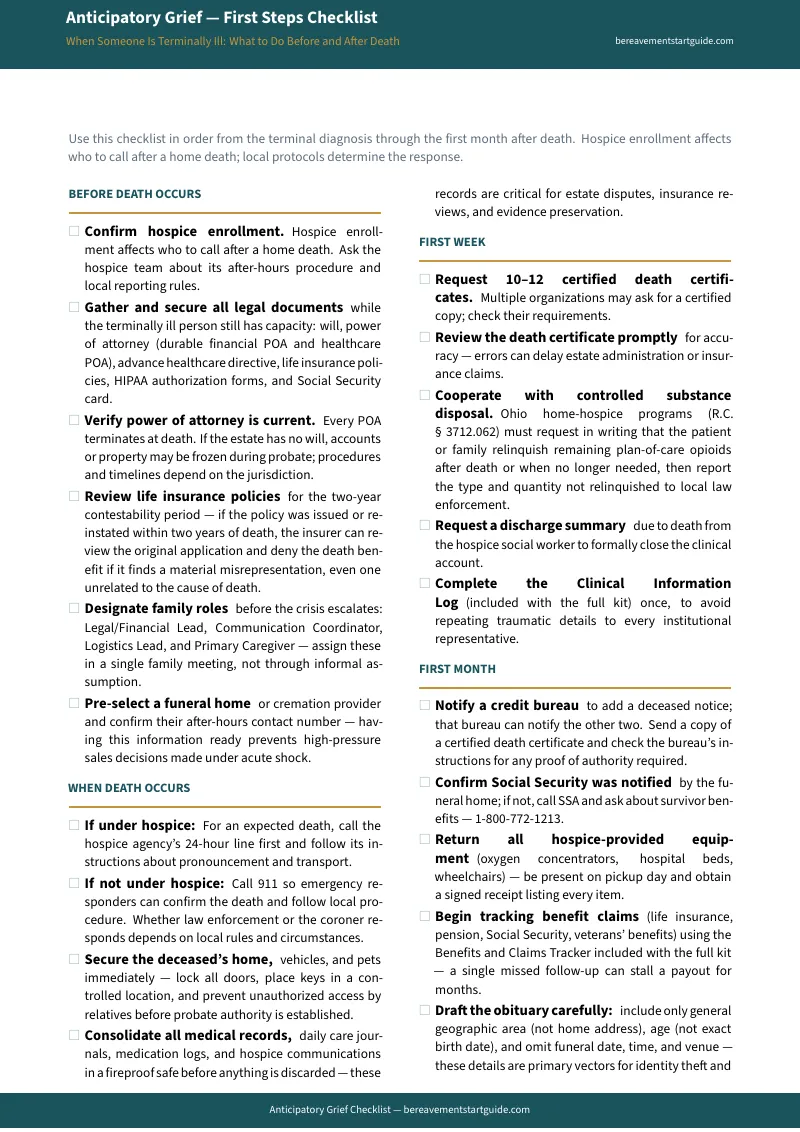
- Pre-death legal triage — which documents to secure while your loved one still has decision-making capacity: advance directives, healthcare power of attorney, financial POA, HIPAA authorizations, beneficiary verifications, and the pre-death estate checklist that prevents a probate crisis
- Insurance contestability audit — how the two-year contestability period works, what insurers actually look for when reviewing death claims, how death certificate wording in Part I and Part II affects your payout, and the specific steps to protect a claim filed within the contestability window
- Hospice and coroner coordination — the difference between a hospice death and an unattended home death, what happens when you call the hospice line vs. 911, how autopsy jurisdiction works, and how to avoid a law enforcement scene investigation in your home
- Post-mortem operations — returning durable medical equipment, legally disposing of controlled substances, closing hospice and medical accounts, and the equipment-return timelines that can trigger unexpected bills
- Identity theft and digital estate protection — how criminals exploit obituaries for postmortem identity theft, the Social Security death notification process, and how to secure digital accounts before and after death
- Family conflict mediation — role-assignment frameworks for shared caregiving, protocols for disagreements over medical decisions, scripts for relatives who criticize from the sidelines, and how to handle the legal-next-of-kin vs. actual-caregiver disconnect
- Age-by-age child communication — clinically grounded language for telling children ages 2 through 18 that someone they love is dying, including what not to say, how each developmental stage processes mortality, and how to include children in the process without traumatizing them
- Witness trauma and caregiver recovery — what watching terminal decline does to your nervous system, why standard talk therapy often fails for caregiver trauma, three evidence-based treatments that work, and the post-caregiving identity crisis that hits after the funeral is over
- Communication scripts and templates — six ready-to-read scripts for notifying relatives, requesting information from officials, requesting bereavement leave, setting boundaries, requesting practical help, and telling a child — each a separate printable PDF
- 9 printable planning tools — standalone fillable PDFs including an incident log, benefits tracker, family role worksheet, pre-death document checklist, caregiver burnout assessment, somatic tracking log, conflict de-escalation worksheet, and child communication guide
Who This Toolkit Is For
- An adult child managing a parent's hospice care while holding down a job and raising children of their own
- A spouse coordinating between oncologists, insurers, and a family that has opinions about everything but shows up for nothing
- A sibling who moved home to help and is now the default caregiver, decision-maker, and emotional anchor for everyone else
- A partner, friend, or extended family member who stepped into a caregiving role because someone had to
- Anyone navigating the months or years before an expected death — regardless of the diagnosis, the family structure, or their legal relationship to the person who is dying
Why Free Resources Fall Short
Hospice gives you a one-page pamphlet on comfort care. The hospital social worker hands you a folder of phone numbers. Nonprofit websites offer emotional validation spread across dozens of nested pages. Law firms publish detailed articles about estate planning — but they're lead generators designed to get you on the phone, not to help you act independently at 2 a.m.
None of these resources connect the legal deadlines to the insurance protections to the family dynamics to the caregiver's own physical collapse. And none of them are formatted for someone whose decision-making ability has been compromised by months of sleep deprivation and chronic hypervigilance.
This toolkit connects all of it — legal, financial, medical, relational, personal — into a single system you can navigate in the order your crisis demands, not the order someone at a desk thought was logical.
Satisfaction Guarantee
Full refund, no time limit. If this toolkit doesn't help, email hello@bereavementstartguide.com and we'll refund you immediately. No questions, no friction.
The free checklist covers what to do. The full toolkit covers how — with the scripts, templates, timelines, and legal protections that keep your family from making irreversible mistakes during the hardest months of your life.