The call comes without a manual
An Australian citizen has died in India. Within hours, you are responsible for coordinating two legal systems, two sets of bureaucracy, and a chain of documents that must be assembled in exact sequence — while processing the worst news of your life.
The Australian High Commission in New Delhi will give you a list of funeral directors. They will not tell you that a missing police report delays the death certificate, which delays notarisation, which delays state pre-authentication, which delays the MEA Apostille, which delays probate, which freezes the entire estate in Australia. They will not explain that some Indian hospitals withhold the body until all medical bills are settled. They will not mention that the Foreign Regional Registration Office must cancel the deceased's visa before surviving travel companions can leave. And they will not walk you through the succession law that governs Indian assets — rules that differ depending on whether the deceased was Hindu, Muslim, or Christian.
Google will give you fragments. Diaspora forums will give you advice that confuses the apostille timeline with immediate document availability — sending you to the wrong office with the wrong expectations. Your travel insurer's emergency line will give you hold music and an adjuster whose first move is to check whether an exclusion applies.
The Apostille Chain Roadmap
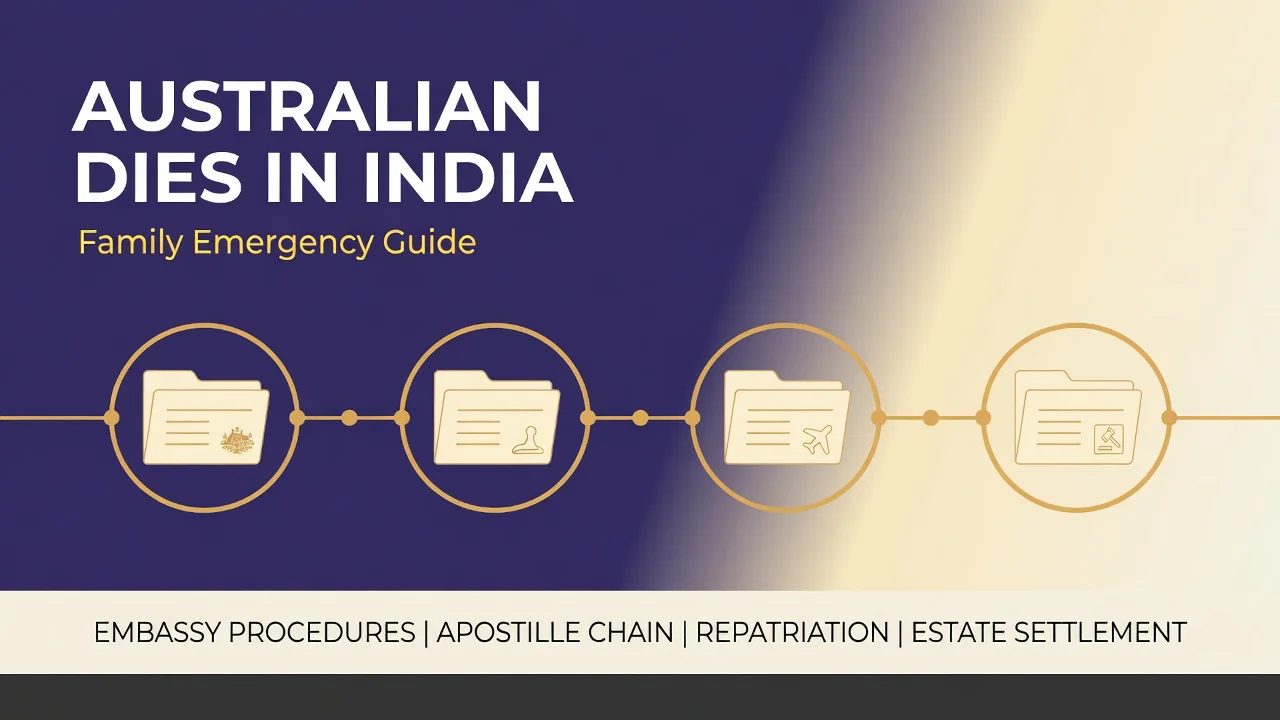
The Australian Dies in India — Family Emergency Guide is an apostille chain roadmap — connecting every Indian authority, every Australian institution, and every document handoff in the order your family actually faces them. India and Australia are both members of the Hague Apostille Convention, which means an Indian death certificate apostilled by the Ministry of External Affairs is directly admissible in Australian courts and financial institutions. But between the municipal death certificate and a usable apostille sit three mandatory steps — notarisation, state-level pre-authentication, and MEA submission through one of five authorised agents — and a single missed step forces the chain to restart from the beginning.
This is the guide that sits between the High Commission's information sheet and the funeral director's invoice — the part nobody covers because it spans both countries.
What's inside
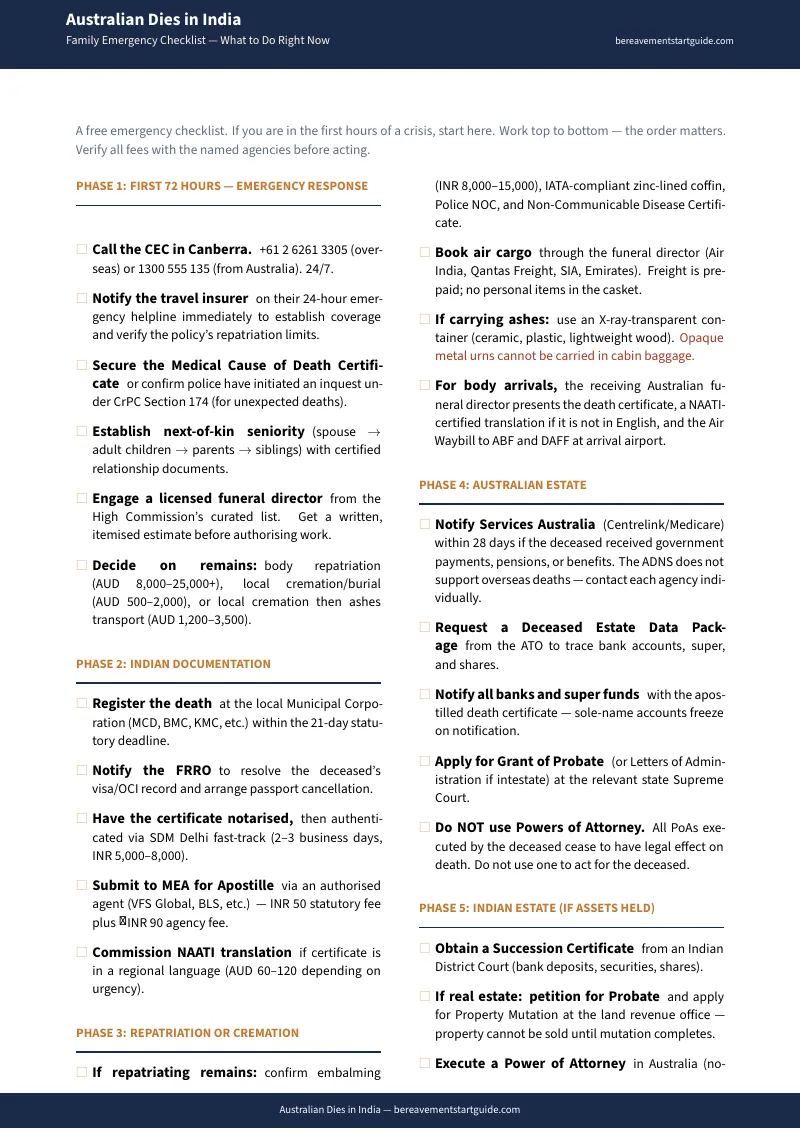
- The 72-hour emergency sequence — the exact calls to make (Australian High Commission New Delhi, Consulates-General in Mumbai, Chennai, Kolkata, and Bengaluru, Consular Emergency Centre Canberra, travel insurer), in the right order, with direct numbers and after-hours lines that are not on the High Commission website
- Indian police and forensic procedures — what triggers a mandatory investigation under CrPC Section 174, how the Sub-Divisional Magistrate controls body release, the hospital detention risk for unpaid bills, and why the distinction between in-hospital and out-of-hospital deaths changes your entire timeline by weeks
- The complete three-step MEA Apostille chain — from the municipal death certificate through notarisation by an Indian Notary Public, state-level pre-authentication (the fast-track SDM Delhi route at 2–5 business days / ₹5,000–₹8,000 versus the standard State Home Department route at 10–20 business days / ₹10,000–₹15,000), and MEA submission through authorised agents (BLS International, Superb Enterprises, IVS Global, Alhind Tours) — with fees, timelines, and the step-skipping errors that restart the chain
- Repatriation versus local cremation — worked cost comparison — full-body repatriation (AUD 8,000–15,000+ covering embalming, hermetically sealed zinc-lined casket, airline cargo, DAFF biosecurity clearance) versus local cremation with ash return (AUD 1,500–3,000 covering cremation certificate, X-ray-transparent container, airline carry-on compliance), with a decision framework matching each option to religious, cultural, financial, and timeline factors
- FRRO and immigration clearance — the often-overlooked requirement to notify the Foreign Regional Registration Office, cancel the deceased's visa or OCI record, and secure exit clearance for travel companions whose own visas may be at risk until the immigration record is resolved
- Travel insurance exclusion map — common exclusion triggers for the India corridor (pre-existing conditions, adventure activity clauses, alcohol-related incidents), and the documentation strategy that supports your claim before the adjuster starts looking for reasons to deny it
- Australian bank account freezes — how to request pre-probate release of funeral funds, the exact documentation the bank's deceased estates division requires, and why a certificate without the full apostille chain and NAATI certification will be rejected
- ATO, Services Australia, and superannuation — the Deceased Estate Data Package for tracing all active accounts and superannuation balances, the Services Australia notification, and the specific certified documents superannuation trustees require for death benefit claims
- State-by-state probate with foreign certificates — which Australian registries allow overseas death registration, the documentary thresholds for each Supreme Court, and how name transliteration discrepancies between the Indian certificate and the Australian passport are resolved
- Indian estate settlement — succession law by religion (Hindu Succession Act, Indian Succession Act for Christians, Muslim personal law), court succession certificates versus letters of administration, property mutation, the Two-Will Strategy for families with assets in both countries, FEMA rules for repatriating inherited funds, and DTAA tax treaty provisions
- Emergency contact directory — Australian High Commission New Delhi, all Consulates-General, Consular Emergency Centre, MEA Apostille Division, DAFF Biosecurity, and specialist Australia–India corridor repatriation services
- Printable standalone planning tools — emergency contact card, document apostille tracker, repatriation decision worksheet, insurance claim evidence checklist, Australian notifications tracker, and Indian-side cost log — designed to be printed and used alongside the guide
Who this is for
- Spouses and partners in Australia coordinating remotely with Indian police, hospitals, and funeral directors while managing grief under extreme time pressure
- Adult children handling the bureaucracy — travel insurance claims, bank freezes, ATO notifications, superannuation claims, and contradictory advice from forums and family WhatsApp groups
- Executors and estate administrators who need the India-to-Australia document chain correct on the first attempt — particularly where the deceased held assets in both countries
- Travel companions in India who may face passport retention, FRRO scrutiny, or visa complications during a police investigation
- Corporate HR and risk managers handling duty-of-care for Australian employees or contractors deployed in India
Why not free resources?
The Australian Government's Smartraveller page tells you the High Commission cannot pay for repatriation. It does not tell you the sequence of documents you need to make repatriation possible, or what order they must be obtained in, or what happens when one piece is missing.
Repatriation firms in India will manage the Indian logistics — for AUD 8,000 or more. They will not tell you how to handle the Australian side: the bank freeze, the ATO data package, the superannuation claim, the probate application that requires a specific chain of apostilled and translated documents.
Diaspora forums are full of well-meaning accounts that confuse the apostille timeline with immediate availability — advice that sends you to an MEA agent before the state pre-authentication is complete, wasting days and agent fees. And the Indian estate side — succession law that varies by religion, FEMA rules for moving inherited funds, property mutation across Indian states — is almost never addressed by any free resource because it requires specialist knowledge of both jurisdictions.
This guide connects the dots between all of them. It is the one resource that maps the full corridor — from the first phone call to the High Commission through the final probate hearing and the last rupee transferred — in the order an Australian family actually faces it.
Your purchase is protected
Full refund, no time limit. If the guide does not cover what you need, email hello@bereavementstartguide.com and we will refund the full amount — no questions, no deadline.
Get started now
Download the free emergency checklist for the critical first 72 hours. Or get the full guide — — for the complete apostille chain roadmap, the cost comparison framework, the Indian estate settlement procedures, and printable planning tools your family needs.