The call comes without a manual
An Australian citizen has died in Thailand. Within hours, you are responsible for coordinating two legal systems, two languages, and a chain of documents that must be assembled in exact sequence — while processing the worst news of your life.
The Australian Embassy in Bangkok will hand you a list of funeral directors. They will not tell you that a missing police report delays the death certificate, which delays MFA legalisation, which delays the Embassy authentication, which delays the NAATI translation, which delays probate, which freezes the entire estate. They will not tell you that some Thai hospitals withhold the body until all medical bills are settled. They will not explain why your bank just froze every sole-name account and what documentation — exactly — you need to unfreeze them.
Google will give you fragments. Expat forums will give you advice that confuses the upcoming Apostille framework with the current legalisation chain — sending you to the wrong office with the wrong documents. Your travel insurer's emergency line will give you hold music and an adjuster whose first move is to check whether the scooter exclusion applies.
The Legalisation Chain Roadmap
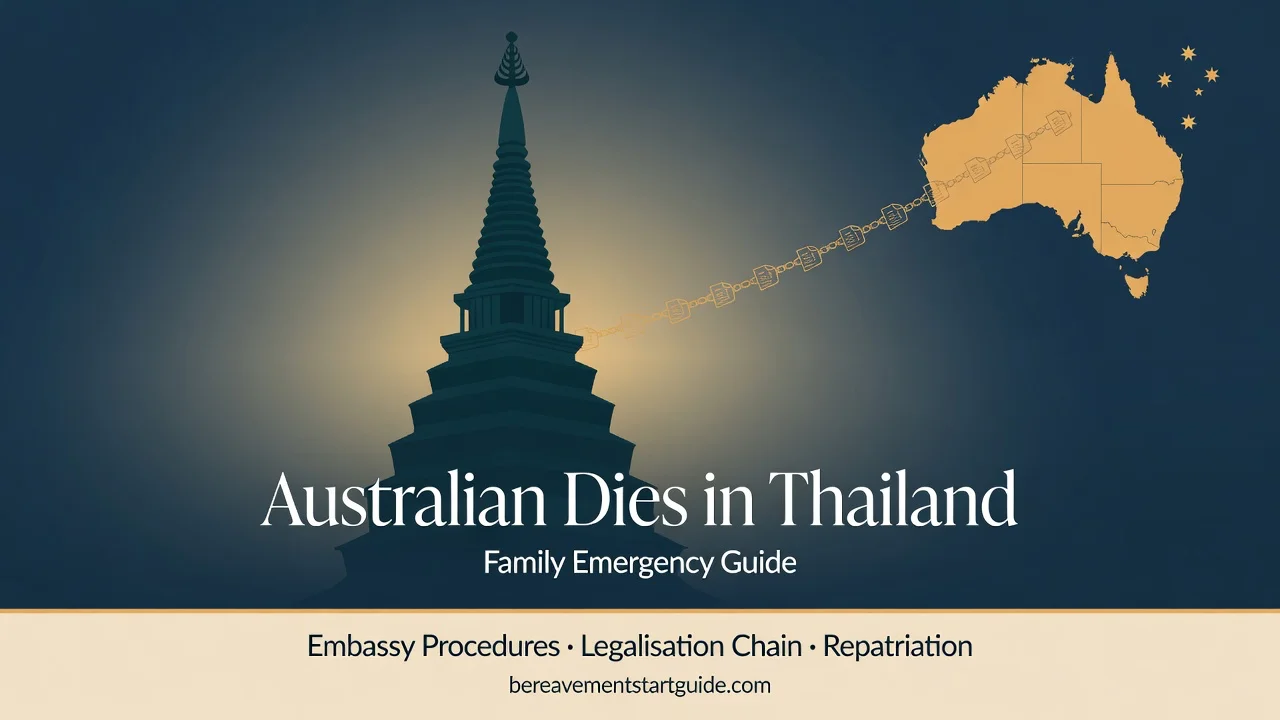
The Australian Dies in Thailand — Family Emergency Guide is a legalisation chain roadmap — connecting every Thai authority, every Australian institution, and every document handoff in the order your family actually faces them. Thailand is not a member of the Hague Apostille Convention. The simplified single-step Apostille that works for Indonesian or European death certificates is unavailable here. Every Thai document must navigate a strict four-step chain — NAATI translation, notarial certification, MFA stamping, and Embassy authentication — or Australian courts, banks, and superannuation trustees will reject it. This guide maps that chain step by step.
This is the guide that sits between the Embassy's information sheet and the funeral director's invoice — the part nobody covers because it spans both countries.
What's inside
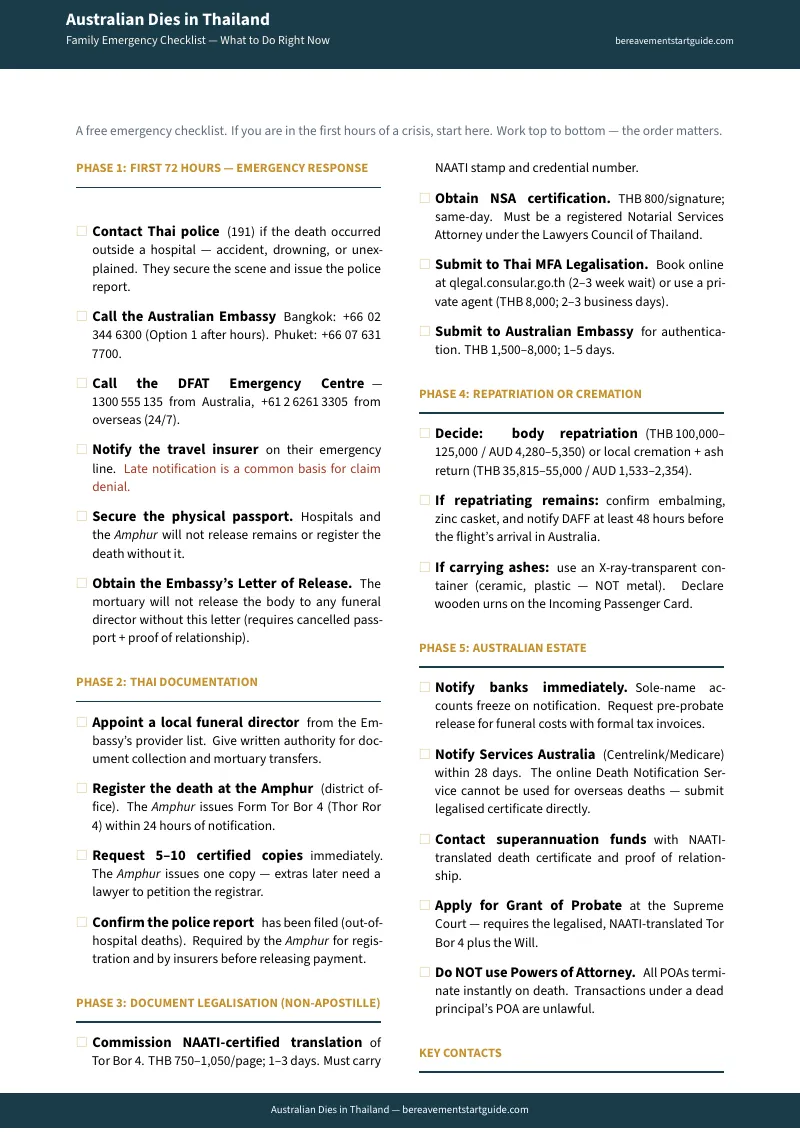
- The 72-hour emergency sequence — the exact calls to make (Embassy Bangkok, Consulate-General Phuket, Consular Emergency Centre Canberra, travel insurer), in the right order, with direct numbers and after-hours lines that are not on the embassy website
- Thai police and forensic procedures — what triggers a mandatory autopsy, how the physical examination finishes in 24 hours but the official forensic report takes six to eight weeks, the hospital detention risk for unpaid medical bills, and why the police clearance must come before anything else can move
- The complete four-step legalisation chain — from the Amphur's Form Tor Bor 4 through NAATI-certified translation (THB 750–1,050/page), Notarial Services Attorney certification (THB 800/signature), Thai MFA legalisation (two to three weeks standard, or THB 8,000 via express agent), and Australian Embassy authentication (THB 1,500–8,000) — the full non-Apostille chain that remains mandatory until Thailand formally activates the Hague Convention
- Repatriation versus local cremation — worked cost comparison — full-body repatriation (THB 100,000–125,000 / AUD 4,280–5,350 covering embalming, zinc-lined casket, police transit permit, airline cargo, DAFF biosecurity) versus local cremation with ash return (THB 35,815–55,000 / AUD 1,533–2,354 covering temple cremation, cremation certificate, X-ray-transparent container, and airline carry-on compliance), with a decision framework matching each option to religious, cultural, financial, and timeline factors
- Travel insurance exclusion map — the scooter/motorcycle exclusion (no valid Australian motorcycle licence + IDP = no coverage), the alcohol and drug exclusion (BAC above policy limit voids the claim), the pre-existing condition review, and the medical tourism exclusion — with the documentation strategy that supports your claim before the adjuster starts looking for reasons to deny it
- Australian bank account freezes — how to request pre-probate release of funeral funds, the exact documentation the bank's deceased estates division requires, and why a foreign certificate without NAATI certification will be rejected
- ATO, Centrelink, and superannuation — the deceased-person notification form (NAT 74279), the Services Australia Advice of Death, the "acute family crisis" provision for relatives who need to fly to Thailand without losing their Centrelink payments, and the supplementary forensic report that superannuation trustees require beyond the standard death certificate
- State-by-state probate with foreign certificates — which Australian registries allow overseas death registration, the documentary thresholds for each Supreme Court, and how name discrepancies between the Thai Tor Bor 4 and the Australian passport can restart the application
- Emergency contact directory — Embassy Bangkok, Consulate-General Phuket, Consular Emergency Centre, Thai MFA Legalisation Division, DAFF Biosecurity, and specialist Australia–Thailand repatriation funeral directors
- Printable standalone planning tools — an emergency contact card, a document legalisation tracker, a repatriation decision worksheet, an insurance claim evidence checklist, an Australian notifications tracker, and a Thai-side cost log — designed to be printed and used alongside the guide
Who this is for
- Spouses and partners in Australia coordinating remotely with Thai police, hospitals, and funeral directors while managing grief under extreme time pressure
- Adult children handling the bureaucracy — travel insurance claims, bank freezes, ATO notifications, superannuation claims, and contradictory advice from forums and family WhatsApp groups
- Executors and estate administrators who need the Thai-to-Australian document chain correct on the first attempt
- Travel companions in Thailand who may be stranded or restricted from leaving during a police investigation
- Corporate HR and risk managers handling duty-of-care for Australian employees or contractors deployed in Thailand
Why not free resources?
The Australian Government's Smartraveller page tells you the Embassy cannot pay for repatriation. It does not tell you the sequence of documents you need to make repatriation possible, or what order they must be obtained in, or what happens when one piece is missing.
Funeral directors in Thailand will manage the Thai logistics — for THB 100,000 or more. They will not tell you how to handle the Australian side: the bank freeze, the ATO notification, the superannuation claim, the probate application that requires a specific chain of legalised and translated documents.
Expat forums are full of well-meaning accounts that confuse the upcoming Apostille framework with the current four-step legalisation chain — advice that will send you to the wrong office with the wrong documents. And unlike Indonesia, which joined the Hague Convention in 2022, Thailand's accession has not yet taken effect.
This guide connects the dots between all of them. It is the one resource that maps the full corridor — from the first phone call to the Embassy through the final probate hearing — in the order an Australian family actually faces it.
Your purchase is protected
Full refund, no time limit. If the guide does not cover what you need, email hello@bereavementstartguide.com and we will refund the full amount — no questions, no deadline.
Get started now
Download the free emergency checklist for the critical first 72 hours. Or get the full guide — — for the complete legalisation chain roadmap, the cost comparison framework, the insurance dispute strategy, and printable planning tools your family needs.